Why Most Generative AI Projects Fail in UAE Enterprises (and How to Fix Them)
June 23, 2026

Ayush Kanodia
.jpg?w=1920&q=75)
Summary:
UAE enterprises are investing heavily in generative AI, yet most pilots never become real business outcomes. The pattern repeats across banking, government, energy, retail, and logistics: bold ambition, a polished demo, then a project that quietly stalls.
Gartner's analysis found that more than 50% of GenAI projects are abandoned after proof of concept, driven by poor data quality, weak risk controls, escalating costs, and unclear business value. Other widely cited enterprise research points to roughly 95% of generative AI pilots delivering no measurable profit-and-loss impact.
The encouraging part? Failure is rarely about the models. It comes down to strategy, data readiness, governance, and integration into real workflows. This guide explains why generative AI projects fail in UAE enterprises, what makes the local market different, and the framework a trusted AI development company UAE uses to fix it.
The Real State of Generative AI in UAE Enterprises
The UAE is not short on ambition. National AI strategies, sovereign infrastructure investment, and an AI-first government agenda have pushed adoption faster than almost any other region. Enterprises in Dubai and Abu Dhabi are testing chatbots, copilots, document automation, and AI agents across nearly every function.
The demand for talent tells the same story. According to PwC's 2026 Global AI Jobs Barometer, AI-related job postings in the UAE doubled from 5,000 to 10,000 between 2021 and 2024, and AI-exposed occupations grew by 13% over the same period. That is a market moving fast and hiring for it.
But experimentation is cheap. Transformation is expensive. The gap between "we're testing AI" and "AI is making us money" is where most projects die. A small group of UAE enterprises extracts genuine value from generative AI solutions.
The majority of fund pilots impress a boardroom and disappear within months. Understanding the difference is the first step to landing on the right side of that line.
Why Most Generative AI Projects Fail
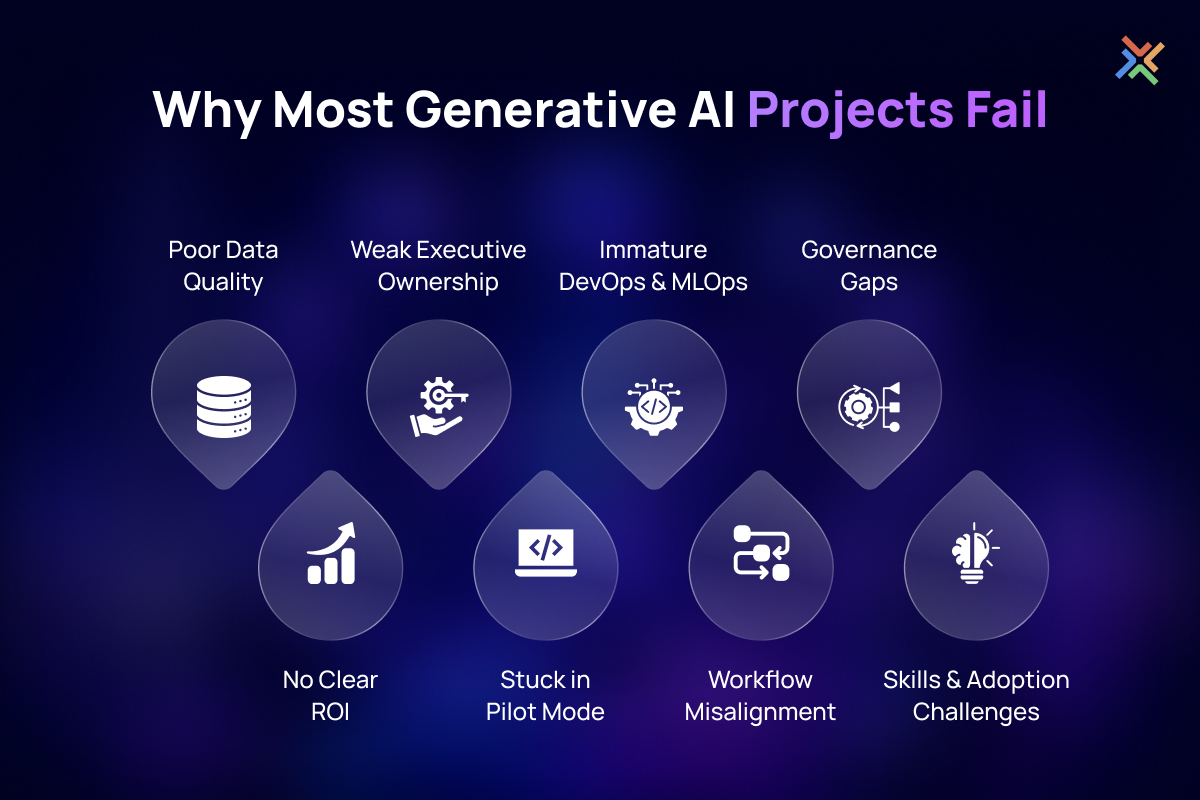
Most failures trace back to a handful of structural problems. The technology works. The organization around it usually isn't ready. Gartner's research reinforces this: poor data quality, inadequate risk controls, escalating total cost of ownership, and unclear business value are the recurring culprits behind abandoned projects.
Poor Data Quality and Fragmentation
Generative AI reflects the quality of the data feeding it. When data sits in silos, carries inconsistent labels, or is duplicated across systems, models produce confident but wrong answers. These hallucinations destroy trust quickly. Without a solid AI data infrastructure and governed pipelines, even the strongest large language models return unreliable results. This is why retrieval augmented generation and well-curated knowledge sources matter more than raw model power.
Hype-Driven Adoption Without Clear ROI
Too many initiatives start with the tool, not the outcome. Leaders buy AI because competitors are buying AI. "Improved productivity" sounds good in a steering committee but won't satisfy a CFO. Projects without a defined economic target, such as cutting processing time by 30% or removing a specific vendor contract, lose funding the moment enthusiasm fades.
Weak Executive Ownership
When no one in the C-suite truly owns the AI agenda, it drifts into a research exercise. Tools get procured before problems get defined, which reverses the natural order of any sound AI strategy. Without clear sponsorship tied to measurable goals, momentum dissipates and budgets get cut.
The Pilot-to-Production Gap
A demo is not a product. Many UAE enterprises build a slick proof of concept that never crosses into live operations. Moving to production demands real engineering: version control, testing, monitoring, and a structured release process. Without MLOps or LLMOps to track accuracy and model drift, the project never survives the jump.
Lack of DevOps and MLOps Maturity
Generative AI is a system-level investment, not a bolt-on. Without automation pipelines, scalable cloud environments, and continuous integration, AI gets trapped in endless proof-of-concept loops. Enterprises that build the foundation first, then layer use cases on top, consistently see higher success rates. This is why the strongest AI development services UAE treat infrastructure as the starting point, not an afterthought.
Workflow Integration Failures
AI pilots often run as stateless tools. They can't remember context, accumulate feedback, or fit into how employees actually work. A system that forgets everything between sessions can't compound value. If the AI sits outside the daily workflow, people simply stop using it, and the productivity case collapses.
Governance and Responsible AI Gaps
Adoption has outpaced governance almost everywhere. Few enterprises have a mature AI governance framework, clear ownership of model risk, or a responsible AI policy covering safety, privacy, accountability, and fairness. That gap is costly in regulated sectors, where compliance failures carry real penalties. Governance built in from day one prevents the bias, privacy, and accountability problems that sink projects later.
Skills Shortages and Change Resistance
Implementation friction is mostly human. The biggest barriers to AI adoption are people and process, not algorithms. Employees need to trust the system, understand its limits, and see it as augmentation rather than a threat. Without structured training and change management, adoption stays shallow no matter how capable the technology is.
What Makes the UAE Context Different
Generic global advice only goes so far. UAE enterprises face conditions that demand local expertise from an AI consulting company UAE that genuinely understands the market.
Arabic Language and Regional Nuance
Off-the-shelf models struggle with Arabic dialects, the constant code-switching between Arabic and English, and the cultural context that shapes customer interactions here. A chatbot that handles English flawlessly may stumble badly in Arabic. Closing that gap requires real Custom Generative AI Development UAE, including fine-tuning, retrieval augmented generation grounded in local content, and careful evaluation against region-specific language.
Data Residency and Sovereign AI
Organizations handling sensitive national, financial, or personal data face genuine tension. Cloud-based global LLMs offer convenience, but data residency rules and the push toward sovereign AI infrastructure often require localized or on-premise deployment. Choosing the wrong enterprise AI architecture early creates compliance and cost problems that are painful to unwind later.
Regulated Industries and Compliance Complexity
UAE businesses operate across multiple regulatory frameworks, from sector-specific rules in banking and healthcare to data protection requirements. Generative AI projects that ignore AI compliance until launch tend to stall in legal review. Bringing compliance teams in from the start is far cheaper than retrofitting controls after the fact.
High Expectations and Compressed Timelines
The pace of digital transformation in Dubai and Abu Dhabi is fast, and leadership expectations are high. That pressure pushes teams to skip the unglamorous foundational work, which is precisely what causes the failures above. Speed without a backbone produces impressive prototypes and no path to scale.
How to Fix It: A Phased Framework for Generative AI Success
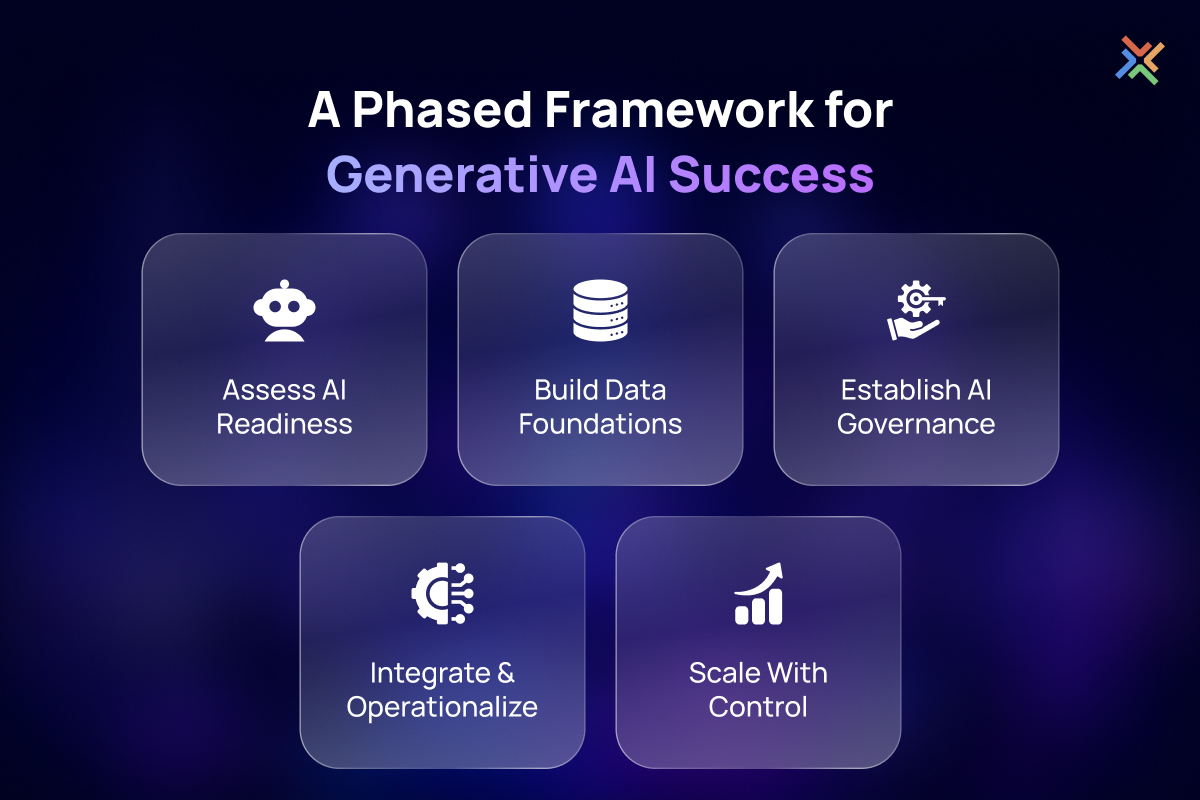
You don't fix generative AI failure with a better model. You fix it with discipline. Here is a practical, phased approach used by enterprises that successfully scale, and the same approach a capable Enterprise AI Development Company UAE will follow.
Phase 1: AI Readiness Assessment and Use-Case Prioritization
Start with an honest AI readiness assessment. Map your data infrastructure, current DevOps maturity, governance posture, and team skills. Use an AI maturity model to see where you actually stand, not where you'd like to be. Then prioritize one or two high-volume, high-friction processes where automation clearly moves a financial metric. Outcome first, model second. This is the single most reliable way to avoid generative AI project failure.
Phase 2: Governed Data and Infrastructure Foundations
Before deployment, fix the foundations. Establish data governance, metadata standards, and lineage tracking. Centralize fragmented data so models train on a single source of truth. Invest in scalable, secure enterprise AI architecture, whether cloud-native or sovereign, that fits your residency requirements. This is the runway everything else depends on, and skipping it is the most common reason pilots never reach production.
Phase 3: Governance, Security, and Responsible AI
Stand up an AI governance framework early. Define who owns model risk, how bias is detected, and how outputs are audited. Embed AI security and responsible AI principles into the build rather than bolting them on afterward. Add input validation, output monitoring, audit trails, and access controls. In regulated UAE sectors, this discipline is exactly what gets a project past legal review and into production.
Phase 4: Build, Integrate, and Operationalize
Move from clever prompts to orchestrated systems. Use retrieval augmented generation to ground outputs in your own data, add persistent memory so the AI retains context, and connect it through APIs into the tools your teams already use. Deploy AI agents where multi-step tasks justify them. Wrap everything in MLOps so you can monitor accuracy, catch drift, and roll back safely. This is where generative AI shifts from novelty to genuine AI workflow automation, business process automation, and intelligent automation.
Phase 5: Scale With Portfolio Discipline
Don't bet everything on one giant project. Run a portfolio of smaller deployments, validate each with data, and scale what works. Pair this with structured workforce training so adoption sticks. AI scalability comes from cross-functional ownership, where engineering, domain experts, risk, and finance share accountability. That is how you scale generative AI solutions across an organization without losing control of cost or quality.
How to Measure AI ROI Finance Will Trust
AI ROI measurement is where credibility lives or dies. Vague productivity claims get cut. Specific, baselined numbers get reinvested.
Before you build, establish a baseline. After deployment, measure the delta against it: hours saved, error rates reduced, contracts eliminated, conversion improved.
Watch for the hidden "verification tax," where employees spend so long checking AI outputs that the gains evaporate. A good AI adoption framework tracks net value, not raw output.
When you can show finance exactly where the return comes from, AI stops being an experiment and becomes an investment thesis worth scaling.
How Much Does Generative AI Implementation Cost in the UAE?
Costs vary widely based on data readiness, infrastructure choices, customization depth, and integration complexity. A focused use case on clean data and existing cloud infrastructure costs far less than a sovereign deployment built on fragmented legacy systems. The largest hidden costs almost always come from poor foundations and rework, not from the models themselves.
This is why upfront strategy pays for itself. An AI readiness assessment, a clear AI roadmap, and governed data foundations typically reduce total cost of ownership by preventing the expensive false starts that derail so many initiatives. Token costs, model hosting, and ongoing maintenance also compound at scale, so building FinOps visibility in early keeps budgets predictable as usage grows.
Partner WDCS Technology UAE for Generative AI Solutions
Most generative AI projects in the UAE don't fail because the technology is weak. They fail because they're treated as a quick tool instead of an architectural shift, without the data, governance, and integration to make them last.
As a generative AI development company UAE, WDCS Technology helps enterprises bridge that gap. We begin where it matters, with economic mapping and an AI readiness assessment, then build governed data foundations, enterprise-grade architecture, and AI integration that fits your workflows and residency requirements.
Our generative AI development services UAE cover the full journey, from AI transformation services UAE strategy through to production deployment, backed by the MLOps discipline that keeps systems reliable as they scale.
Our work spans custom generative AI development UAE, Arabic-ready models, responsible AI, and machine learning solutions built for regulated sectors. Our team and generative AI consulting services UAE focus on durable value over flashy demos.
If you're ready to move past pilots and build generative AI solutions that actually deliver, connect us now to discuss about your roadmap.
Book Your Generative AI Readiness Assessment
Stop guessing why your generative AI pilots stall. WDCS Technology UAE helps enterprises move from idea to impact with clear strategy, custom development, seamless integration, and built-in governance—all tied to measurable business outcomes. Whether you're scaling across Dubai or Abu Dhabi, our team turns ambition into production-ready AI solutions. Contact WDCS Technology UAE today and build AI that actually delivers.