AI Compliance in UAE: Regulatory Frameworks for Business in 2026
December 31, 2025

Ayush Kanodia
.jpg?w=1920&q=75)
The use of artificial intelligence in Dubai UAE is a long way from experimentation. It has become a game changer in Dubai’s digital transformation in banking, healthcare, energy, government, smart cities, and other services.
The rapid deployment of artificial intelligence technology brings operational enhancements and innovation, predictive capabilities, and services. With these advancements come increased pressure for compliance. Innovation cannot outpace the legal, ethical, and operational boundaries of artificial intelligence.
The UAE’s AI legal compliance is a growing and evolving framework, and this is one of the areas of focus: balancing the best in the world with the best for the UAE. For businesses, the legal environment is a complex one: a patchwork of federal law, sectoral guidelines, and even global regulations.
The integration of these regulations is essential to avoid penalties and facilitate trust with regulators, investors, and customers. It is through the responsible use of artificial intelligence that a business is able to gain a strategic advantage. The leading AI development company UAE will offer services that merge innovation with compliance.
In this blog, you will be able to uncover how to benefit from AI compliance in the UAE, with the focus being with regulatory frameworks, risks in sectorial regulations, implementation of strategies, and finally global adaptable local operations to enable businesses the confidence to use AI without restraint and without inefficiency.
The UAE AI Regulatory Landscape
With the UAE’s focus on the ethical and safe use of AI technologies in the region, they have become a global leader in integrating AI. The UAE’s approach is to merge federal regulations on AI with specific regulations in individual AI sectors for a global, yet locally relevant, approach.
Overview of Federal AI Policies and Sector-Specific Guidelines
Important initiatives in implementing AI in the UAE are:
- 2031 UAE Artificial Intelligence Strategy: Determines specific sectors in the UAE and the government’s targets for using and implementing AI and outlines a human-centered and ethical approach to using AI.
- Personal Data Protection Law: Defines the boundaries of compliant AI systems, including the collection, processing, and transfer of data, as well as data privacy.
- Sectoral Guidelines: Offer specific regulations in more sensitive and risk-prone sectors, like financial services, health care, and energy.
Key Regulatory Authorities
- UAE AI Office: To enhance the ethical use and implementation of AI in federal systems and the private sector, to foster the growth of the federal government and private sector.
- Ministry of the Economy: it is responsible for the regulation of commercial sectors with the use of AI, including the issuance of licenses, regulation of standards, and the establishment of a certification system for industries, and the regulation of AI in the financial sector, especially in credit scoring, fraud detection, and algorithm trading.
- Telecommunications and Digital Regulatory Authority: (TDRA)’s regulation of the use and applications of AI in telecommunications, smart cities, IoT, and digital services.
AI Regulations Affecting Key Sectors
- Finance: AI's use in credit scoring, fraud detection, and algorithmic trading should be auditable, accountable, and explainable to regulation.
- Healthcare: AI's use in predictive diagnostics and patient management must follow risk mitigation building blocks and PDPL compliance.
- Energy: Predictive maintenance, grid management, and safety monitoring AI use must have organizational structure.
- Gov. & Smart Cities gov. AI public services and surveillance must be transparent, fair, and aligned with society.
Alignment with Global Standards
The UAE promotes adopting international standards for seamless cross-border and operational alignment:
- EU AI Act–risk-related AI classification focusing on transparency and human intervention.
- ISO/IEC Standards (42001, 23894, 5338)–AI governance frameworks covering lifecycle, risk and AI.
- NIST AI RMF–facilitates the development of frameworks for the management of AI risks and auditability to assure the safety of AI.
Local initiatives global standards collaboration enhances credibility and lessens the risk of regulatory compliance in multiple jurisdictions.
UAE AI Regulation Challenges
Entities in the UAE face distinct challenges when applying AI technology within their operations and must develop strategies to mitigate risks.
Multi-Jurisdictional Operations and Cross-Border Compliance
Many businesses in the UAE operate on a regional and global scale and must comply with a mix of rules and regulations on other territories.
Challenges involve:
- Competing demands of various rules and regulations
- Complex privacy and cross-border data transmission under PDPL and GDPR
- Operational strain needed to control risk uniformly.
Sector-Specific Risks
- Financial Services: Algorithmic bias and model errors, and scrutiny from the Central Bank.
- Healthcare: Predictive diagnostic AI accuracy: patient data privacy and AI decision liability.
- Energy Utilities: Safety-critical AI, grid management errors and other cyber threats.
- Government Public Services: Trust from Citizens, Transparency, and Ethical AI use in smart cities.
High-Risk AI Applications
Credit and lending algorithms, predictive healthcare models, safety-critical automation for industries, and biometric recognition systems are all high-risk areas for these enterprises. Non-compliance will likely lead to legal and financial issues and damage the brand.
Legal, Financial, and Reputational Consequences
These enterprises face fines from the PDPL and sector-specific laws, audit failures, and operational restrictions and will lose trust from stakeholders.
AI Compliance in Practice for UAE Businesses
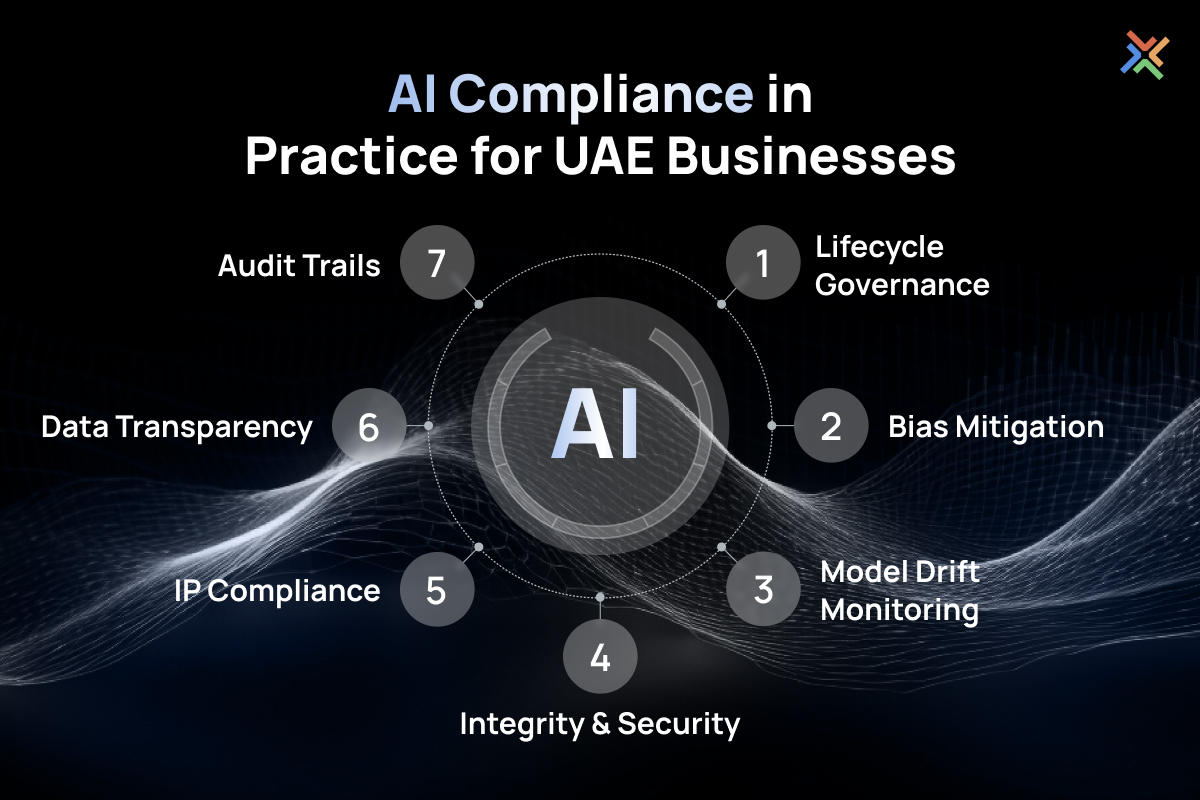
Compliance in AI across the UAE should encompass the integration of governance throughout the lifecycle of development, deployment, and monitoring of the AI system, ensuring the AI operates in a fair, safe, and transparent manner across finance, healthcare, public administration, and so on.
- As AI becomes more integrated into various interdisciplinary practices, the bias within these systems ultimately affects UAE enterprises.
- When used uncritically, such systems pose a discrimination risk, contributing to unrepresentative data, flawed algorithms and critical erroneous outcomes to AI-based systems exemplified in credit decisions, patient diagnoses, and services delivery in the public domain.
- Model drift is likely to be AI’s true compliance issue because of system inaccuracies attributable to deficiency in sufficient and continuous AI oversight maintenance, where it should be AI doing the oversight.
- AI Integrity will be challenged by adversarial attacks, usually by malefactors seeking to fraudulently and disruptively manipulate the AI, hence the imperative of regular maintenance of the AI.
- The IP of systems legally and ethically should comply with the UAE PDPL and the specific sectoral regulations.
- Data compliance and governance must be built across the systems in use and must remain transparent to the public to a reasonable degree from the perspective of the sector in focus, i.e. healthcare and finance.
- Lastly, we need to think about auditability. Complete audit trails documenting the design, testing, and deployment and monitoring of the system help with compliance.
Effectuating the principles of the system ensures the AI meets compliance and provides equitable, sustainable and accountable results. This will help gain the trust of the UAE regulators, customers, and investors.
Core Components of a UAE AI Compliance Framework
A robust framework includes six pillars essential for UAE enterprises. Businesses looking to hire AI developers UAE must prioritize candidates skilled in local regulations and ethical AI practices.
- Data Governance: All businesses in the UAE must comply with PDPL, enforce privacy by design in the AI and implement secured cross-border data transfer mechanisms with other countries.
- Algorithmic Transparency & Explainability: AI models must have documented logic and inputs, should provide explanations for decisions made (positive or negative) on customers or patients, and should have auditables to prove accountability.
- Mitigation of Bias and Fairness: Organizations should undertake regular assessments to check for demographic, gender and nationality biases and introduce measures to mitigate the same and models should be tracked to ensure fairness is maintained.
- Risk Management & Accountability: There should be defined governance structures, comprehensive risk assessments, and clearly defined reporting lines to regulators and executives.
- Security and Resilience: To ensure AI systems are resilient and secure, Robust AI-driven cybersecurity measures such as disaster recovery and business continuity planning and adversarial testing are put in place.
- Ethics and Regulatory Compliance: The use of AI must be ethically aligned to the UAE’s societal norms and the legal frameworks in the international arena must also be observed such as the ISO and OECD principles, and human supervision must be present in critical decision-making.
Global Frameworks Adapted for UAE Governance
Though guidance from international standards is valuable, they must still be adapted for regional compliance.
Lessons from the EU AI Act
- Risk-based AI classifications should be extended to finance, healthcare, and the public sector.
- High-risk AI systems must be subject to auditing, transparency, and human oversight.
ISO/IEC Standards
- 42001 (AI Management System): Certifiable AI governance and leadership.
- 23894 (AI Risk Management): A framework for the identification and mitigation of AI-specific risks.
- 5338 (AI System Lifecycle Processes): Recognized processes for the lifecycle of AI.
NIST AI RMF & Generative AI Guidance
- Risk governance, ongoing monitoring, and evidence collection must be prioritized.
- Generative AI systems must be designed to prevent misuse and be traceable.
IEEE 7000 Series & OECD AI Principles
Embed ethics directly into AI design and engineering.
Support UAE society with human-centric, fair, transparent, accountable, and ethical AI.
Implementing AI Compliance in UAE Enterprises
Ensure compliance, and gain operational efficiencies through a structured, sustainable approach. Enterprises should use specialized AI to develop compliant, scalable AI systems.
Governance Committees & Executive Ownership
- Clear leadership responsibility should be assigned for AI oversight.
- Compliance needs to be an integral part of strategic decisions.
Embedding Compliance into MLOps Pipelines
- Integrate the checking of biases, establishing thresholds for validation, and incorporating audit gates into the MLOps Pipeline.
- Aim for compliance with the PDPL and industry-specific regulations.
Automated Monitoring, Evidence Collection, and Audit Readiness
- Leverage AI observability tools to monitor performance, drift, and bias for AI models.
- Provide continued evidence for regulators without manual intervention.
Stakeholder Alignment
- Legal, risk, IT, and operational teams should work together on governance.
- Standard dashboards may enhance accountability and improve the decision-making processes.
Phased Implementation
- Pilot compliance frameworks in one industry sector, like finance, energy, or healthcare.
- Refine the processes to broaden the scope progressively for faultless compliance across the enterprise.
Strategic Benefits of Ethical AI for UAE Businesses
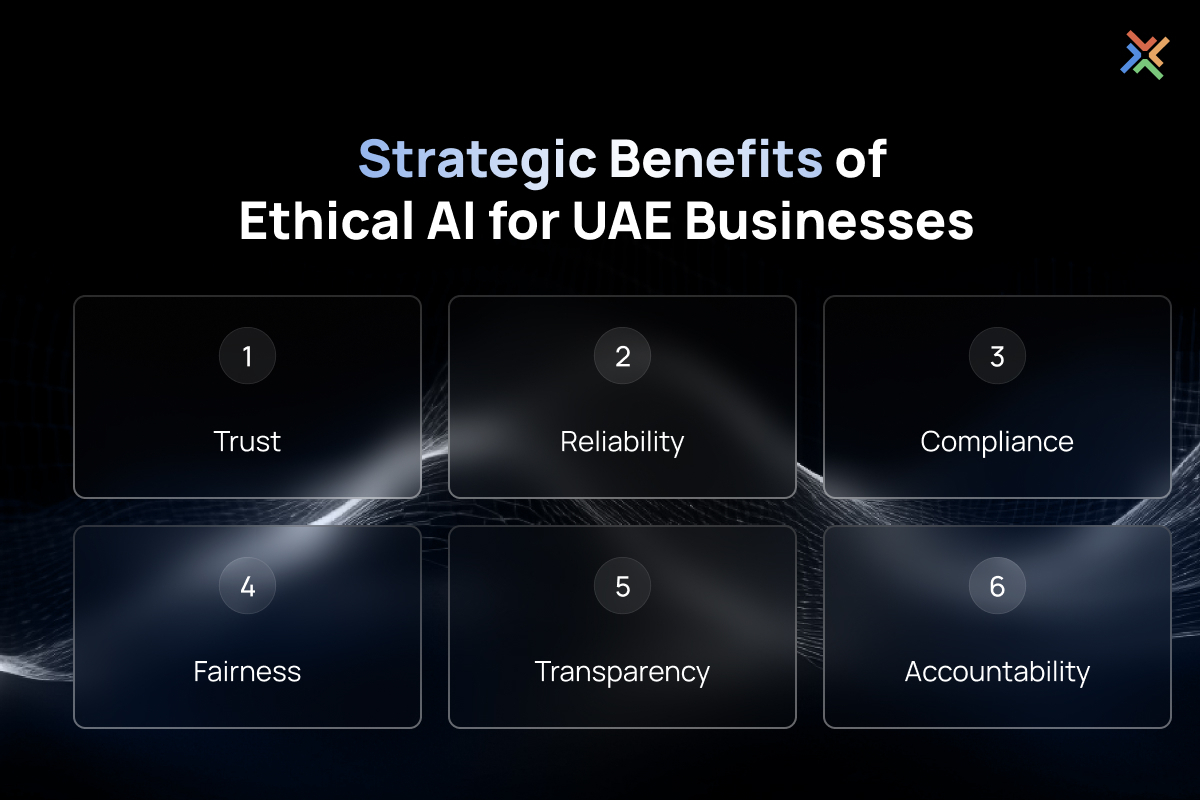
Integrating AI compliance ethical AI frameworks in your organization has valuable benefits to the business and to the operations business culture. UAE corporations adopting AI ethical and compliance frameworks experience both competitive and operational edges.
Building Trust
The responsible AI use demonstrates the organization’s trustworthiness and ethical relationships with the regulators and controls with the organization being a market leader.
Faster Scaling
A unified compliance framework reduces regulatory bottlenecks. Streamlined approvals allow rapid deployment of AI products, accelerating innovation while remaining within legal boundaries.
Improved AI Reliability
Ongoing validation of regulations and controls improve model visibility and explainability to AI automated decisions made in high-risk sectors (healthcare, finance) over a period of time.
Operational & Cultural Advantages
The organization’s culture shifts from reactive control to positive governance through compliance and this compliance becomes a multiplier of innovation, enabling the teams to confidently innovate instructions under a positive regulatory framework.
UAE-Specific Case Studies
- Banking: AI-enabled credit scoring systems with fairness and explainability of decisions.
- Smart Cities: AI in traffic control and adaptive maintenance. Predictive maintenance.
- Energy Efficiency: AI in Grid monitoring with cyber security and disaster recovery capability.
Tools, Platforms, and Managed Services for UAE AI Compliance
UAE Enterprises have the option to use AI development services UAE with advanced technology for efficient operational compliance.
- UAE AI Observability and Compliance Platforms: Monitoring, bias, and compliance for audits, framework, UAE and Middle Eastern compliance bias tailored detection.
- Managed Compliance Services: Ongoing compliance services from Transilience AI and local partners in compliance with structured outcomes.
- Continuous Assurance: Monitoring to distinguish automatically collected evidence and manage potential undisclosed vulnerabilities.
Future-Proofing AI Compliance in the UAE
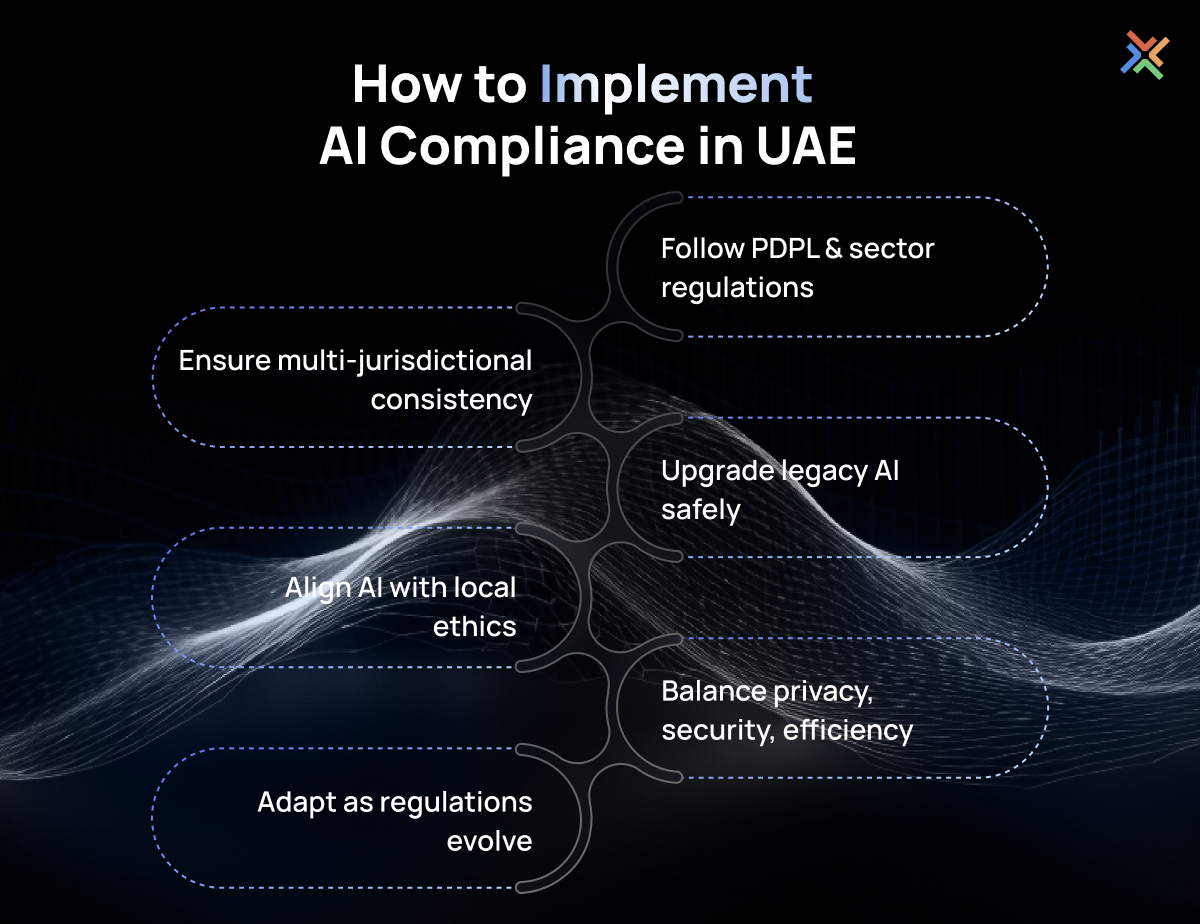
The prediction of the variables that will become available is a vital signal to the future. The variables are a signal to future anticipation to presumptively remain below the horizon of regulatory vision.
Integrating AI Compliance with PDPL and Sectoral Regulations
- Balance privacy, security, and operational efficiency.
- Adapt frameworks dynamically as regulations evolve.
Multi-Jurisdictional AI Operations
- Achieve compliance consistency within the GCC and worldwide.
- Fill in missing pieces and eliminate overlaps in borderless operations.
Retrofitting Legacy AI Systems
- Enhance models without documentation, explainability, or audit trails.
- Legacy systems pose risks and must conform to current standards of governance.
Aligning Ethical AI with UAE Societal Norms
Integrate fairness and transparency into AI design systems along with human intervention.
Abide by the local norms in culture, society, and ethics.
Build Compliance-Ready AI with WDCS to Lead the UAE Market
The UAE’s AI regulations are dynamic. Early Compliance Integration (CI) in AI strategy offers enterprises significant competitive advantages. Operational, financial, and reputational risk factors are diminished, and trust is established with regulators, customers, and investors.
Partnering with an AI development company UAE, enterprises can leverage compliance-ready AI to innovate within the boundaries of the PDPL, and sectoral regulations, and international standards.
With WDCS provided technology in the UAE, businesses can operationalize the compliance of AI within the development, deployment, and monitoring stages for continued alignment with the PDPL, sector regulations, and global best practices. Compliance emerges not only as an innovative tool to manage operational flows but also as a pillar of sustainable growth.
Get in touch with us to have compliance-ready AI implemented in your business to become market leaders in the AI-driven economy of 2026 and beyond, shifting compliance requirements to business opportunities.
Frequently Asked Questions:
Common questions related to AI compliance, best practices, and regulations for businesses in the UAE.
Q1: What is the core focus of UAE AI compliance?
A: Regulation of AI for the UAE is trying to find the fix for the balance between harnessing domestic and integrating ethical practices and transparency, accountability, fairness, and the restraint of data under the PDPL.
Q2: Do I need to worry about the EU AI Act in the UAE?
A: Yes, if your AI system is accessible to users in the EU, you must comply with its requirements.
Q3: How do I handle data privacy with AI?
A: Strong safeguards should be deployed for your projects, such as Data Protection Impact Assessments (DPIAs) for AI.
Q4: Are there specific requirements for AI in my industry?
A: Yes, expect sector-specific guidelines for areas like finance (CBUAE) and new regulations in gaming.
Q5: What should my company do now?
A: Start inward with your AI governance, and develop self-assessment of your ethical position such as the MOAI Seal, and record your AI implementations in model cards and logs, and apply IS0 42001 so that you can manage the expectations to ensure there is AI-enabled work with a human in the loop.
Q6: Is AI compliance separate from existing IT security?
A: Partially. AI carries with it the added risks of algorithmic bias and a lack of transparency which means that other policies and a DPIA.
Unlock AI Compliance and Innovation with WDCS Today!
Partner with a trusted AI development company UAE to implement AI solutions that are secure, ethical, and fully compliant with PDPL, sector regulations, and global standards. Turn regulatory requirements into a competitive advantage.