IoT and Digital Twins: Transforming UAE’s Infrastructure Development
March 19, 2026

Ayush Kanodia
Dubai’s digital economy has reached a decisive inflection point. AI has become operational infrastructure. Government-led AI strategies, enterprise modernization mandates, and sector-wide automation initiatives have accelerated adoption across banking, healthcare, aviation, logistics, retail, and real estate.
The growth trajectory validates this momentum. The UAE artificial intelligence market is projected to grow at a CAGR of 45.9% between 2026 and 2034, reaching USD 221.38 billion by 2034.
For enterprises operating in Dubai, conversational AI has shifted from “nice-to-have automation” to revenue-impacting digital infrastructure. Customer expectations are real-time. Multilingual service is mandatory. Backend systems must be connected. Data governance must be compliant with UAE regulations. A chatbot is no longer a widget embedded on a website; it is an intelligent interface layer connecting customers, employees, and enterprise systems.
As a result, the search for AI chatbot development experts in Dubai has intensified. Decision-makers are evaluating which chatbot development company in UAE can architect scalable, secure, enterprise-ready conversational systems aligned with long-term business strategy.
This guide provides a rigorous evaluation framework, analyzes the Top AI chatbot development companies in Dubai UAE 2026, and outlines what businesses should realistically expect from chatbot development services in UAE.
Selecting the wrong partner introduces technical debt, compliance risk, and operational inefficiency. Selecting the right partner accelerates automation maturity and measurable ROI.
How to Evaluate an AI Chatbot Development Company
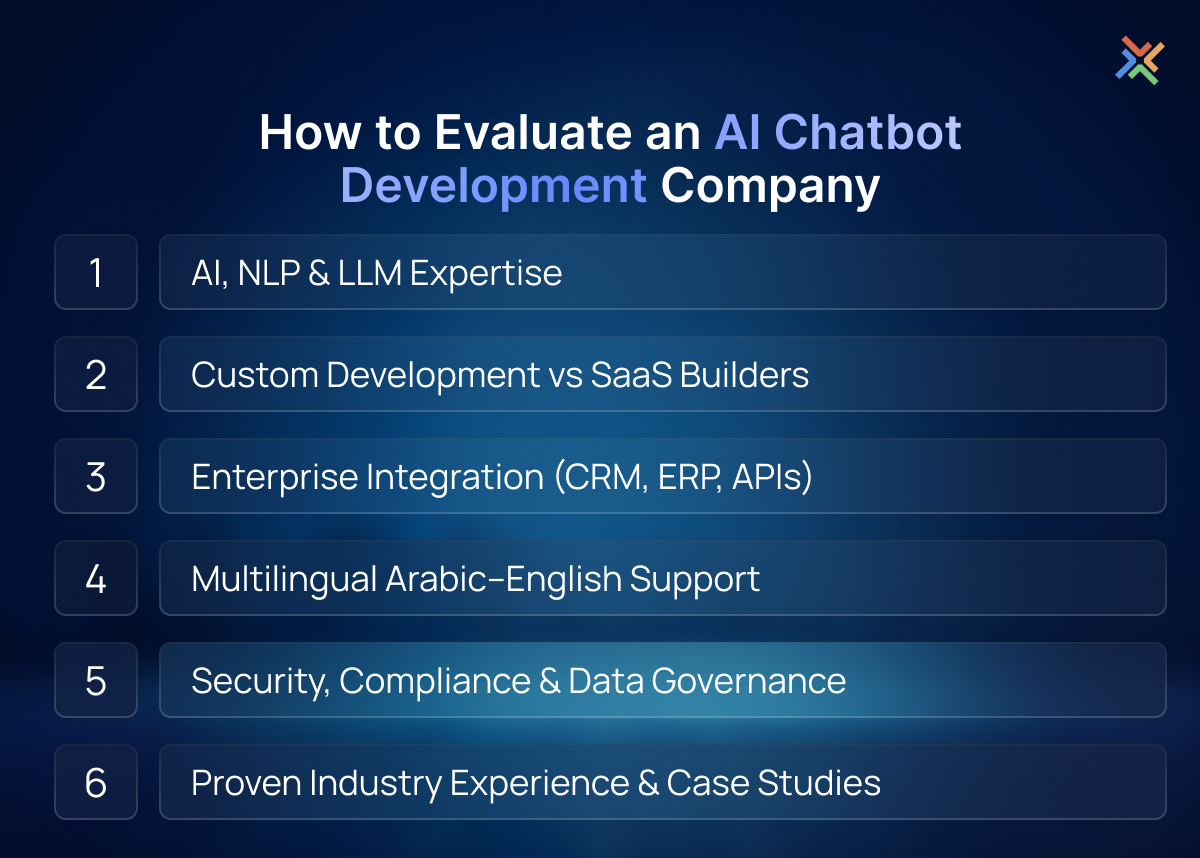
Choosing a chatbot partner is a strategic decision. Many Chatbot development companies Dubai present similar marketing language, but technical depth and enterprise readiness vary significantly. The following evaluation framework reflects how experienced CTOs and digital transformation leaders assess AI chatbot developers UAE Dubai.
Expertise in AI, NLP & Large Language Models (LLMs)
Modern conversational systems are built on transformer-based architectures, contextual embeddings, and retrieval-augmented generation (RAG). Any provider offering AI-based chatbot Development Services in UAE must demonstrate more than superficial integration with third-party APIs.
A credible team should be able to explain its model stack decisions.
Are they using hosted LLMs, open-source models, or fine-tuned domain-specific architectures?
How are hallucinations mitigated?
Is there a RAG pipeline connecting enterprise knowledge bases?
What evaluation metrics are used to measure intent accuracy, response grounding, and contextual coherence?
Enterprise chatbot engineering requires more than prompt engineering. It involves vector database configuration, semantic search design, intent classification, memory management, and guardrail implementation. Companies that cannot articulate these components in technical detail are typically relying on pre-built tools rather than architecting solutions.
When evaluating AI chatbot development companies in Dubai UAE, request architectural documentation, not just demos.
Custom Development vs SaaS Chatbot Builders
Many vendors operate as SaaS resellers. These platforms are useful for small businesses with limited workflows but often lack scalability and customization for enterprise environments.
Custom chatbot development services in UAE become important when you require backend integrations, proprietary knowledge base ingestion, role-based access control, and advanced analytics. A full-service chatbot app development company in UAE should be capable of designing modular conversational architectures that evolve alongside business needs.
SaaS builders often restrict logic flexibility and data control. Enterprises in banking, healthcare, or government cannot rely solely on black-box solutions. Ownership of conversational data pipelines and deployment architecture is critical.
The distinction is simple: are you buying a tool, or are you investing in a system engineered around your business model?
Enterprise Integration Capabilities (CRM, ERP, APIs)
A chatbot that cannot transact, update records, or retrieve real-time information is limited in value. Enterprise AI chatbot development services Dubai UAE must extend beyond customer-facing messaging.
Integration capabilities should include CRM systems like Salesforce or HubSpot, ERP systems such as SAP or Oracle, payment gateways, ticketing platforms, HR systems, and internal APIs. Secure authentication mechanisms including OAuth, token-based validation, and encryption standards must be implemented.
The depth of integration determines automation ROI. A bot that can only answer FAQs reduces marginal workload. A bot that executes workflows, updates records, and triggers backend processes transforms operational efficiency.
Multilingual Arabic–English Accuracy
Dubai’s market demands bilingual fluency. Arabic conversational AI requires specialized training data, dialect recognition, and right-to-left interface support. Many AI chatbot development companies in Dubai claim Arabic support but rely on generic translation APIs.
Effective Arabic chatbot deployment requires dataset curation, contextual nuance handling, and domain-specific intent modeling. Evaluate whether the provider has tested conversational accuracy in both Modern Standard Arabic and Gulf dialects. Precision in language directly impacts user trust and engagement.
Security, Compliance & Data Governance Standards
UAE data protection regulations impose strict obligations on organizations handling personal information. A chatbot development agency in UAE must demonstrate compliance readiness, including data encryption, access logging, role-based permissions, and data residency controls.
Ask about cloud hosting regions.
Can deployments be restricted to UAE-based infrastructure if required?
Are there audit trails for model interactions?
Is sensitive data masked before model processing?
Security architecture should be documented and auditable. Without this, conversational AI introduces compliance risk rather than efficiency gains.
Proven Industry Experience & Case Studies
The final differentiator is implementation evidence. A top-rated AI chatbot development company should provide measurable case studies. Metrics such as reduction in call center volume, improvement in first-contact resolution, or automation of backend processes offer tangible proof.
Experience across industries matters because conversational logic varies significantly between banking, healthcare, and retail. Domain familiarity reduces training time and deployment friction.
When evaluating chatbot development providers UAE, prioritize partners who demonstrate strategic understanding of your sector rather than generic technology capability.
10 Best AI Chatbot Development Companies in Dubai, UAE
The following companies represent a curated analysis based on technical capability, enterprise readiness, regional presence, and strategic positioning.
1. WDCS Technology
WDCS Technology positions itself as an enterprise-focused AI transformation partner rather than a transactional vendor. The company delivers conversational AI chatbot development services designed for scalability, regulatory alignment, and long-term optimization.
Their approach integrates LLM-powered conversational engines with RAG pipelines to connect enterprise knowledge bases securely. Emphasis is placed on hallucination control, structured data ingestion, and backend system connectivity. WDCS demonstrates strength in complex enterprise integration across CRM and ERP ecosystems, making it suitable for banking, healthcare, and government use cases.
As a chatbot development company in UAE operating at enterprise scale, WDCS prioritizes bilingual deployment, secure infrastructure design, and analytics-driven optimization. Their methodology reflects architectural maturity rather than surface-level implementation.
2. Code Brew Labs
Code Brew Labs is known for scalable digital product engineering. Within the chatbot domain, the company focuses on omnichannel deployment and performance analytics. Their solutions integrate AI conversational systems across web and mobile ecosystems, with emphasis on user engagement metrics. Code Brew Labs serves retail, fintech, and logistics clients requiring high-volume conversational traffic management.
3. Emvigo Technologies
Emvigo Technologies positions itself around ROI-driven automation. Their chatbot deployments are often combined with operational workflow optimization to reduce support overhead. They serve mid-sized enterprises seeking intelligent automation without excessive infrastructure complexity. While not exclusively enterprise-scale, Emvigo offers practical solutions aligned with operational efficiency.
4. Autviz Solutions
Autviz Solutions integrates generative AI with structured MLOps frameworks. Their strength lies in model lifecycle management, retraining processes, and performance monitoring. Organizations prioritizing AI governance and long-term scalability may find their MLOps orientation attractive. Their deployments often involve complex AI ecosystems beyond standalone chat interfaces.
5. Innobayt Solutions
Innobayt Solutions focuses on SMEs requiring custom NLP chatbot implementations. Their services emphasize domain adaptation and business-specific conversational design. While typically serving smaller organizations, they demonstrate competence in localized chatbot development UAE implementations with practical business alignment.
6. EORA AI
EORA AI specializes in high-complexity conversational flows. Their systems are designed to manage multi-step decision trees and layered enterprise workflows. They are suited for enterprises requiring advanced automation logic rather than basic FAQ bots.
7. Verbat Technologies
Verbat Technologies integrates robotic process automation with conversational AI. This hybrid architecture enables bots to execute backend tasks such as document processing, invoice validation, and data entry. Their approach appeals to enterprises seeking automation beyond customer service.
8. Techugo
Techugo has established a presence in government and healthcare digital projects. Their chatbot deployments emphasize compliance, structured data management, and user accessibility. They are particularly relevant for regulated sectors requiring secure deployment frameworks.
9. Webmob Software Solutions
Webmob Software Solutions integrates predictive analytics with LLM-powered chatbots. Their deployments often include behavior tracking and intent forecasting to enhance personalization. They serve retail and enterprise automation clients requiring data-driven conversational systems.
10. MyCloudPulse
MyCloudPulse focuses on cloud-native deployment strategies across AWS and Azure ecosystems. Their emphasis lies in scalable infrastructure and DevOps-driven delivery cycles. For organizations prioritizing performance optimization and infrastructure scalability, MyCloudPulse offers relevant expertise.
AI Chatbot Development Services in Dubai: What Businesses Should Expect in 2026
The expectations surrounding chatbot development services in UAE have evolved rapidly. Businesses now require measurable operational transformation.
Conversational AI vs Rule-Based Chatbots
Rule-based bots rely on decision trees and predefined scripts. Conversational AI systems leverage NLP and LLMs to interpret user intent dynamically. In 2026, enterprises should prioritize AI-driven contextual systems capable of adaptive dialogue rather than static response mapping.
Omnichannel Deployment (Web, Mobile, WhatsApp, Social Platforms)
Modern conversational systems must operate across websites, mobile apps, WhatsApp Business, and social media platforms. Consistent cross-channel experience ensures customer retention and brand continuity.
Generative AI & Knowledge Base Integration
RAG architecture allows chatbots to retrieve enterprise knowledge dynamically. This reduces hallucination risk and ensures contextual grounding. The expansion of the generative AI chatbot market to a projected USD 113.35 billion by 2034 reflects demand for intelligent, knowledge-connected systems rather than simple response engines.
Workflow Automation & Backend Integration
AI chatbot developers UAE Dubai increasingly focus on transaction execution. Bots can process bookings, generate invoices, escalate tickets, and update CRM records in real time.
Analytics, Monitoring & Continuous Optimization
Enterprise-grade conversational systems require ongoing monitoring. Metrics include intent recognition accuracy, containment rate, response latency, and business outcome conversion rates. Continuous optimization differentiates mature AI deployments from experimental pilots.
Cost of AI Chatbot Development in UAE
Pricing varies based on complexity, model architecture, and integration depth. Basic rule-based chatbots may range between AED 25,000 and AED 60,000. Mid-level AI chatbots with CRM integration typically range between AED 60,000 and AED 150,000.
Enterprise-grade LLM-powered systems with RAG pipelines, multilingual support, and deep backend integration can exceed AED 150,000 to AED 500,000 or more.
Total cost of ownership includes hosting, model API usage, retraining cycles, monitoring tools, and ongoing support. Businesses aiming to Hire expert chatbot developers in UAE should evaluate long-term scalability costs rather than focusing solely on initial deployment fees.
How to Choose the Right AI Chatbot Development Partner in Dubai
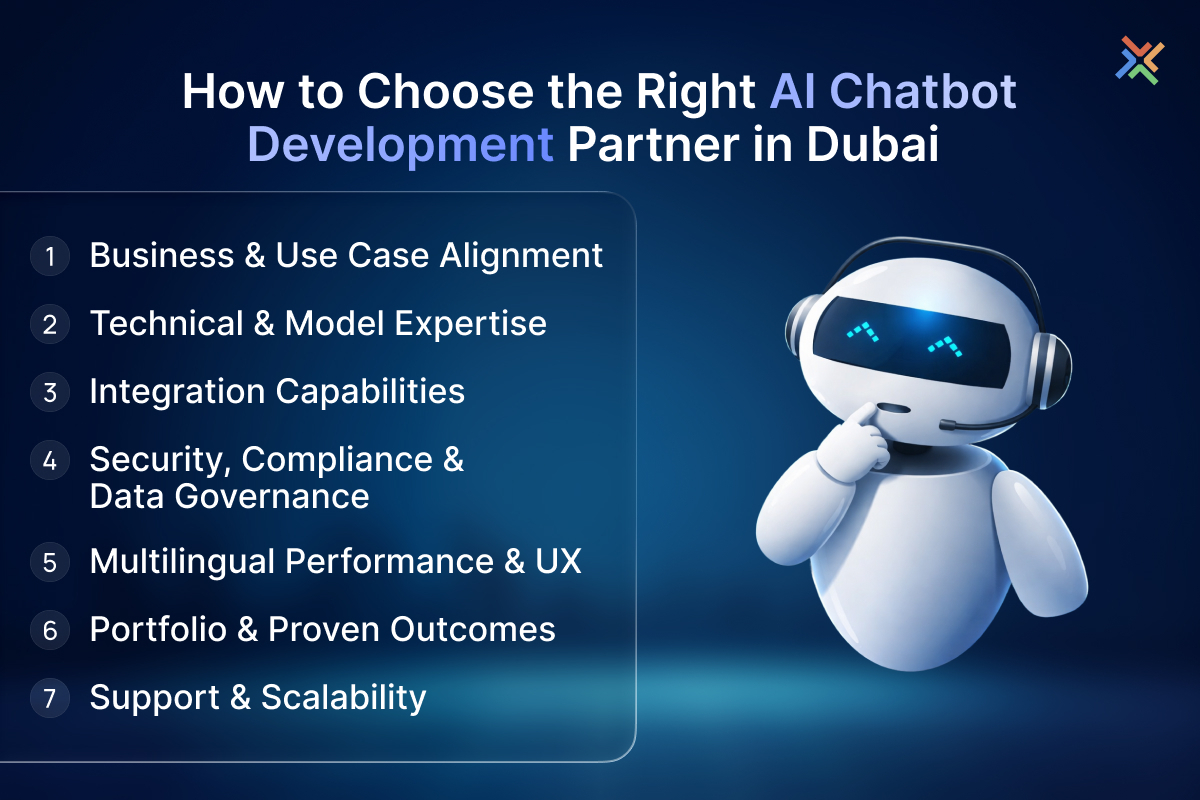
Selecting among AI chatbot development services companies in Dubai requires structured due diligence. Key criterias to evaluate:
- Business & Use Case Alignment: Ensure the vendor understands your goals, use cases, and KPIs (e.g., reduced support costs, higher CSAT, automation of backend processes). A partner should adapt solutions to your workflows, not force you to fit their tool.
- Technical & Model Expertise: Check their proficiency with AI foundations, LLMs, NLP/NLU, RAG pipelines, vector stores, transformer architectures and their ability to articulate architectural decisions, mitigate hallucinations, and manage conversational memory.
- Integration Capabilities: Evaluate how well they integrate chatbots with your existing CRM, ERP, ticketing systems, internal APIs, and enterprise data sources. True value comes from bots that transact, update records, and trigger workflows, not just respond to text.
- Security, Compliance & Data Governance: Look for robust data protection practices including encryption in transit and at rest, SOC 2/ISO certifications, access controls, audit logging, and compliance with UAE data laws and industry standards.
- Multilingual Performance & UX: Beyond basic translation, assess whether the partner can train models on domain‑specific data, handle dialect nuances, and deliver seamless experiences in both Arabic and English.
- Portfolio & Proven Outcomes: Demand case studies showing measurable impact, industry experience in contexts similar to yours, and references you can verify. Vendors who have deployed at scale and can share performance metrics are more reliable.
- Support & Scalability: Confirm ongoing support, training resources, future upgrades, and architecture planning for growth, your chatbot should keep pace with traffic spikes, new channels, and evolving business needs.
The right partner should align conversational AI architecture with your operational model. A credible chatbot development company in UAE functions as a strategic AI advisor, not merely a vendor delivering code.
Partner with WDCS Technology for Enterprise AI Chatbots!
The UAE’s AI market is growing rapidly, and conversational AI has become a critical component of enterprise digital infrastructure. Selecting the right AI chatbot development partner in Dubai is essential to ensure scalable, secure, and high-performing solutions that deliver real business impact.
WDCS Technology stands out among the top AI chatbot development companies in Dubai UAE 2026, offering enterprise-grade architecture, bilingual Arabic–English deployment, deep CRM and ERP integration, and ROI-driven results. Their expertise ensures that chatbots do more than answer questions, they automate workflows, boost customer engagement, and integrate seamlessly with enterprise systems.
Partner with WDCS Technology to unlock the full potential of AI for your business. Contact us for a free strategy consultation and start building intelligent, secure, and scalable conversational systems that drive measurable efficiency and growth.
Transform Your Infrastructure with WDCS Technology
Unlock the full potential of IoT and digital twin technologies with WDCS Technology, a trusted IoT development company UAE. From design to deployment and ongoing optimization, we help governments and enterprises enhance efficiency, improve safety, and future-proof infrastructure. Get a free consultation today and start building smarter, resilient cities that meet UAE’s vision for 2031.