Top 10 IoT App Trends Shaping Dubai’s Smart City Vision in 2026
March 06, 2026

Ayush Kanodia
.jpg?w=1920&q=75)
Dubai’s smart city journey has moved beyond experimentation. By 2026, the city is not simply connecting devices; it is orchestrating intelligence at scale. The shift is profound. Instead of focusing on isolated smart solutions, Dubai is building a deeply integrated, AI-powered, and autonomous urban ecosystem designed to enhance sustainability, operational efficiency, and resident happiness.
The backbone of this transformation is the Internet of Things. IoT app solutions are becoming the digital nervous system of the city, connecting infrastructure, transportation, healthcare, utilities, and citizen services into one responsive network. This transformation is aligned with the Dubai 2040 Urban Master Plan, which emphasizes sustainable development, paperless governance, and AI-driven decision-making.
For enterprises and government bodies alike, the message is clear. The future of infrastructure depends on intelligent applications built by experienced developers who understand architecture, security, scalability, and integration at a systems level. This is why demand for a capable IoT Development Company UAE continues to grow rapidly in 2026.
The Market Forces Accelerating IoT Adoption in the UAE
Dubai’s smart city ambitions are supported by measurable economic momentum. The UAE IoT device market is projected to reach USD 2.5 trillion by 2033, up from USD 1.1 trillion in 2024.
Between 2026 and 2033, the sector is expected to grow at a steady CAGR of approximately 9.5 percent. Meanwhile, the UAE digital transformation market is forecasted to expand from USD 1.82 billion in 2026 to USD 3.75 billion by 2031.
On a broader scale, global connected devices are estimated to reach 39 billion by 2030, with smart cities representing a significant share of adoption. In the Middle East, the Massive IoT market is projected to reach USD 6.56 billion by 2031, growing at an impressive 22.9 percent CAGR.
These statistics highlight one reality. IoT development is foundational to economic competitiveness, sustainability planning, and digital governance. Organizations that delay IoT integration risk falling behind in efficiency, compliance, and innovation.
The Convergence of 5G, AI, and IoT: The Rise of AIoT in Dubai
IoT alone enables connectivity. Artificial Intelligence transforms data into insight. 5G provides ultra-low latency communication. Together, they create AIoT, or Artificial Intelligence of Things.
AIoT enables predictive automation rather than reactive management. In practical terms, this means infrastructure can anticipate problems, transportation systems can adapt dynamically, and energy grids can self-balance before disruptions occur. Dubai’s heavy investment in 5G deployment ensures that real-time analytics can occur without latency delays that once limited IoT applications.
For IoT app development services in UAE, this convergence changes technical expectations. Applications must now support edge processing, machine learning integration, high-speed connectivity, and secure distributed architectures. Smart city systems must process millions of data points in real time without compromising reliability.
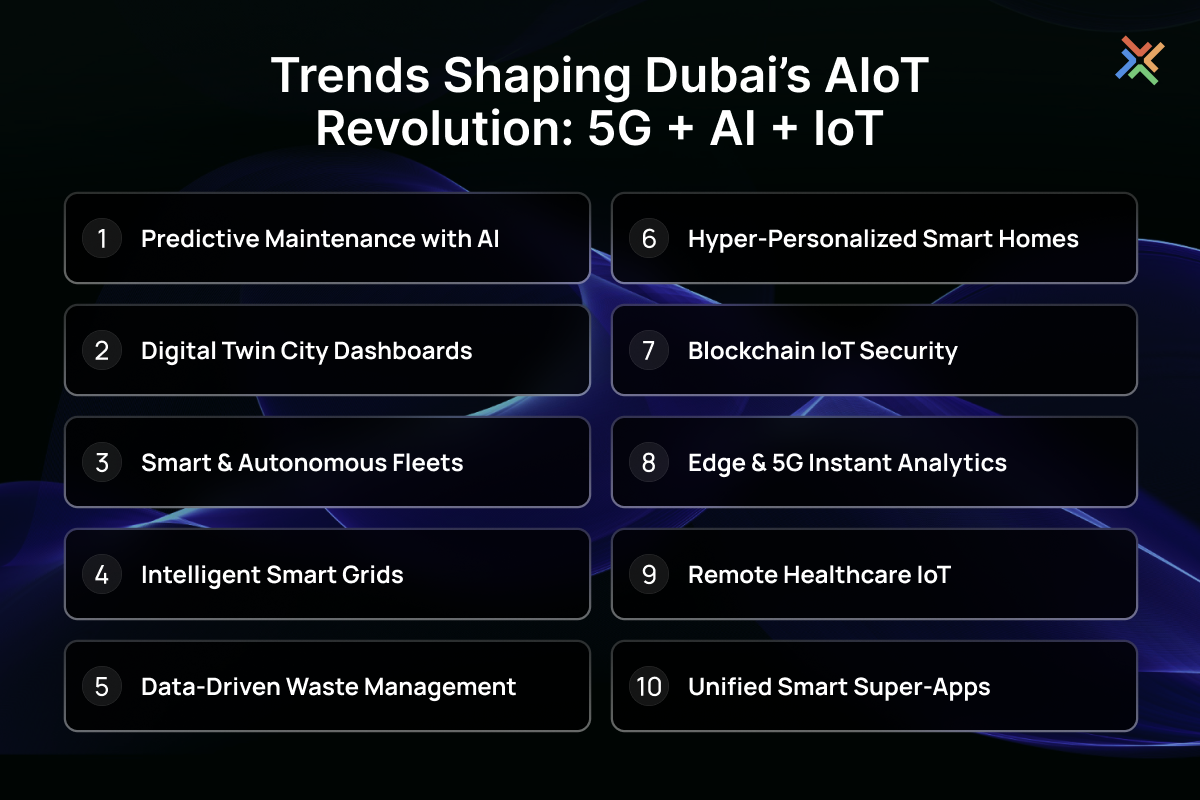
Trend 1: AI-Powered Predictive Maintenance Applications
Predictive maintenance represents one of the most impactful IoT app trends shaping Dubai in 2026. Traditionally, infrastructure repairs were reactive. Systems failed first, and maintenance followed. This approach created downtime, safety risks, and high repair costs.
Today, IoT sensors embedded in bridges, roads, HVAC systems, elevators, pipelines, and industrial equipment continuously stream performance data to analytics platforms. AI algorithms detect anomalies that indicate potential failure. Instead of responding to breakdowns, authorities receive early warnings and can intervene proactively.
For a city like Dubai, where high-density infrastructure operates in extreme environmental conditions, predictive maintenance is essential. Airports, metro systems, commercial towers, and logistics hubs rely on uninterrupted functionality. Even minor disruptions can have cascading economic impact.
An experienced IoT Development Company UAE must design maintenance applications that integrate real-time data ingestion, cloud analytics, AI modeling, and secure device communication. Scalability is critical because these systems often manage thousands of connected sensors across multiple sites.
Trend 2: Digital Twin Visualization and Real-Time Urban Dashboards
Digital twin technology is transforming how Dubai plans and manages its urban environment. A digital twin is a live, data-driven 3D replica of a physical asset or district. These models are powered by continuous IoT data streams.
In 2026, urban planners and facility managers will use digital twins to monitor building energy consumption, simulate traffic flow adjustments, assess pedestrian patterns, and test emergency response scenarios before implementation. This approach reduces risk and improves decision accuracy.
Digital twin applications require advanced IoT app solutions capable of integrating sensor networks, visualization engines, analytics frameworks, and cloud infrastructure. Real-time updates are essential. If latency disrupts synchronization between physical assets and digital models, decision-making accuracy declines.
Organizations seeking to hire IoT developers in UAE increasingly prioritize teams experienced in integrating visualization dashboards with live sensor data. The ability to translate raw data into actionable insights defines the value of digital twin platforms.
Trend 3: Autonomous Vehicle and Smart Fleet Management Apps
Dubai aims to make 25 percent of its transportation autonomous by 2030. Achieving this milestone requires robust IoT-enabled fleet management applications.
Autonomous taxis, buses, and delivery drones rely on vehicle-to-everything communication. Vehicles must exchange information with traffic signals, road infrastructure, central control systems, and other vehicles. This communication ensures optimized routing, reduced congestion, and enhanced safety.
IoT app developers designing mobility platforms must address challenges such as real-time route recalibration, predictive vehicle maintenance, passenger safety monitoring, and secure data encryption. Edge computing is particularly important in mobility systems because split-second decisions cannot rely solely on distant cloud processing.
As Dubai expands smart mobility initiatives, demand for IoT development services in transportation and logistics sectors continues to rise. Companies building connected fleet systems must partner with experienced IoT app developers capable of managing high-volume data exchange with minimal latency.
Trend 4: Smart Grid and Intelligent Utility Management Platforms
Energy efficiency and water conservation are central to Dubai’s sustainability objectives. Smart grid platforms powered by IoT sensors and smart meters enable real-time monitoring of electricity and water consumption.
Applications allow residents and businesses to track usage patterns, detect anomalies, and optimize consumption behavior. On a city-wide scale, authorities use aggregated data to balance loads, reduce outages, and integrate renewable energy sources effectively.
The integration of renewable systems such as solar panels adds complexity to utility management. IoT app solutions must process distributed energy inputs while maintaining grid stability. AI-driven forecasting models help predict demand surges and prevent overloads.
For organizations investing in sustainability technology, choosing the right IoT development services provider in UAE ensures secure data encryption, seamless integration with existing infrastructure, and scalable system design.
Trend 5: Intelligent Waste Management and Environmental Monitoring Systems
Waste management is becoming increasingly data-driven in Dubai’s smart city ecosystem. IoT-enabled bins equipped with fill-level sensors transmit real-time data to centralized platforms. Instead of following fixed collection schedules, waste management teams operate on dynamic routes optimized by live analytics.
This approach reduces fuel consumption, operational costs, and environmental impact. It also aligns with Dubai’s ambition to move toward zero-waste initiatives.
Beyond waste collection, environmental monitoring applications track air quality, temperature fluctuations, humidity levels, and pollution metrics. These applications support public health planning and sustainability compliance.
Developing such systems requires IoT app developers who understand sensor integration, low-power communication protocols, and scalable cloud architectures capable of managing thousands of distributed data points.
Trend 6: Hyper-Personalized Smart Home and Connected Living Applications
Smart living is becoming standard across residential developments in Dubai. Hyper-connected homes integrate lighting, climate control, security systems, appliances, and voice assistants into centralized IoT applications.
In 2026, smart home apps are no longer limited to remote switching. They leverage AI to learn user behavior and automate preferences. For example, systems adjust lighting and temperature based on occupancy patterns while optimizing energy efficiency.
Security integration is another key component. Real-time alerts, facial recognition-enabled access systems, and remote monitoring enhance safety while reducing manual intervention.
For real estate developers and technology firms, hiring IoT developers in UAE with experience in multi-device ecosystems ensures seamless interoperability between devices from different manufacturers.
Trend 7: Blockchain-Enabled IoT Security Architectures
As IoT ecosystems expand, security becomes increasingly critical. Each connected device represents a potential vulnerability. In response, blockchain technology is emerging as a secure framework for IoT data management.
Blockchain-enabled IoT platforms provide tamper-proof transaction logs and decentralized verification processes. This approach enhances trust in automated financial transactions, property management systems, and identity verification platforms.
Security-first IoT development focuses on device authentication, end-to-end encryption, secure firmware updates, and decentralized identity management. For government and fintech applications in Dubai, blockchain-backed IoT solutions reduce risk while maintaining regulatory compliance.
Trend 8: Edge Computing and 5G-Driven Instant Analytics
Traditional IoT systems relied heavily on centralized cloud processing. However, latency limitations made real-time decision-making challenging. Edge computing addresses this issue by processing data closer to its source.
In Dubai’s 5G-powered infrastructure, edge computing enables instant analytics for traffic monitoring, surveillance systems, and emergency response coordination. When milliseconds matter, edge processing ensures immediate action without waiting for remote cloud analysis.
IoT app development requirements in UAE increasingly incorporate hybrid architectures that combine edge intelligence with centralized analytics. This balance provides speed without sacrificing long-term data storage and machine learning capabilities.
Trend 9: IoT-Enabled Remote Healthcare and Smart Hospitals
Healthcare innovation is a priority under Dubai’s digital transformation initiatives. IoT-enabled wearable devices monitor patient vitals in real time, transmitting data to healthcare providers for continuous observation.
Smart hospital platforms integrate patient monitoring, asset tracking, temperature regulation, and automated medication systems. These solutions reduce human error, enhance patient outcomes, and streamline operational workflows.
Remote healthcare monitoring also enables proactive interventions. When wearable devices detect irregular heart patterns or abnormal glucose levels, alerts trigger immediate medical review.
Developing healthcare IoT applications requires rigorous compliance with data privacy regulations and robust encryption standards. Organizations must collaborate with IoT app developers experienced in secure health data integration.
Trend 10: Unified Smart Super-Apps for Citizen Services
Dubai is moving toward centralized digital interaction platforms. Super-apps integrate multiple government and municipal services into a single interface. Residents can pay bills, renew licenses, report civic issues, and book transportation through one unified system.
These applications rely on IoT data streams to provide real-time updates. For example, traffic data integration improves commute planning, while utility dashboards provide consumption insights within the same app.
Super-app ecosystems demand scalable architecture capable of handling high user volumes and multiple service integrations. A reliable IoT Development Company UAE ensures seamless API connectivity and secure identity management across platforms.
Why Do UAE Businesses Need an IoT Development Company in 2026?
In 2026, IoT is about orchestrating entire ecosystems. Dubai’s smart city infrastructure integrates transportation, utilities, healthcare, real estate, and public services into interconnected digital environments. That level of complexity cannot be handled through fragmented development efforts.
Businesses need an experienced IoT Development Company UAE because modern IoT initiatives require architectural thinking, not just coding. Every connected device must communicate securely, scale efficiently, and integrate seamlessly with legacy systems, cloud platforms, and AI-driven analytics engines. A misstep at the architecture level can result in performance bottlenecks, security vulnerabilities, or costly system redesigns.
A specialized IoT partner brings structured methodology across device management, edge and cloud computing, real-time data streaming, predictive analytics, and cybersecurity compliance. They also understand regional regulatory frameworks and industry-specific requirements, whether in utilities, healthcare, logistics, or smart mobility.
Most importantly, a strategic IoT development partner future-proofs investments. As Dubai accelerates toward AI-driven automation and sustainable infrastructure under the 2040 Urban Master Plan, businesses must ensure their IoT app solutions are scalable enough to evolve alongside policy shifts and technological advancements. Working with a capable IoT development services provider reduces risk and increases long-term ROI.
How to Hire IoT Developers in UAE for Scalable Smart Infrastructure?
Hiring IoT developers in UAE requires more than reviewing technical resumes. Smart infrastructure projects demand multidisciplinary expertise that spans hardware integration, communication protocols, data engineering, cybersecurity, and AI modeling.
Businesses should begin by evaluating experience in designing end-to-end IoT architectures. Developers must understand protocols such as MQTT, BLE, ZigBee, NFC, and cellular connectivity, as well as how to implement them within secure and scalable frameworks. Knowledge of edge computing is increasingly essential, especially for applications that require low-latency decision-making such as mobility systems or real-time monitoring platforms.
Equally critical is the ability to transform raw sensor data into business intelligence. IoT app solutions generate vast data streams, but data alone does not create value. Developers must demonstrate expertise in analytics dashboards, visualization tools, predictive algorithms, and system optimization models.
Security should never be an afterthought. Businesses should assess whether developers follow best practices in encryption, device authentication, firmware management, and compliance standards. A structured security framework is essential in smart city environments where infrastructure reliability and citizen data protection are priorities.
For large-scale initiatives, partnering with an established IoT Development Company UAE often proves more effective than hiring isolated freelancers. Ecosystem-level execution requires coordinated teams capable of managing integration, testing, deployment, and long-term maintenance.
The Road to Dubai 2040: What the Next Phase of IoT Innovation Looks Like
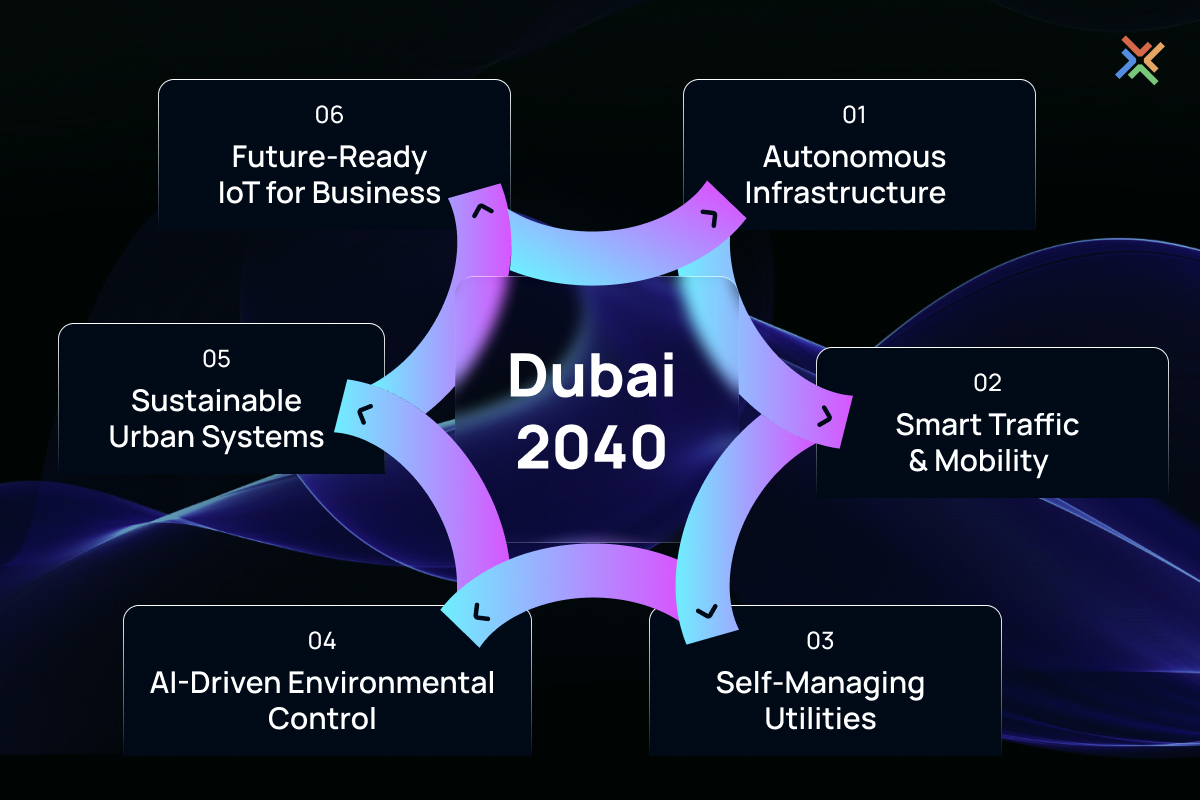
Dubai’s next phase of smart city evolution will be defined by autonomy and interoperability. By 2040, infrastructure systems are expected to operate with minimal human intervention, driven by AI-enhanced IoT networks capable of predictive and self-correcting behavior.
Future IoT ecosystems will extend beyond monitoring into fully automated response systems. Traffic grids will recalibrate dynamically based on real-time congestion patterns. Utility networks will self-balance energy loads based on consumption forecasts. Environmental monitoring platforms will trigger automated mitigation strategies when pollution thresholds rise.
Sustainability will remain central to this transformation. Smart grids will integrate renewable energy sources more intelligently, water management systems will optimize conservation, and building management platforms will enhance energy efficiency across residential and commercial developments.
Mobility ecosystems will also become increasingly autonomous. Connected vehicles, drone logistics, and integrated public transport systems will operate within unified IoT frameworks that prioritize safety, efficiency, and reduced carbon emissions.
For businesses, this evolution signals one clear direction. IoT app development services in UAE must move toward adaptive, AI-powered, and scalable architectures capable of evolving over decades. The organizations that align their digital infrastructure with Dubai’s long-term vision today will be positioned to lead tomorrow’s intelligent economy.
Building Sustainable IoT App with WDCS Technology
Dubai’s Smart City vision in 2026 is defined by intelligence, integration, and sustainability. IoT app development services in UAE play a foundational role in enabling predictive infrastructure, autonomous mobility, smart healthcare, and unified citizen experiences.
As the UAE IoT market accelerates toward multi-trillion-dollar valuation, organizations must invest strategically. Connect now with WDCS technology, experienced IoT app developers to ensure scalable architecture, robust security, and seamless integration.
The smart city of tomorrow is not built through isolated innovation. It is built through connected intelligence. Businesses that align with this vision today will shape Dubai’s digital future for decades to come.
Frequently Asked Questions (FAQs)
How is IoT being used in Dubai’s Smart City projects?
IoT is used to connect infrastructure, utilities, transportation systems, healthcare devices, and public services into a unified digital network. Sensors collect real-time data, which is analyzed through AI-powered apps to automate traffic flow, monitor energy consumption, manage waste collection, and improve public safety. This data-driven approach helps Dubai operate more efficiently and sustainably.
What are the real benefits of IoT apps for businesses in Dubai?
IoT apps help businesses reduce operational costs, improve asset performance, automate processes, and gain real-time visibility into operations. For example, predictive maintenance reduces downtime, smart energy monitoring lowers utility bills, and connected logistics systems improve delivery efficiency. Companies that invest early often gain a competitive advantage through better decision-making and faster response times.
Is IoT secure enough for smart city and enterprise use?
Yes, when built properly. Modern IoT app solutions use end-to-end encryption, device authentication, secure firmware updates, access control layers, and sometimes blockchain-backed validation. Security is built into the architecture from the start. Partnering with an experienced IoT development company UAE ensures compliance with data protection standards and minimizes vulnerabilities.
How much does IoT app development cost in the UAE?
The cost of IoT app development services in UAE depends on project complexity, number of connected devices, required integrations, security requirements, and scalability needs. A basic IoT app may cost significantly less than a large-scale smart infrastructure platform that integrates AI, edge computing, and real-time analytics. Most enterprise projects require a custom scope assessment.
How long does it take to develop an IoT application?
Development timelines vary based on system complexity. A smaller IoT application may take a few months, while large-scale smart city or industrial IoT platforms can take six months or longer, including testing, integration, and deployment. Projects involving AI modeling, edge computing, and multi-system integration typically require phased implementation.
How do I hire IoT developers in UAE for a smart city or enterprise project?
Start by evaluating experience in IoT architecture, AI integration, cloud and edge computing, and cybersecurity. Review past smart infrastructure or enterprise IoT projects. It is often more effective to work with a specialized IoT development agency UAE that offers end-to-end IoT development services rather than hiring individual developers without ecosystem-level expertise.
Build the Future of Smart Cities with WDCS
Partner with WDCS to develop cutting-edge IoT applications that power Dubai’s smart city vision. Our expert developers deliver scalable, secure, and AI-driven IoT development solutions. From predictive maintenance to unified citizen services, we help businesses and governments implement connected intelligence that drives efficiency, sustainability, and long-term growth.