AI Readiness Assessment for UAE Businesses: 10 Areas to Evaluate Before Investing
October 22, 2026

Ayush Kanodia
Summary: An AI readiness assessment helps UAE businesses determine whether a proposed AI initiative is commercially viable, technically feasible and operationally sustainable. Before investing in AI development organisations should evaluate business objectives, data quality, infrastructure, workflows, cybersecurity, governance and employee readiness. This guide covers 10 essential assessment areas, practical warning signs and the steps businesses should take before moving an AI project into a controlled pilot.
What Is an AI Readiness Assessment?
An AI readiness assessment is a structured evaluation of whether a business has the data, technology, processes, skills and governance needed to implement a specific artificial intelligence use case successfully.
It helps decision-makers understand what is feasible, which gaps could prevent implementation and what needs to happen before committing to development.
For example, a Dubai-based retailer might be ready to test an AI assistant that answers questions using approved product documentation. However, deploying an AI agent that changes inventory records or issues refunds requires additional integration, access controls, testing and approval mechanisms.
AI readiness is use-case-specific. A company does not need perfect infrastructure or a comprehensive enterprise AI strategy before exploring every opportunity. It needs sufficient evidence and appropriate controls for the particular application under consideration.
A useful assessment should produce:
- Prioritised AI opportunities based on business value and feasibility.
- Identified data, workflow and integration gaps.
- Security, privacy and governance requirements.
- Recommended technical approaches and dependencies.
- Measurable pilot acceptance criteria.
- A phased implementation roadmap.
The goal is not simply to assign a readiness score. It is to help leadership make a better investment decision.
Why UAE Businesses Should Assess AI Readiness
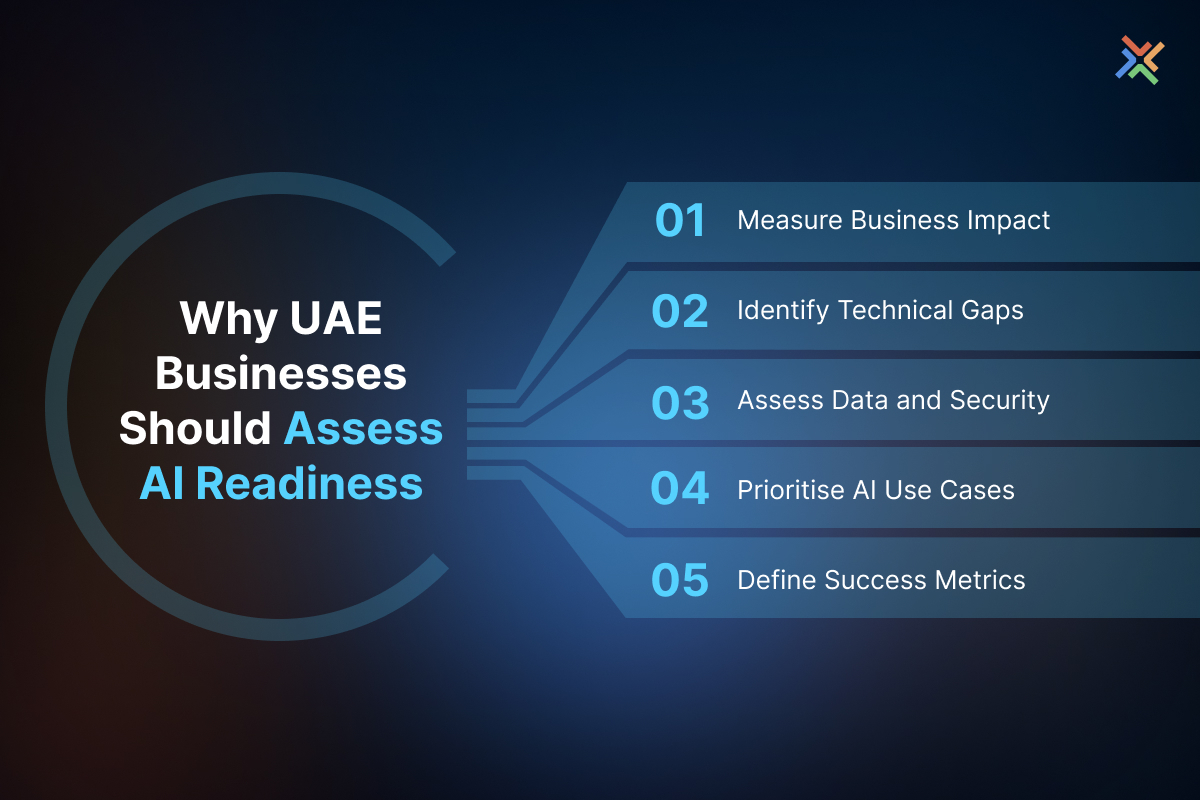
AI adoption is expanding, but adoption alone does not guarantee measurable business results.
McKinsey's State of AI 2025 survey found that 88% of respondents reported regular AI use in at least one business function, while only 39% reported enterprise-level earnings before interest and taxes (EBIT) impact. These findings concern survey respondents globally, not UAE businesses specifically.
They nevertheless illustrate an important distinction between using AI and translating it into enterprise-level financial impact.
An AI readiness assessment helps businesses investigate why an initiative might succeed or stall before implementation begins.
For UAE organisations, this includes evaluating data handling, existing enterprise systems, relevant regulatory obligations, language requirements and operational ownership.
A structured assessment can help businesses:
- Identify technical dependencies before development starts.
- Avoid investing in AI when conventional automation would be more appropriate.
- Establish measurable outcomes rather than relying on demonstrations.
- Identify privacy and security requirements early.
- Prioritise feasible opportunities instead of pursuing multiple disconnected pilots.
Businesses exploring AI development services UAE should establish these requirements before choosing a model, platform or development approach.
10 Areas to Evaluate Before Investing in AI
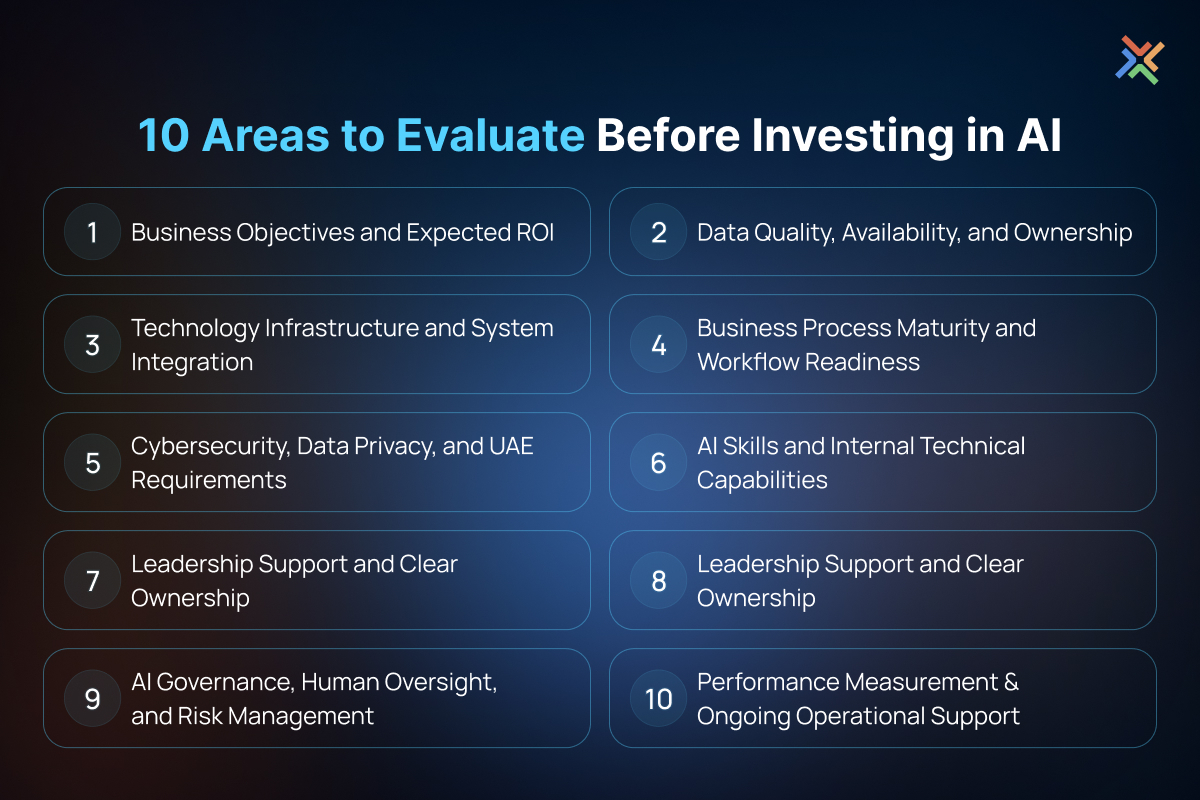
AI investment starts long before choosing a model or vendor. Your data, systems, people and processes must be ready to support it. Here are 10 areas UAE businesses should assess before investing in AI.
1. Business Objectives and Expected ROI
Start by defining the business problem. An AI project should address a measurable operational, customer or commercial need.
Statements such as "we want to introduce AI" are insufficient because they do not establish what the system must improve.
Instead, define the current situation, desired outcome, affected users and criteria for evaluating success.
Ask:
- Which business problem are we solving?
- How much time, money or operational capacity does it currently consume?
- What measurable improvement would justify the investment?
- Who owns the outcome?
- How will implementation and ongoing operating costs affect the business case?
For example, a UAE-based property company might evaluate AI-assisted enquiry classification to reduce manual routing and improve response times.
The assessment should establish a baseline for handling time, classification quality and escalation rates before development begins.
Warning sign: The project has a technology objective but no documented business outcome or accountable owner.
2. Data Quality, Availability and Ownership
AI systems depend on information that is relevant, accessible, sufficiently accurate and permitted for the intended use.
However, having large amounts of business data does not automatically make an organisation AI-ready.
Customer records may be fragmented across CRM platforms, spreadsheets, emails and other systems. Documents may contain outdated information, conflicting definitions or sensitive data that cannot be freely shared with an AI provider.
Evaluate:
- Where the required data resides.
- Whether the information is complete, current and representative.
- Who owns the data and authorises its use.
- Whether access permissions are documented.
- Whether historical examples cover normal cases and exceptions.
- How data quality will be tested and maintained.
For a customer support assistant, this could mean checking whether approved policies, product information and historical enquiries are accessible and consistent.
For a forecasting model, it may involve examining historical records, missing values and changes in how business metrics have been recorded.
Warning sign: The team depends on data it cannot reliably locate, validate, access or legally use.
3. Technology Infrastructure and System Integration
A prototype can work with uploaded documents while the production application needs to interact with CRM, ERP, HR, finance or document management systems.
The assessment must establish whether the existing technology environment can support the intended workflow.
Review:
- Available APIs and supported integration methods.
- uthentication and access permissions.
- Data transfer and synchronisation requirements
- Development, testing and production environments.
- Integration failure handling and recovery.
- Logging, monitoring and maintenance responsibilities.
- Hosting and deployment constraints.
Consider an AI assistant that drafts customer responses. If it cannot retrieve current order information from the relevant business system, its answers may be incomplete or outdated.
Similarly, an AI agent that updates customer records needs stricter controls than one that only recommends changes.
The appropriate architecture may involve a managed AI service, an application programming interface (API), retrieval-augmented generation (RAG), conventional automation or a combination of technologies. The assessment should determine the requirements before the architecture is finalised.
Warning sign: The proposed solution assumes access to business systems that their owners have not approved or validated.
4. Business Process Maturity and Workflow Readiness
AI works within a business process. If the process is inconsistent, undocumented or dependent on individual employees' informal knowledge, implementation becomes more difficult.
Map the current workflow, including inputs, outputs, decision points, handoffs, exceptions and accountability.
Ask whether employees follow a consistent procedure and whether the business understands how unusual cases are handled.
For example, automating invoice processing requires clarity about invoice validation, approval thresholds, disputed amounts, duplicate submissions and exceptions.
If different departments follow different approval procedures, introducing AI without resolving those differences can reproduce existing inefficiencies.
Process redesign or conventional automation may be more appropriate than AI when the workflow is predictable and rule-based.
Warning sign: Nobody can describe the complete workflow or explain how exceptions are resolved.
5. Cybersecurity, Data Privacy and UAE Requirements
Security and privacy must be considered before business data enters an AI application, particularly when the system processes customer information, employee records, financial details or confidential documents.
The UAE's Personal Data Protection Law, Federal Decree-Law No. 45 of 2021, establishes a framework for protecting personal data and regulating its processing. The official government overview also addresses data confidentiality and cross-border transfers. Applicability, exceptions and additional obligations must be evaluated for the organisation and use case.
Businesses should assess:
- Which information the AI system can access.
- Whether external providers process or retain submitted data.
- Where information is stored and processed.
- Whether provider terms permit data to be used for model training.
- How identity, authentication and access permissions are enforced.
- Whether sensitive information can be minimised or redacted.
- How outputs, system actions and security incidents are logged.
Organisations may also need to consider sector-specific obligations, contractual commitments and applicable free-zone requirements.
For additional guidance on responsible AI design, businesses can consult Digital Dubai's AI Ethics Principles and Guidelines.
Warning sign: Employees are entering confidential information into unapproved AI tools or nobody can explain how sensitive data is handled.
6. AI Skills and Internal Technical Capabilities
AI implementation requires more than access to developers or AI platforms. Businesses need people who understand the operational problem, can evaluate system performance and can maintain the solution after deployment.
Assess access to:
- Business and domain specialists.
- Software engineers and integration developers.
- Data engineering and analytics expertise.
- Cybersecurity and privacy specialists.
- AI evaluation and quality assurance capabilities.
- Operational support and maintenance resources.
The required skills depend on the use case. A simple AI-enabled workflow may need limited specialist involvement, whereas a custom predictive model or enterprise AI agent can require broader technical expertise.
Businesses without all the necessary capabilities internally can work with an external development partner while retaining ownership of business requirements, decisions and outcomes.
Warning sign: The organisation has a prototype but no clear plan for testing, maintaining or monitoring it.
7. Leadership Support and Clear Ownership
AI projects can stall when business leaders approve an initiative but do not assign responsibility for its results.
Every project should have an accountable business sponsor and clearly defined technical and operational owners.
Determine who will:
- Approve the use case and investment.
- Authorise access to relevant data.
- Validate business requirements.
- Approve security and privacy controls.
- Review performance and operational issues.
- Decide whether the project should expand, change or stop.
For a customer service application, the business owner might lead service quality and adoption, while the technical owner manages integration, monitoring and maintenance.
A UAE AI development partner can support implementation, but it should not replace the organisation's accountability for business decisions and operational outcomes.
Warning sign: Responsibility is spread across departments, with no individual accountable for the result.
8. Employee Adoption and Change Management
Even a technically capable AI solution can fail to deliver value if employees do not use it effectively.
Assess how the proposed system will affect daily work, decision-making, responsibilities and training requirements.
Involve representative users early and ask:
- Does the system solve a genuine operational problem?
- Will employees need to change established workflows?
- What training will they require?
- How will they report incorrect or unhelpful outputs?
- Who will review feedback and coordinate improvements?
- Does the application need Arabic, English or bilingual functionality?
Language requirements should reflect the actual users, documents and customer interactions involved.
For example, a customer-facing assistant serving both Arabic- and English-speaking customers should be evaluated separately across relevant languages and common interaction types. Strong performance in one language should not be assumed to establish equivalent performance in another.
Warning sign: The project assumes that employees will automatically adopt the system once it becomes available.
9. AI Governance, Human Oversight and Risk Management
AI governance establishes how a system should be evaluated, approved, monitored and controlled throughout its lifecycle.
The required controls depend on the consequences of an incorrect output or action.
An internal knowledge assistant may need approved source material, access restrictions, answer evaluation and a clear escalation path. An agent that changes financial or customer records may additionally require action-level permissions, explicit approval thresholds, audit trails and rollback procedures.
Assess:
- Which decisions AI can support or execute.
- Which actions require human approval.
- How uncertain or incorrect outputs are handled.
- How changes to models, prompts and integrations are approved.
- How performance and risks are monitored.
- Who can suspend the system when necessary.
The NIST AI Risk Management Framework offers a useful reference through its four functions: Govern, Map, Measure and Manage. It is voluntary guidance, not a UAE regulatory requirement.
Warning sign: The organisation cannot explain who is accountable when the AI system makes an incorrect recommendation or takes an unintended action.
10. Performance Measurement and Ongoing Operational Support
Before approving a pilot, define how the business will determine whether the solution works.
A successful demonstration is not enough. The system must perform against agreed criteria using representative data and realistic operating conditions.
Choose metrics relevant to the use case, such as:
- Output accuracy or task completion quality.
- Manual handling time.
- Exception and escalation rates.
- Human review effort.
- System availability and response latency.
- Cost per task or interaction.
- Employee adoption and customer outcomes.
For example, an AI document processing pilot should be evaluated on extraction quality, exception handling and review effort—not simply on how quickly it processes a sample document.
The assessment should also consider implementation, integration, hosting, model usage, monitoring, maintenance, training and human review costs.
Assign responsibility for ongoing support and define how performance issues will be detected and addressed.
Warning sign: Success is defined as launching the application, with no baseline, acceptance criteria or post-launch ownership.
How to Interpret Your AI Readiness Results
Once the ten areas have been evaluated, classify the proposed use case according to its readiness for the next investment decision.
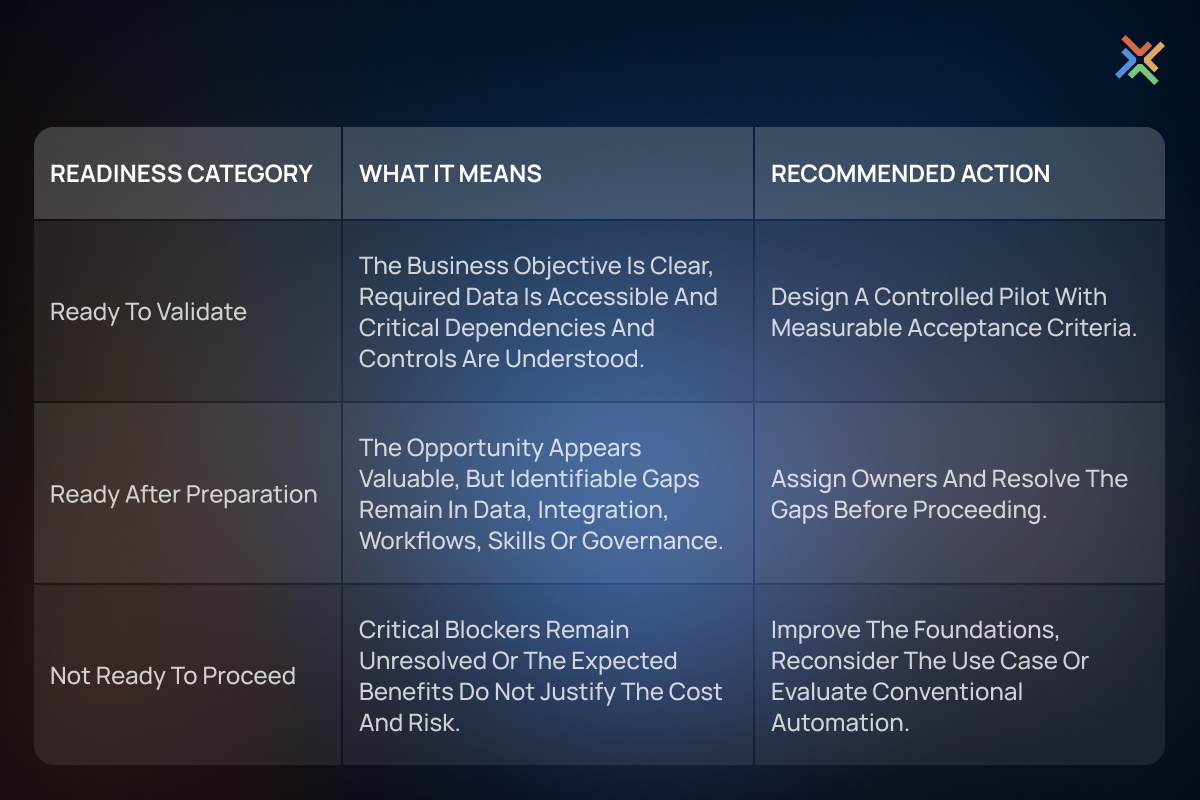
A numerical score can help compare assessment dimensions, but it should not be treated as a recognised industry certification.
A high average score cannot compensate for a critical unresolved risk. Missing data permissions, inadequate access controls or unclear accountability may prevent a project from proceeding regardless of its strengths elsewhere.
What Happens After an AI Readiness Assessment?
The assessment should lead to a practical implementation decision rather than another planning document. The next steps typically include:
- Prioritise opportunities: Compare potential use cases by business impact, feasibility, cost drivers and risk.
- Resolve critical gaps: Improve data quality, clarify workflows, validate integrations or establish required controls.
- Define the pilot: Specify its scope, users, permitted data, success metrics and acceptance criteria.
- Validate performance: Test the solution against representative cases, including exceptions and failure scenarios.
- Make an investment decision: Proceed, revise the approach, extend preparation or stop based on the evidence.
- Plan production deployment: Establish security controls, monitoring, support and operational ownership before scaling.
How WDCS Technology UAE Can Support Your AI Initiative
WDCS Technology UAE provides AI-related services covering generative AI, machine learning, natural language processing, AI chatbot development, business intelligence, robotic process automation and other AI applications.
Its published development process includes requirements assessment, project scoping, technology selection, data preparation, model assessment, system integration, testing, deployment and maintenance. These capabilities are relevant when a business moves from assessing an AI opportunity to defining and implementing a solution.
For businesses evaluating an AI investment, the starting point should be the operational problem, the information available, the systems involved and the outcome that needs to improve.
The appropriate next step may be a limited proof of concept, additional data preparation, process redesign or a more comprehensive development initiative.
Plan Your AI Initiative With WDCS Technology UAE
The right AI investment starts with understanding what your business needs to improve and whether the necessary foundations are in place. An AI readiness assessment helps expose the gaps, establish measurable objectives and determine the next practical step.
Discuss your AI requirements with WDCS Technology UAE to explore the appropriate strategy, technical approach and implementation path for your business. Contact WDCS Technology UAE to discuss your AI development requirements.
Future-Proof AI Investment for your UAE Business
Build on the right foundations before investing in AI. WDCS Technology UAE helps businesses evaluate use cases, data, technology and integration requirements to move from AI ideas to practical implementation.