AI Governance Checklist UAE: 12 Controls Before You Deploy an AI Agent
November 24, 2026

Ayush Kanodia
Introduction:
An AI agent that answers questions is one thing. An AI agent that accesses customer records, updates an ERP system, processes invoices or initiates business actions introduces a different level of operational risk.
For UAE businesses, successful AI deployment requires more than selecting a capable model. Organisations must establish who owns the agent, what information it can access, which tools it can use, when human approval is required and how its actions will be monitored.
These controls matter across customer service, finance, procurement, HR, legal operations and other enterprise workflows. They become especially important when agents handle sensitive personal data, interact with external systems or make decisions that can materially affect customers and employees.
This AI governance checklist for UAE companies provides 12 practical controls to assess before moving an AI agent into production. Each control explains what to implement, how to verify it and what evidence to retain. Working with an experienced AI development company UAE can help businesses integrate these controls into their AI architecture and deployment process.
The checklist is an operational starting point, not a guarantee of regulatory compliance. Applicable obligations depend on the organisation, its activities, the data it processes and the jurisdictions in which it operates.
Why AI Agents Need Stronger Governance Before Production
Traditional chatbots primarily generate responses. AI agents may also plan tasks, retrieve information, call APIs, modify records and trigger workflows. Depending on their design, they can carry out multiple steps with limited human intervention.
That creates additional risks. An agent could retrieve information beyond a user's permissions, act on malicious instructions embedded in a document, update an incorrect record or repeat an action because a workflow failed to confirm its previous result.
Consider a customer service agent that can review an order and draft a refund recommendation. Allowing it to issue refunds automatically introduces a separate financial control requirement. The organisation must define transaction limits, approval thresholds, identity checks and a way to reverse or contain incorrect actions.
Governance should therefore be part of the system architecture, access model, testing process and operating procedures—not a policy document added after development.
UAE AI Governance Requirements Businesses Should Understand
The UAE regulatory landscape requires a context-specific assessment rather than a single checklist applied identically to every business.
The UAE Government's Charter for the Development and Use of Artificial Intelligence sets out national principles for responsible AI, including privacy, data security and alignment with existing legislation. The charter provides important policy context, but it should not be treated as a substitute for identifying binding legal requirements.
The UAE's Personal Data Protection Law Federal Decree-Law No. 45 of 2021 addresses the processing and protection of personal data, including relevant obligations around data security and cross-border transfers. Organisations should assess its scope and applicable exceptions against their particular processing activities. Separate data-protection regimes may apply in financial free zones, including the DIFC and ADGM.
Additional requirements may apply to licensed financial institutions. For example, the Central Bank of the UAE's rulebook addresses AI governance, accountability, validation, monitoring and human oversight for relevant regulated institutions. These provisions should not be presented as universal rules for every UAE company.
For broader risk management, the NIST AI Risk Management Framework offers voluntary guidance organised around governing, mapping, measuring and managing AI risk. It can help teams structure their governance programme, but adopting it does not automatically establish legal compliance.
The 12-Point AI Governance Checklist for UAE Companies
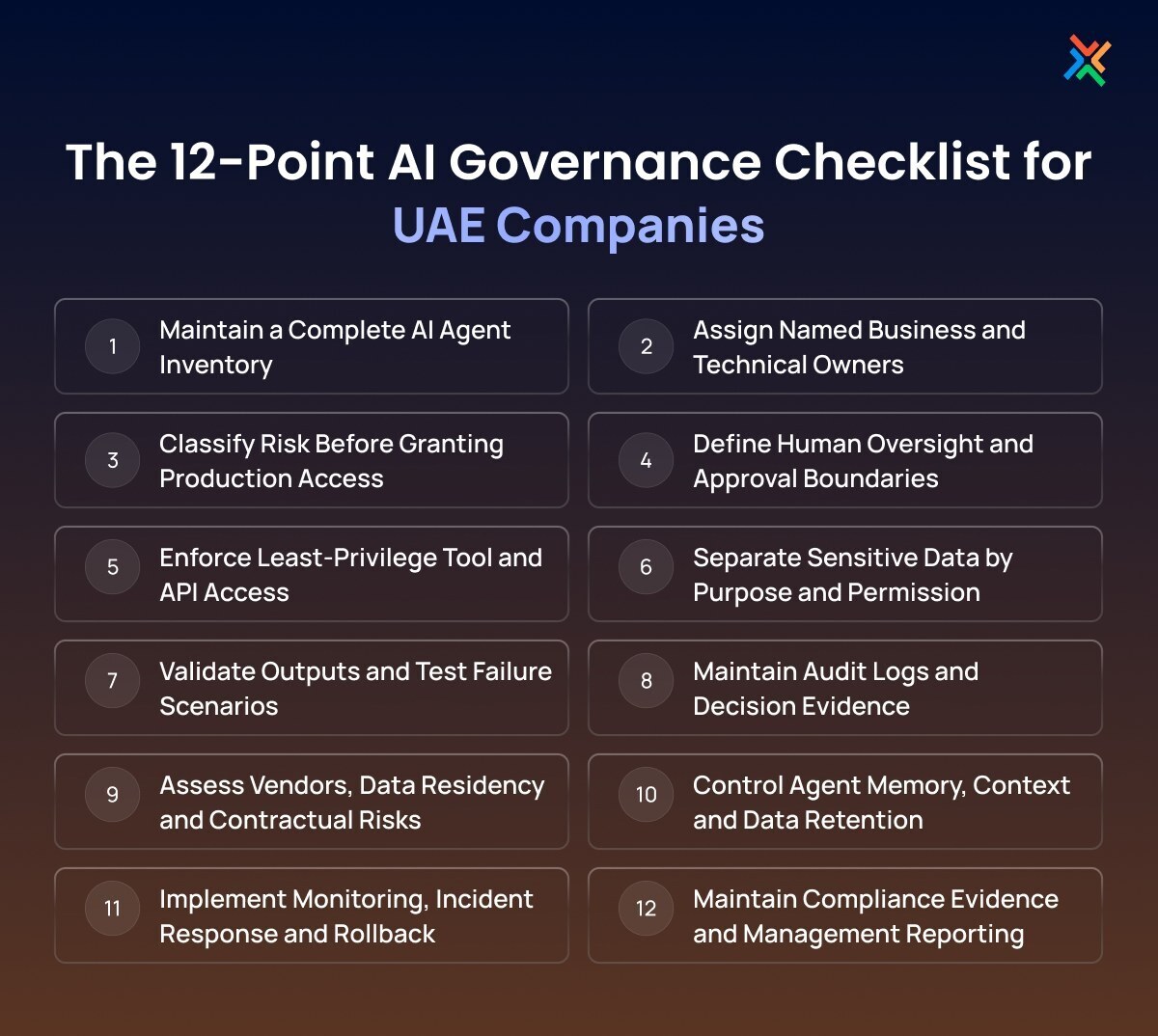
Use the following controls to assess an enterprise AI agent before production. Assign an owner to each control and define what constitutes acceptable evidence for your organisation.
1. Maintain a Complete AI Agent Inventory
What to implement: Create a central register of AI agents developed internally, purchased from vendors or embedded in business applications. Record each agent's purpose, model and version, business owner, technical owner, data sources, connected tools, deployment environment, risk classification and review date.
Why it matters: Unregistered agents can introduce unmanaged access to company data and systems. A central inventory helps security, compliance and operations teams understand where AI is used and which deployments require closer oversight.
How to verify: Compare the inventory against cloud environments, API gateways, software procurement records and business applications. Confirm that each production agent has an identifiable owner and documented purpose.
Evidence to retain: Agent inventory, system architecture, model and version records, tool integrations, risk classification and approval history.
2. Assign Named Business and Technical Owners
What to implement: Assign a business owner accountable for the workflow and a technical owner responsible for system operation. Identify the people responsible for security review, privacy assessment, incident handling and go-live approval.
Why it matters: AI risks can fall between teams when nobody has clear authority to make decisions or suspend a deployment. Ownership should remain clear even when a third-party provider supplies the model or agent framework.
How to verify: Ask who can approve a new capability, accept a documented exception, investigate an incident and disable the agent. If these responsibilities are unclear, the governance model is incomplete.
Evidence to retain: Responsibility matrix, approval records, escalation contacts, operating procedures and documented acceptance of residual risks.
3. Classify Risk Before Granting Production Access
What to implement: Assess the agent according to data sensitivity, degree of autonomy, affected individuals, potential financial or operational impact, reversibility and applicable sectoral obligations.
A read-only internal knowledge assistant may require different controls from an agent that approves invoices, changes employee records or makes customer-impacting decisions.
Why it matters: Applying identical approval requirements to every agent can leave high-impact systems undercontrolled while creating unnecessary friction for low-risk tasks.
How to verify: Define risk categories and approval thresholds. Test whether higher-risk use cases trigger additional security, privacy, legal, compliance or management reviews before production access is granted.
Evidence to retain: Risk assessment, use-case rationale, impact analysis, review sign-offs, exceptions and conditions attached to approval.
4. Define Human Oversight and Approval Boundaries
What to implement: Document which actions an agent may perform autonomously, which require approval and which must remain under human control. Use transaction limits, dual approval or escalation for consequential actions where appropriate.
Why it matters: Human oversight is ineffective if employees cannot understand what they are approving or intervene before an irreversible action occurs.
How to verify: Test approval gates using scenarios such as an unusually large refund, a supplier bank-detail change or a customer-facing commitment outside the agent's authority. Confirm that the agent cannot bypass the required approval path.
Evidence to retain: Approval matrix, workflow rules, test results, approval and rejection logs, override records and escalation procedures.
5. Enforce Least-Privilege Tool and API Access
What to implement: Give each agent access only to the tools, records and operations required for its assigned task. Use scoped credentials, separate service identities and restricted API permissions. Distinguish read-only access from write-capable operations.
Why it matters: A model may produce an unexpected instruction or be manipulated by malicious input. Limiting its permissions reduces the damage it can cause.
How to verify: Attempt unauthorised operations using test accounts and controlled scenarios. Confirm that access restrictions are enforced by the connected system—not merely described in a prompt.
For example, an invoice agent may read purchase orders and draft payment instructions without having permission to release funds.
Evidence to retain: Access-control policies, service-account permissions, API scopes, secrets-management configuration, access-test results and periodic access reviews.
6. Separate Sensitive Data by Purpose and Permission
What to implement: Map the data an agent can retrieve, process, store and transmit. Apply existing user permissions to retrieval systems and separate sensitive information by role, purpose and business function. Minimise personal data sent to models and external providers.
Why it matters: An agent can expose information even when its underlying data source is correctly secured. Retrieval systems, shared context and broad service-account permissions may allow the agent to surface information that the requesting user should not see.
How to verify: Test cross-department access using accounts with different permissions. Check whether the agent can retrieve HR, legal, finance or customer information outside the authorised scope. Review whether sensitive data appears in prompts, logs, memory or vendor systems unnecessarily.
Evidence to retain: Data-flow diagrams, data classification, access policies, privacy assessments, retrieval-permission tests and records of relevant data-processing decisions.
7. Validate Outputs and Test Failure Scenarios
What to implement: Establish measurable acceptance criteria for accuracy, completeness, retrieval quality, tool selection and workflow outcomes. Test normal use as well as malformed inputs, missing information, conflicting instructions, prompt injection and unauthorised tool requests.
Why it matters: A convincing response does not prove that an agent's reasoning, retrieved evidence or actions are correct. Failures can occur at the model, retrieval, integration or workflow level.
How to verify: Run a documented evaluation set before release. Include adversarial tests, permission-boundary tests and end-to-end workflow scenarios. Confirm that the agent can abstain, request clarification or escalate when evidence is insufficient.
Evidence to retain: Evaluation dataset, test cases, acceptance thresholds, results, identified defects, remediation records and release approval.
8. Maintain Audit Logs and Decision Evidence
What to implement: Record the agent identity, triggering event, relevant input and output, retrieved sources, tool calls, approval decisions, execution results, timestamps and errors. Where appropriate, record model versions and policy checks.
Protect logs against unauthorised alteration and access. Avoid retaining unnecessary personal or confidential information and define appropriate retention periods.
Why it matters: Without traceability, an organisation may struggle to establish what an agent did, why a workflow was triggered or where a failure occurred.
How to verify: Reconstruct a completed test transaction from its logs. Confirm that the record identifies the initiating event, relevant actions, approvals and final outcome without relying on an employee's memory.
Evidence to retain: Logging configuration, sample event records, access controls, retention schedules, audit reports and incident reconstruction results.
9. Assess Vendors, Data Residency and Contractual Risks
What to implement: Review the model provider, hosting arrangements, agent platform, subprocessors and connected services. Examine data retention, use of submitted data for model training, processing locations, security measures, incident notification, subcontracting and exit provisions.
Why it matters: An organisation's governance responsibilities do not disappear when it uses an external model or managed AI platform. Vendor terms and technical configurations can affect confidentiality, data transfers, continuity and the ability to investigate incidents.
How to verify: Compare provider documentation and contractual commitments with the actual service configuration. Determine where relevant data is processed, which parties can access it and how data can be retrieved or deleted when the relationship ends.
Evidence to retain: Vendor due-diligence assessment, contracts, data-processing terms, security documentation, subprocessor details and approved configuration records.
10. Control Agent Memory, Context and Data Retention
What to implement: Define what the agent may retain between interactions, how long it may retain it, who can access stored context and when information must be deleted. Separate session context from persistent memory and shared memory between agents.
Why it matters: Persistent context can improve continuity, but it can also retain outdated instructions, confidential information or data that should not be available in a later interaction.
How to verify: Test memory isolation between users and sessions. Confirm that deletion requests and retention policies work across relevant storage layers, including conversation histories, vector databases, caches and connected systems where applicable.
Evidence to retain: Memory design, retention and deletion rules, test results, access policies, data lifecycle records and documented exceptions.
11. Implement Monitoring, Incident Response and Rollback
What to implement: Monitor operational performance, error rates, policy violations, unexpected tool calls, latency and usage costs. Set thresholds that trigger investigation. Define incident ownership, containment steps, fallback workflows and a tested method to disable or revert the agent.
Why it matters: A system that passes pre-deployment testing can still fail after model changes, data changes, integration updates or shifts in user behaviour. Monitoring must continue after release.
How to verify: Simulate an agent making unauthorised requests, repeatedly failing a workflow or producing a material error. Confirm that alerts reach the responsible team and that the agent can be contained without creating a larger operational disruption.
Evidence to retain: Monitoring dashboards, alert rules, incident playbooks, exercise results, rollback tests, incident reports and remediation records.
12. Maintain Compliance Evidence and Management Reporting
What to implement: Maintain a consolidated evidence pack covering the agent's purpose, risk assessment, data flows, access controls, evaluation results, vendor reviews, approvals, exceptions and ongoing monitoring.
Map the evidence to the legal and sector-specific obligations that actually apply to the organisation. Establish reporting routes for material risks and incidents.
Why it matters: Governance must be demonstrable, not merely documented in a high-level policy. Management needs enough evidence to decide whether risks are acceptable and whether controls remain effective.
How to verify: Conduct a deployment-readiness review with business, technical, security and compliance stakeholders. Check whether every required control has an owner, supporting evidence and a clear status.
Evidence to retain: Governance register, risk-treatment plan, management reports, review minutes, approved exceptions, remediation plans and periodic reassessment records.
How to Decide Whether an AI Agent Is Ready for Deployment
Use a documented release decision rather than relying on a general statement that the agent has been tested.
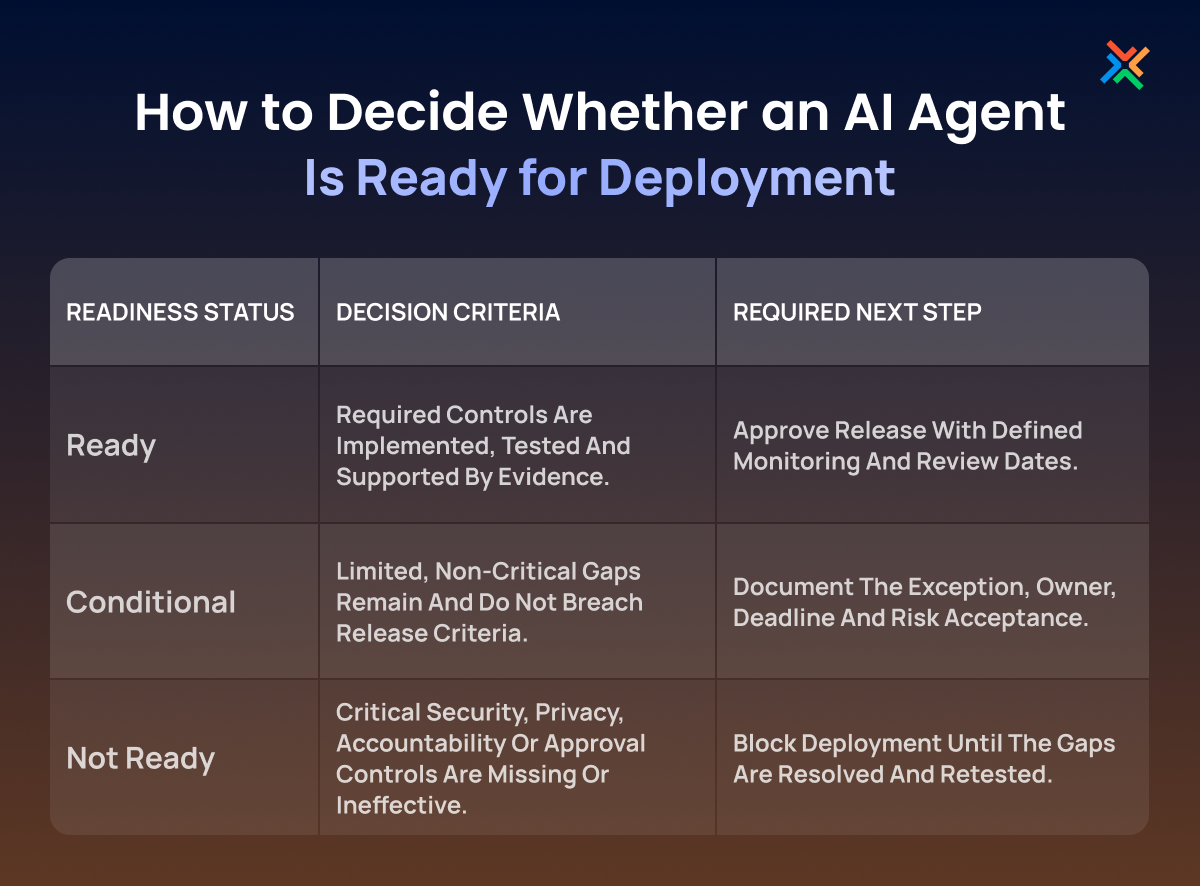
The organisation should define what qualifies as a critical gap before the review begins. A missing access restriction or ineffective approval gate should not be waived simply because the agent performs well in a demonstration.
The NIST AI Risk Management Framework can help structure this lifecycle approach through its Govern, Map, Measure and Manage functions. It is voluntary guidance and organisations should supplement it with applicable legal, regulatory and internal requirements.
A checklist supports a governance decision; it does not guarantee compliance or eliminate residual risk.
Implementing AI Governance With WDCS Technology UAE
Governance becomes effective when its requirements are reflected in the actual AI solution. That means translating business policies into system permissions, data boundaries, workflow approvals, evaluation tests, logging and ongoing monitoring.
WDCS Technology UAE provides AI development services UAE, covering AI strategy, model assessment, data preparation, system integration, testing, deployment and maintenance. These capabilities are relevant when an organisation needs to turn its governance requirements into an implementable technical design.
Planning an AI agent deployment? Connect now to discuss your business workflow with WDCS Technology UAE to identify the required integrations, access boundaries, testing approach and operational controls before production rollout.
Prepare Your AI Agent for Production With the Right Controls
An AI agent must prove more than it works in a demo. Its permissions, data access, integrations and failure controls must be tested before production. WDCS Technology UAE helps businesses turn AI use cases into secure, deployment-ready solutions. Planning an AI agent? Discuss your requirements with WDCS Technology UAE before going live.