AI Agents vs Chatbots vs RPA: Which Should a UAE Business Build First?
November 19, 2026

Ayush Kanodia
Businesses across the UAE are adopting automation to improve customer experiences, reduce repetitive work, and streamline operations. As an AI development company UAE, WDCS Technology helps businesses evaluate technologies such as AI agents, AI-powered chatbots, and robotic process automation (RPA) based on their operational needs.
Each technology serves a different purpose. Chatbots respond to customer enquiries, RPA transfers information between business applications, and AI agents interpret requests, make decisions, and coordinate multi-step workflows.
Choosing the right solution affects implementation complexity, integration requirements, operational costs, security, and human oversight. For UAE businesses, the best starting point depends on the problem to solve. This guide compares all three technologies, explores practical industry applications, and explains how to choose the right automation approach.
What Are AI Agents, Chatbots, and RPA?
Although these technologies are frequently discussed together, they serve different operational purposes. Understanding their underlying mechanisms helps businesses avoid investing in a solution that does not address their actual requirements.
1. AI Chatbots: Automating Customer and Employee Conversations
A chatbot is a software application that interacts with users through text or voice. It receives questions, interprets user input, and generates responses based on predefined conversation flows, a knowledge base, or an AI model.
Traditional chatbots rely on predefined rules, menus, and decision trees. Modern AI chatbots use natural language processing (NLP) and large language models (LLMs) to understand more flexible queries and maintain conversational context.
For example, a customer visiting a Dubai-based real estate company's website might ask about available properties, rental requirements, payment options, or viewing appointments.
An AI chatbot can:
- Answer questions using approved property information.
- Recommend relevant listings based on customer preferences.
- Collect contact details and property requirements.
- Qualify enquiries based on predefined criteria.
- Connect users with sales representatives.
- Retrieve information from integrated CRM systems.
Where chatbots work best: Customer support, website lead generation, appointment scheduling, product recommendations, and employee self-service.
However, a chatbot does not automatically become an autonomous workflow system simply because it uses an LLM. Its ability to perform actions depends on the tools, integrations, permissions, and workflow logic built around it.
2. Robotic Process Automation (RPA): Automating Repetitive Business Tasks
Robotic Process Automation uses software bots to execute repetitive, rule-based tasks across business applications.
Instead of interpreting a business objective and deciding what to do, an RPA bot follows a predefined sequence of instructions.
For example, a finance team may receive invoices, verify specific fields, enter information into an accounting application, and update internal records.
An RPA workflow can:
- Extract information from structured documents.
- Copy data between business applications.
- Populate forms and spreadsheets
- Generate scheduled reports.
- Update records in ERP systems.
- Process repetitive administrative transactions.
RPA can interact with applications through user interfaces or APIs, depending on the available integration options. This makes it particularly useful when businesses need to automate repetitive processes involving existing systems.
Where RPA works best: Invoice processing, payroll administration, data entry, report generation, inventory updates, and other predictable workflows.
Its main limitation is dependence on predefined rules. If an application interface changes, an input format differs, or an unexpected exception occurs, the bot may require updated instructions or human intervention.
3. AI Agents: Automating Multi-Step Workflows With Contextual Decision-Making
AI agents are software systems designed to pursue defined objectives by interpreting information, selecting actions, and interacting with connected tools or applications.
Unlike conventional chatbots that primarily handle conversations, AI agents can execute multi-step tasks within an assigned scope of authority.
An AI agent may use:
- Large language models for reasoning and language understanding.
- Retrieval-augmented generation (RAG) to access relevant business information.
- APIs and external tools to interact with applications.
- Memory or workflow state to maintain task context.
- Orchestration logic to coordinate multiple steps.
- Guardrails and permission controls to restrict actions.
- Human approval mechanisms for sensitive operations.
Consider a UAE logistics company receiving a shipment enquiry involving an unexpected delivery delay.
An AI agent could retrieve shipment information, review relevant documentation, identify the likely issue, check available delivery options, and prepare a proposed response.
Depending on its permissions, it could also update a system or initiate an approved workflow. Decisions involving financial commitments or sensitive operational changes could remain subject to human approval.
Where AI agents work best: Complex customer service workflows, document-intensive operations, internal knowledge management, multi-system coordination, and processes requiring contextual interpretation.
The important distinction is that an AI agent is not simply a chatbot with a more sophisticated interface. Its value comes from its ability to coordinate actions toward a defined business objective.
AI Agents vs Chatbots vs RPA: Key Differences
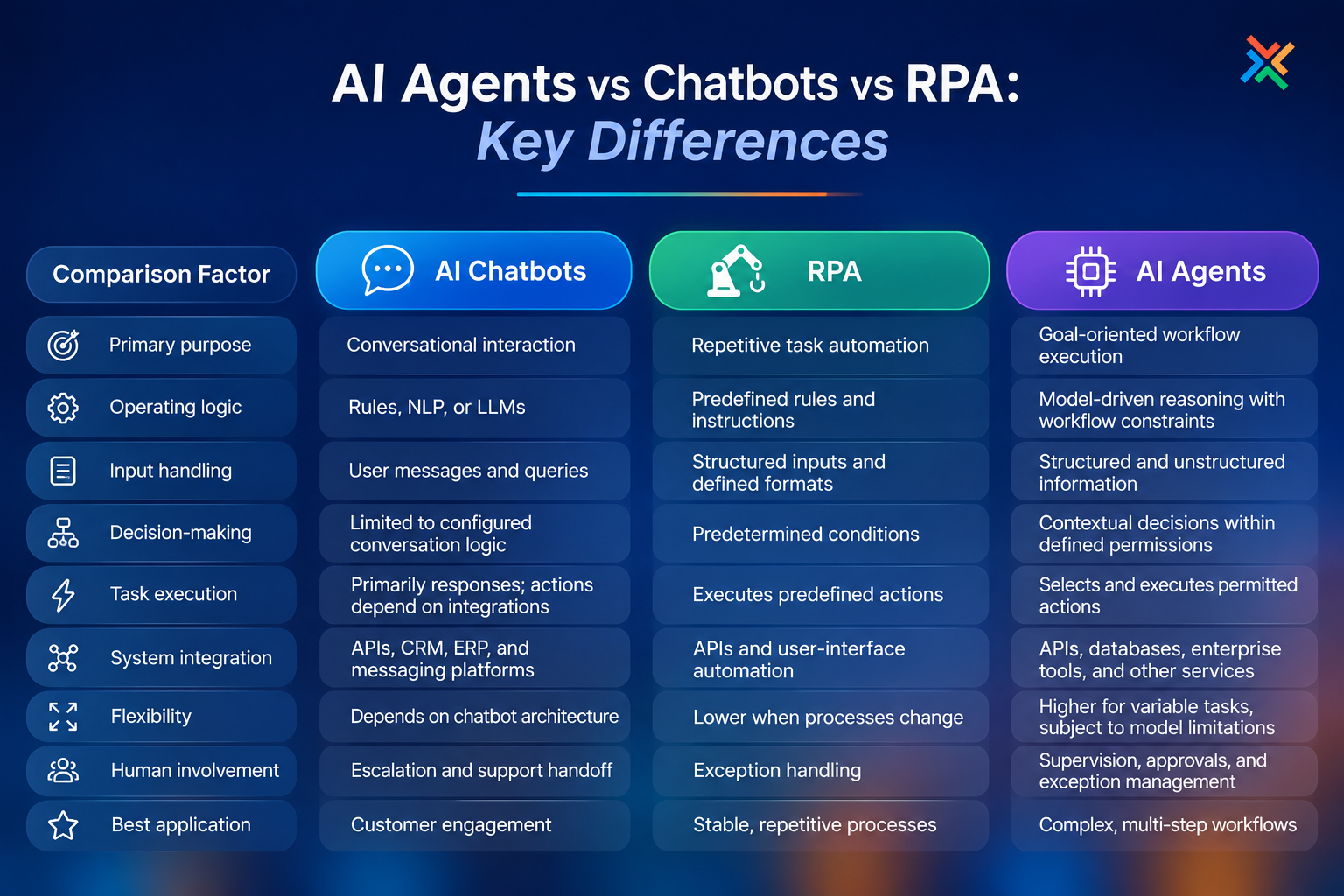
The most useful way to compare these technologies is to examine how they make decisions, interact with systems, handle changing inputs, and execute business processes.
How Their Decision-Making Mechanisms Differ
The most important difference is how each technology determines its next action.
A conventional chatbot follows a conversation flow or uses an AI model to generate a response. It may retrieve information or initiate an integrated action, but its scope depends on its configuration.
RPA follows explicit instructions. If a task requires opening an application, extracting a field, and updating another system, the bot performs those steps according to its programmed logic.
An AI agent can interpret a goal and select from available tools to determine how to complete the task. It may adjust its next step based on retrieved information or the outcome of an earlier action.
This flexibility introduces additional complexity. AI agents can produce incorrect outputs or select inappropriate actions if their instructions, data access, and execution boundaries are poorly designed.
The distinction is therefore not that agents are always better. It is that they are designed for a different class of problems.
When Should UAE Businesses Choose Each Technology?
The right technology depends on the nature of the workflow, the expected outcome, and the degree of decision-making involved.
Choose an AI Chatbot for Customer Engagement and Lead Generation
For businesses receiving repeated enquiries across websites, social channels, and customer service channels, an AI chatbot can be a practical starting point.
Consider a UAE property management company receiving enquiries about apartments, rental agreements, availability, and property viewings.
A chatbot can answer common questions, collect customer preferences, identify relevant properties, and capture contact information for the sales team.
Its effectiveness can be measured through:
- Number of enquiries handled.
- Lead qualification completion rate.
- Customer response time.
- Successful human handoffs.
- Enquiry-to-meeting conversion rate.
For B2B companies, chatbots can also qualify website visitors by collecting information about company size, project requirements, technology preferences, and implementation timelines.
However, businesses should avoid treating every chatbot interaction as a qualified lead. Lead scoring, CRM integration, and appropriate routing are necessary to turn conversations into meaningful sales opportunities.
Choose RPA for Stable, High-Volume Administrative Work
RPA is a strong option when employees repeatedly perform the same actions across business applications.
For example, a UAE accounting department may process supplier invoices from multiple vendors.
If the documents follow consistent formats and the processing rules are clearly defined, RPA can automate activities such as:
- Retrieving invoice files.
- Extracting predefined fields.
- Entering information into accounting software.
- Updating payment records.
- Generating transaction reports.
The key requirement is process consistency.
If invoice layouts vary significantly, contain handwritten information, or require interpreting complex descriptions, conventional RPA may struggle without additional document-processing capabilities.
In these situations, combining intelligent document processing with RPA can provide a more suitable architecture.
RPA handles the predictable execution steps, while AI-based extraction helps interpret variable document inputs.
Choose AI Agents for Complex, Multi-System Business Workflows
AI agents become relevant when completing a task requires more than following a fixed sequence.
Consider a UAE enterprise receiving a complex customer service request involving an order discrepancy.
The workflow may require checking order information, reviewing customer correspondence, retrieving delivery records, comparing internal policies, and determining the appropriate resolution.
An enterprise AI agent can coordinate these activities using connected systems and defined business rules.
A controlled implementation might:
- Interpret the customer's request.
- Retrieve the relevant order and delivery records.
- Compare the available information.
- Identify missing details or inconsistencies.
- Recommend an appropriate resolution.
- Request human approval where required.
- Execute approved updates and record the outcome.
This approach is particularly useful when information is spread across different systems and the correct next step depends on the context.
However, an AI agent should not receive unrestricted access to enterprise applications. Financial transactions, customer account changes, and other sensitive actions should have appropriate authorization and approval controls.
How to Choose Between Chatbot, RPA or AI Agent First?
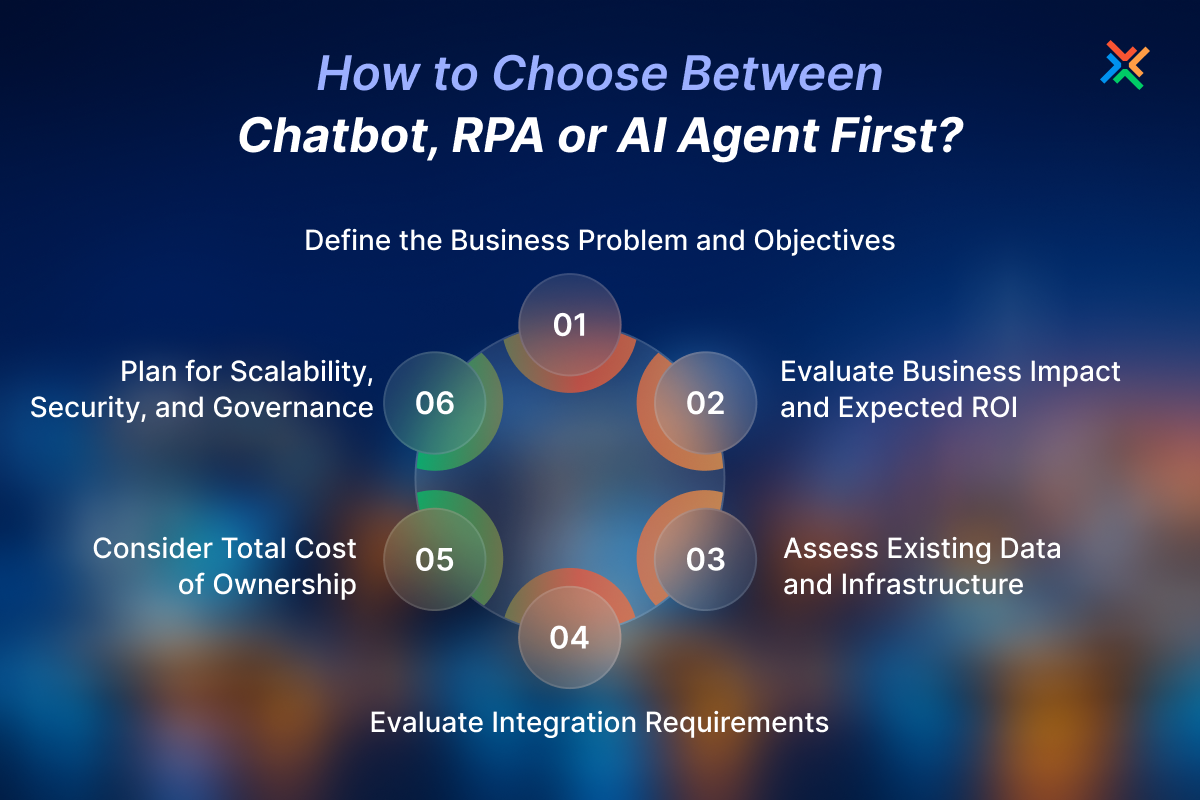
Before selecting a development approach, businesses should evaluate their operational requirements rather than starting with a preferred technology. The following decision framework can help.
- AI Chatbot: Responding to repetitive customer enquiries.
- AI Chatbot: Capturing and qualifying website leads.
- RPA: Automating repetitive data entry.
- RPA: Processing predictable administrative workflows.
- AI-Assisted Document Processing: Interpreting documents with variable formats.
- AI Agent: Coordinating multiple applications and workflows.
- AI Agent: Handling complex requests that require contextual decisions.
- Chatbot with RPA or AI Agent Integration: Combining conversations with backend task execution.
Evaluate Business Impact Before Technology
Start by identifying the business problem and defining a measurable outcome.
For example:
- If sales teams spend considerable time responding to repetitive enquiries, measure the opportunity to reduce response delays and improve lead qualification.
- If finance employees manually transfer information between applications, measure processing time, error rates, and exception frequency.
- If operations teams coordinate multiple systems to resolve complex requests, measure workflow completion time, escalation rates, and manual intervention.
The technology should address the identified bottleneck.
Assess Existing Data and Infrastructure
Each solution has different technical dependencies.
Chatbots require an accurate knowledge source, conversational design, and relevant integrations.
RPA requires documented processes, stable application interfaces, and clearly defined business rules.
AI agents require additional architectural considerations, including model selection, data access, tool integrations, orchestration, permission boundaries, and evaluation mechanisms.
Businesses should also assess whether their existing CRM, ERP, databases, and internal applications provide APIs or require alternative integration methods.
Consider Total Cost of Ownership
Implementation costs are not limited to initial development.
A chatbot may require ongoing knowledge-base updates, model usage, integration maintenance, and conversation monitoring.
RPA may involve licensing, bot maintenance, process changes, exception handling, and infrastructure costs.
AI agents may introduce additional expenses related to model inference, retrieval infrastructure, tool orchestration, security controls, evaluation, and human oversight.
There is no universally cheapest option. A simple RPA workflow can be more economical than introducing an LLM into a deterministic process, while an agent may offer greater value when multiple manual steps require contextual interpretation.
Businesses should compare the total cost of ownership against measurable operational improvements.
UAE-Specific Considerations for AI and Automation Development
Selecting an automation technology in the UAE requires attention to more than technical capabilities. Language requirements, regulatory obligations, data management, and industry-specific workflows can influence the architecture.
Arabic and English Language Requirements
UAE businesses often serve customers and employees with different language preferences.
A chatbot or AI agent intended for multilingual interactions should be evaluated for its ability to understand and respond appropriately in English and Arabic.
Testing should include:
- Modern Standard Arabic and relevant regional language variations.
- English and Arabic code-switching.
- Arabic text in different formats.
- Names, addresses, dates, and currency references.
- Multilingual documents and customer enquiries.
- Consistency across text and voice interactions.
Language support should be validated against real business inputs rather than assumed from a model's advertised capabilities.
Data Privacy and Regulatory Requirements
Automation systems may process customer records, employee information, financial documents, and other sensitive business data.
The UAE's Federal Decree-Law No. 45 of 2021 on the Protection of Personal Data establishes requirements concerning personal data processing, protection, and cross-border data transfers, subject to its scope and applicable exceptions.
Businesses should assess the relevant legal regime for their operations, including whether separate requirements apply in financial free zones such as DIFC or ADGM.
Before deploying an AI chatbot, RPA bot, or AI agent, consider:
- What information the system can access.
- Whether personal data is necessary for the workflow.
- Where information is stored and processed.
- Which third-party models or services receive data.
- How long records and interaction logs are retained.
- Whether access and processing activities are auditable.
- How data deletion and access requests are handled.
Legal and compliance teams should review the specific requirements applicable to the organization and deployment.
Security and Human Oversight
Security becomes particularly important when automation moves from providing information to executing business actions.
A chatbot that answers a general enquiry has a different risk profile from an AI agent that can access customer records or initiate transactions.
A controlled architecture should include role-based access, authentication, least-privilege permissions, activity logging, input validation, and defined approval requirements.
For AI agents, additional safeguards should address prompt injection, unauthorized tool calls, inaccurate outputs, and unintended actions.
The NIST AI Risk Management Framework and its Generative AI Profile provide useful references for organizations developing AI governance and risk management practices.
How AI Agents, Chatbots and RPA Work Together
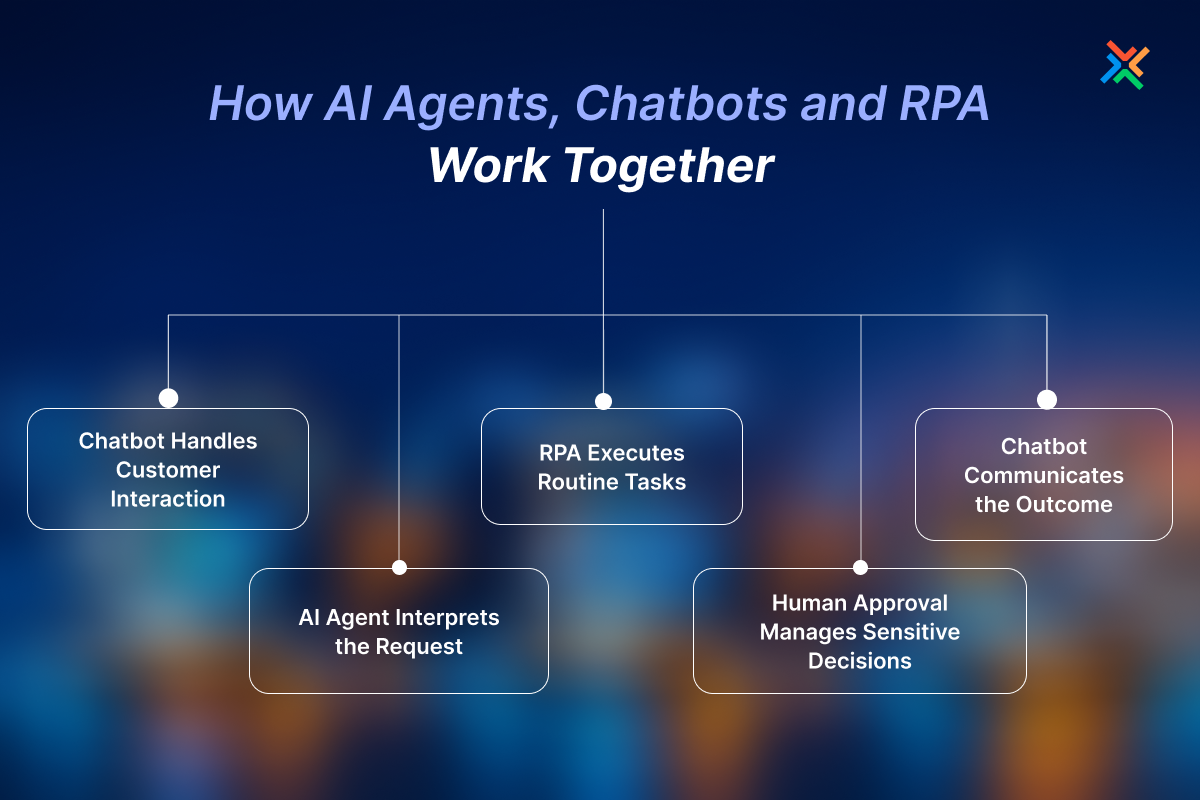
Businesses do not always need to select only one technology. In many cases, the strongest architecture combines their capabilities. Consider a UAE-based retail business handling online orders, delivery enquiries, and customer complaints. A combined workflow could operate as follows:
Step 1: Chatbot handles the interaction
The customer contacts the business through its website or another supported channel. The chatbot identifies the enquiry, collects relevant information, and authenticates the customer where required.
Step 2: AI agent interprets the request
If the request involves a delivery discrepancy, the AI agent retrieves the relevant information from connected systems, evaluates the available details, and identifies the appropriate next step.
Step 3: RPA executes predictable tasks
An RPA bot can perform predefined actions in a legacy application, such as updating a record or transferring approved information between systems.
Step 4: Human approval handles sensitive decisions
If the requested resolution involves a refund, account adjustment, or policy exception, the workflow can route the recommendation to an authorized employee.
Step 5: The customer receives an update
The chatbot communicates the approved outcome and provides the customer with the relevant status information.
This architecture separates conversational interaction, contextual decision-making, and deterministic execution. It also makes the system easier to govern because each component has a clearly defined responsibility.
Which Technology Should a UAE Business Build First?
There is no universal winner in the AI agents vs chatbots vs RPA comparison. The right starting point depends on the type of work your business needs to automate.
Choose a chatbot when customer conversations, enquiry handling, and lead qualification are the immediate priorities.
Choose RPA when employees spend significant time performing predictable, repetitive tasks across existing applications.
Choose an AI agent when workflows involve unstructured information, contextual decisions, and coordination across multiple systems.
For businesses with broader automation objectives, a phased approach can reduce implementation risks. Start with a clearly defined process, validate the solution, measure its performance, and expand its capabilities as the underlying infrastructure and governance mature.
The objective should not be to implement the most advanced technology available. It should be to build an automation system that solves a real business problem, integrates with existing operations, and delivers measurable value.
Building the Right Automation Solution With WDCS Technology UAE
Choosing between AI agents, chatbots, and RPA requires an understanding of business workflows, existing infrastructure, data availability, and long-term operational objectives.
WDCS Technology UAE provides AI development services covering AI strategy and consulting, generative AI, NLP, AI chatbot development, robotic process automation, and integration with existing business systems.
Its development approach includes requirements assessment, project scoping, technology selection, data preparation, model assessment, system integration, testing, deployment, and ongoing maintenance.
Depending on the business requirement, a solution may involve:
- AI chatbot development: Custom conversational applications for customer support, lead qualification, recommendations, and business interactions.
- RPA development: Automation of repetitive business tasks and application workflows.
- AI agent development: Intelligent systems that coordinate tools, interpret information, and execute defined multi-step workflows.
- AI integration: Connecting AI capabilities with existing business applications and infrastructure.
If you are planning an automation initiative, start by identifying one business process where manual effort, delayed responses, or disconnected applications create measurable operational challenges. A clearly scoped pilot makes it easier to evaluate feasibility, integration requirements, and expected business value before expanding the solution.
Ready to identify the right automation opportunity for your business? Connect with WDCS Technology UAE to discuss your requirements and explore a suitable AI, chatbot or RPA development approach.
Build the Right Automation Solution for Your UAE Business
Whether you need AI chatbots, RPA, or intelligent AI agents, WDCS Technology UAE helps you identify the right automation approach for your business goals. Connect with our team to discuss your requirements and build an automation solution that delivers measurable business value.