Why WebAR Outperforms Apps for Dubai Real Estate and Retail
October 05, 2026

Ayush Kanodia
.png?w=1920&q=75)
Summary:
Dubai’s real estate and retail sectors increasingly rely on digital experiences to help customers evaluate properties and products before making decisions. WebAR can bring those experiences directly into a mobile browser through a link, QR code or website, removing the need to download a dedicated application.
For property developers, WebAR can support interactive property visualization, off-plan marketing and digital sales journeys. For retailers, it can enable product visualization, virtual try-ons and interactive in-store experiences. Businesses exploring broader immersive solutions can also work with providers of AR/VR app development services in UAE when they need experiences that extend beyond browser-based AR.
The advantage is not that WebAR is universally better than native AR apps. WebAR can reduce distribution friction when the objective is to get an AR experience in front of a customer quickly. Native apps remain relevant when businesses need persistent user accounts, deeper device integration, offline functionality or highly customized recurring experiences.
What Is WebAR and How Does It Work?
WebAR or Web-based Augmented Reality, delivers an AR experience through a web browser instead of requiring users to install a dedicated mobile application.
A customer can typically reach an experience through a website, product page, campaign link or QR code. Depending on the implementation and device, web technologies can display interactive 3D content and transition users into supported AR experiences. Google's <model-viewer>, for example, supports interactive 3D models on the web and AR on compatible devices.
This makes WebAR particularly relevant to marketing campaigns where the customer may be discovering a brand, property or product for the first time.
The key difference is distribution. A native AR app requires an app-store journey before the user can experience the AR feature. WebAR can place the experience much closer to the point where the customer is already making a decision.
WebAR vs Apps: Where the Customer Journey Changes
Consider two customer journeys.
With an app-based experience:
Discover → Visit app store → Download → Install → Open → Find experience → Use AR
With WebAR:
Discover → Tap link or scan QR code → Open browser → Use AR
For a recurring application, the additional steps of an app may be justified. For a campaign, property listing, product page or one-time visualization, those steps can create unnecessary friction.
Recent industry comparisons similarly frame WebAR versus app-based AR as a delivery decision rather than a simple technology contest.
WebAR is generally suited to product pages, campaigns and QR-led experiences, while native applications can make more sense when businesses require persistent usage, account context or deeper device capabilities. (SwiftXR)
That distinction matters for Dubai businesses because an AR experience does not exist in isolation. It has to fit the customer journey around it.
Why WebAR Fits Dubai Real Estate
Dubai's property market creates a particularly strong case for digital visualization. Dubai Land Department reported AED 252 billion in real estate transactions during Q1 2026, up 31% year over year in value, with 60,303 transactions recorded during the quarter. (Dubai Land Department)
For developers and brokers, the challenge is not simply attracting attention. Prospective buyers often need to understand a property before they can justify an enquiry or site visit.
Visualize Off-Plan Properties
WebAR can help translate a property concept from a brochure, listing, billboard or QR code into an interactive digital experience.
A prospective buyer could scan a QR code from a property advertisement and explore a 3D representation of a unit or development from a smartphone. Depending on the experience, the user could visualize layouts, interiors, finishes or selected elements within their physical environment.
This can make digital property marketing more contextual than static photography alone.
Connect Property Marketing With Enquiries
WebAR becomes more commercially useful when it is connected to the next action.
A property campaign could move from:
QR code → WebAR experience → property information → floor plan → enquiry
Instead of treating AR as a standalone visual feature, developers can make it part of the lead-generation journey.
For international buyers who may not be physically present in Dubai, this can also provide another digital touchpoint before a physical viewing or sales conversation.
How Dubai Retailers Can Use WebAR
The case for browser-based AR extends beyond real estate. UAE consumers already show substantial use of digital tools during physical shopping. PYMNTS Intelligence reported that 89% of UAE retail shoppers surveyed used digital tools while browsing physical stores, while 71% used digital features during their most recent shopping experience. The study surveyed 1,392 consumers and 212 merchants in the UAE. (PYMNTS.com)
This creates an opportunity to connect physical retail with interactive digital experiences.
Product Visualization
A retailer selling furniture, home décor, electronics or other visually dependent products can use WebAR to let customers see how an item looks in their environment.
The customer does not necessarily need a dedicated app. A QR code on packaging, a product page or an in-store display can become the entry point.
The experience could follow:
Scan → View 3D product → Place or inspect product → View specifications → Purchase or enquire
The commercial value comes from reducing uncertainty at a point where customers are evaluating the product.
Virtual Try-On and Interactive Experiences
Fashion, eyewear, beauty and accessories can use AR for experiences such as virtual try-ons. Retailers can also use WebAR for packaging activations, interactive displays, promotional campaigns and digital product storytelling.
WDCS, the leading AR/VR development company, already identifies product visualization, AR/VR content, 3D graphics, interactive product displays and AR/VR development among its listed capabilities.
WebAR vs Native AR Apps: The Trade-Offs
WebAR has a distribution advantage, but it does not eliminate the reasons businesses build native applications.
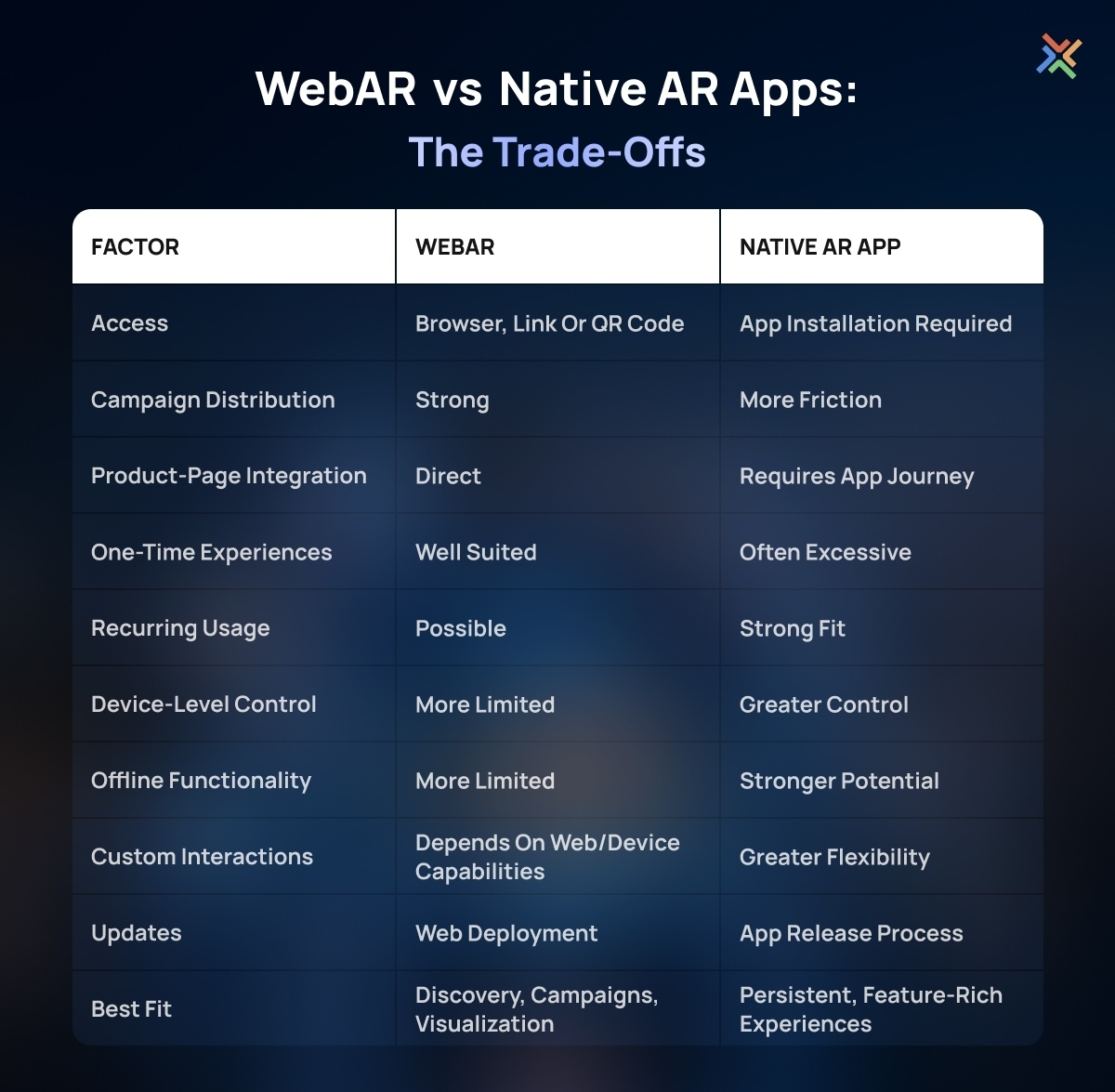
The technical limitations matter. Google's documentation notes that while <model-viewer> supports 3D models across modern browsers, AR functionality depends on compatible devices and browser support. (Google for Developers)
Therefore, WebAR projects should include device testing, fallback experiences, optimized 3D assets and clear performance requirements.
When Should a Dubai Business Choose WebAR?
WebAR is generally worth considering when:
- The experience needs to reach first-time users.
- Customers arrive through search, advertising, social media or a product page.
- A QR code is a natural entry point.
- The AR experience supports a specific marketing or buying decision.
- Users do not need persistent accounts or extensive app functionality.
- The business wants to connect AR directly to an existing website or campaign.
A native AR app can be more appropriate when:
- AR is central to a frequently used mobile application.
- Users need persistent profiles or saved configurations.
- The experience requires deeper device-level capabilities.
- Offline functionality is important.
- The application requires complex interactions beyond the browser's capabilities.
The right choice therefore depends on the experience, audience, technical requirements and business workflow not simply whether one technology is newer.
What Does a Successful WebAR Project Require?
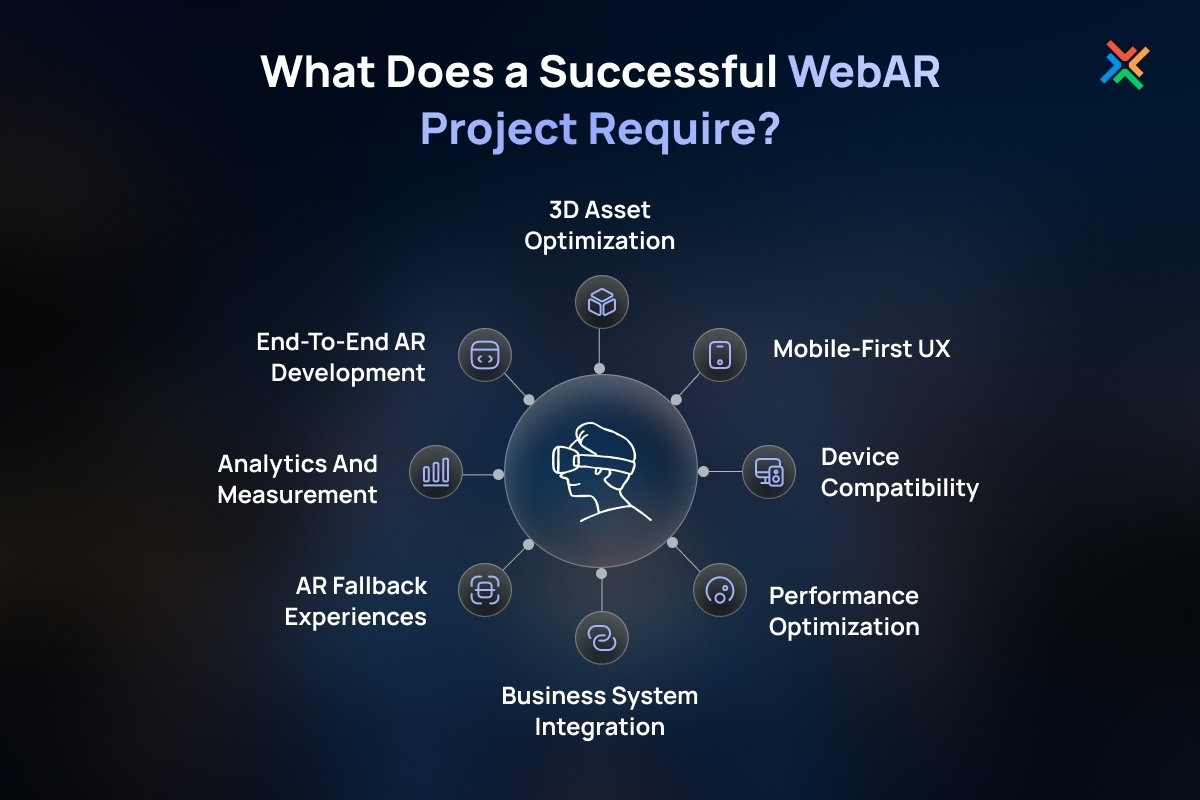
A WebAR project involves more than placing a 3D model inside a browser.
Businesses should consider the complete implementation:
- 3D assets: Product or property models need to be prepared and optimized for target devices.
- Mobile UX: The AR journey should be simple enough for a user arriving from a campaign, listing or physical location.
- Device compatibility: iOS and Android devices should be tested across representative browsers and hardware.
- Performance: Large 3D assets can affect loading and responsiveness, making optimization important.
- Integration: Where appropriate, the experience should connect with product catalogs, property information, enquiry forms, analytics or other business systems.
- Fallbacks: Not every device will support every AR capability. Users should still receive a useful product or property experience when AR is unavailable.
- Measurement: Businesses should determine which actions matter, such as AR launches, product interactions, property views, enquiries or downstream conversions.
AR/VR development process includes concept design, 3D modeling, system architecture, prototyping, testing, deployment and integration of code and content.
Build a WebAR Experience Around Your Business Goal
WebAR can give Dubai real estate and retail businesses a lower-friction route to immersive customer experiences. Its strongest advantage is distribution: customers can encounter the experience where they already are, whether that is a property listing, website, product page, advertisement, packaging or physical store.
For businesses evaluating WebAR, the key decision is therefore not simply whether AR should be used. It is how AR should fit into the customer journey and whether browser-based delivery or a native application better supports the required experience.
WDCS Technology provides AR/VR development services in UAE covering augmented reality solutions, AR/VR content, 3D graphics, interactive product displays, prototyping, testing and deployment.
If you are planning an AR experience for Dubai real estate, retail, ecommerce or another customer-facing use case, connect now to discuss the required experience, target devices, 3D assets, integrations and delivery model with the WDCS Technology team.
Launch a WebAR Experience with WDCS Technology UAE
Take your property, retail or ecommerce experience from concept to deployment with WebAR built for real-world customer journeys. WDCS Technology can support 3D content, AR development, device compatibility, integrations and deployment for your use case.