Mobile-First E-Commerce in 2026: Winning Strategies for UAE Businesses
February 12, 2026

Ayush Kanodia
The UAE is developing its digital economy and e-commerce is expected to reach over $20 billion by the year 2026. The smartphones are now a leading driver of online purchases in the range of 70-80 percent, with 99 percent smartphone penetration, tech-oriented younger generation, and easy digital payment platforms like Apple Pay, Tabby, and Tamara.
Mobile-first e-commerce in this case has become the solution for the businesses that want to gain market share, increase conversions, and stay competitive in the rapidly changing digital environment of the UAE.
Mobile-first is not only a choice of consumers but also an increase in expectations. Customers are now increasingly seeking websites that load quickly, are navigable with ease, and have customer experiences that are customized based on their location, behaviour and purchasing history. The brands that fail to be mobile-first may lose their clients to the brands that have frictionless mobile experiences.
The mobile-first principles, AI-based personalization, simplified payment choices, and hyperlocal delivery are the foundations of success of UAE retailers. Partnering with a trusted eCommerce development company in UAE positions businesses to thrive in 2026 and beyond.
The UAE E-Commerce Landscape: Trends, Mobile Penetration, and Consumer Behavior
The adoption rate of mobility in the UAE is very high. This makes mobile as the leading platform of discovery, comparison and purchase online. Mobile devices will also make up over half of the e-commerce transactions according to the recent projections making UAE a mobile-commerce-first economy.
Key trends shaping the market include the rise of social commerce, instant digital payments, and a preference for seamless, cross-platform app shopping experiences. Mobile-first buying has become normalized using platforms such as Instagram, Tik Tok and Noon, and novel payment systems such as Tabby and Tamara allow more flexible, safe, and quicker checkout.
UAE consumer behavior is focused on convenience and speed and also personalization. Consumers want quick websites, few check out procedures and personalized suggestions. They are not as likely to accept slow pages, cluttered interfaces and complicated navigation. The best performing segments include luxury, fashion, electronics, and groceries, which represent aspirational and practical consumer demands.
In the case of companies that aim to cater to this market, the development of eCommerce in UAE with the focus on mobile-first design is vital. Knowing what locals do, companies will be able to maximize the product discovery, improve the engagement and get higher conversion rates without violating the local regulations.
What “Mobile-First E-Commerce” Really Means in 2026
Mobile-first e-commerce in 2026 is more than responsive design. It is a process which includes smartphone design experiences and then expanding into desktop or tablet. Approach takes into account the real-life user interactions and network limitations and device limitations, which offers the best experience that is the fastest and most intuitive.
Mobile first strategy includes:
- Creating interfaces that are intuitively small in size, having clear CTAs and legible typography.
- Optimizing the image, media and contents so that they are fast and consume less data.
- Introducing AI-based personalization and predictive analytics in the quest to improve engagement.
- Allowing digital payments, one-tap and Buy Now, Pay Later (BNPL) integration.
To the UAE businesses, this strategy conforms to the realities of the market: the high smartphone penetration, advanced consumers and growing demands to have whatever they need at any given time. Mobile-first is not a matter of design anymore, it is a business growth strategy.
Mobile-First vs Mobile-Friendly: Why UAE Brands Can’t Ignore the Difference
Mobile-friendly websites are still mistaken for mobile-first design by many businesses. Mobile-friendly only implies that a desktop site is scaled down to a smaller screen. Mobile-first, conversely, is mobile-based.
This difference is critical in the UAE. Mobile-first sites are faster, less frictional at checkout, and better at engagement metrics, which have become highly important to Google algorithms in search ranking. Mobile friendly websites tend to have cluttered navigation, slow load times and poor user experience leading to loss of revenue and loss of search visibility.
Investing in eCommerce website solutions in UAE with a true mobile-first focus ensures better performance, higher conversions, and stronger competitive positioning.
Why Mobile-First Is Now a Growth Strategy, Not Just a Design Trend
Mobile-first is no longer a trend, it is a driver of growth. The UAE market in 2026 will require a high level of speed, personalization, and access to the omnichannel. Companies that are mobile-first can:
- Seize a bigger portion of mobile traffic.
- Minimize bounce rates and enhance engagement.
- Increase conversions with streamlined checkout processes.
- Use AI to provide contextual recommendations.
Mobile-first companies must not afford to be mobile-last as competitors who provide frictionless mobile experiences risk losing out on high-value markets such as fashion, electronics, and luxury goods.
Google’s Mobile-First Indexing and Its Impact on UAE E-Commerce Rankings
Google has shifted its focus to indexing and ranking mobile versions of websites. This implies that your desktop design is second, your mobile site is what defines your performance in terms of SEO. This directly applies to the UAE businesses:
Slow and hard to navigate sites on mobile will be ranked lower, and they will lose organic traffic.
Mobile-first optimization enhances load times, usability, and core web vitals that Google currently places a lot of emphasis on.
Structured data, trust signals, and content hierarchy must be optimized for mobile screens.
Working with an eCommerce development company in UAE ensures your mobile presence meets Google’s mobile-first requirements, improving both rankings and discoverability.
Core Mobile-First Strategies UAE Businesses Must Adopt in 2026
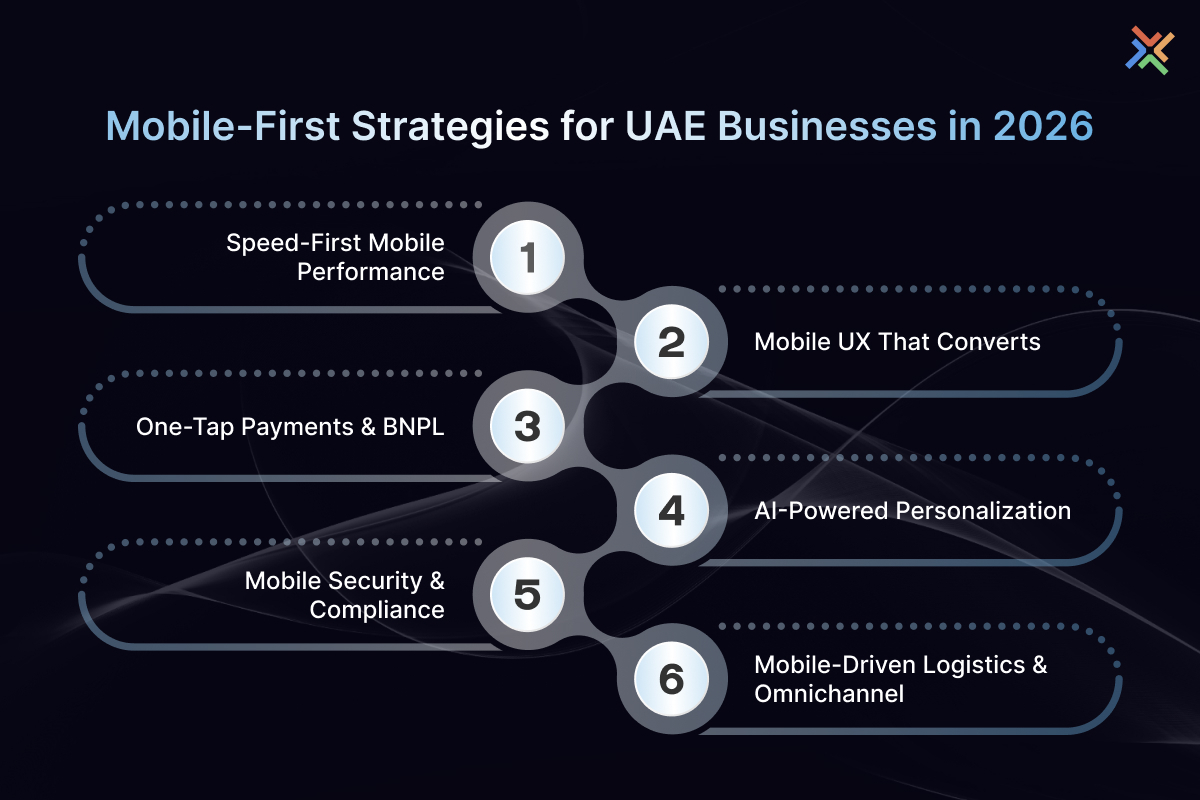
Essential mobile-first strategies UAE businesses should implement in 2026 to stay ahead of the competition.
Speed-First Architecture for Mobile E-Commerce
Mobile users are impatient; slow websites lead to high bounce rates. Speed-first architecture involves:
- Compressing images and video for mobile delivery.
- Utilizing CDNs for global performance.
- Implementing efficient caching and lightweight frameworks.
- Minimizing scripts and plugins that slow load times.
Fast mobile sites are critical in the UAE, where consumers expect near-instant access and high-performance experiences.
Mobile-Optimized UX That Drives Conversions
A mobile-first UX prioritizes intuitive navigation, readable typography, and touch-friendly interfaces. Key principles include:
- Clear product hierarchy and easy-to-find menus.
- One-click or minimal-step checkout flows.
- Prominent search functionality with predictive suggestions.
- Bilingual support for Arabic and English users.
By optimizing UX for mobile, businesses reduce friction, improve satisfaction, and increase conversion rates.
One-Tap Mobile Payments, Digital Wallets, and BNPL Integration
Convenient payment options are essential for UAE consumers. Mobile-first strategies integrate:
- Apple Pay, Google Pay, and local digital wallets.
- Buy Now, Pay Later solutions like Tabby and Tamara.
- Simplified payment flows that minimize input requirements.
Seamless checkout experiences lead to higher sales and repeat business, particularly in high-frequency purchase categories like groceries, fashion, and electronics.
Personalization and AI-Driven Mobile Shopping Experiences
AI enables mobile-first retailers to deliver tailored experiences, including:
- Predictive recommendations based on browsing history and location.
- Personalized promotions, push notifications, and emails.
- Conversational commerce through AI chatbots for product discovery and support.
Personalization increases engagement, loyalty, and average order value in the UAE market.
Mobile-First Security, Trust Signals, and Compliance
Security builds trust. UAE consumers expect transparent, secure, and compliant mobile shopping experiences. Businesses should focus on:
- SSL encryption and secure payment gateways.
- Visible trust signals such as customer reviews, certifications, and return policies.
- Compliance with UAE PDPL and global data privacy regulations.
Logistics, Fulfillment & Omnichannel Marketing for Mobile Customers
Mobile-first strategies extend beyond digital experiences into fulfillment and marketing:
- Fast, reliable local delivery is crucial, especially for high-demand categories.
- Omnichannel marketing ensures consistent messaging across apps, social media, and physical stores.
- Integration of order tracking, notifications, and flexible pickup options improves customer satisfaction.
The Role of Headless and Composable Commerce in Mobile-First E-Commerce
Headless and composable commerce architectures decouple frontend experiences from backend systems, enabling:
- Faster page loads and performance optimization.
- Flexible integration of AI, payments, analytics, and loyalty programs.
- Seamless omnichannel experiences across mobile apps, web, and social commerce.
For UAE businesses, these architectures allow scalability, experimentation, and market responsiveness without costly system overhauls.
Mobile-First E-Commerce Website Features That Convert in the UAE Market
Mobile-first websites with high conversion have the following features:
- Sticky add to cart buttons and one-second checkout.
- Intelligent searching and filtering and predictive recommendations.
- Multi-language (Arabic and English).
- Individualized product suggestions on AI analytics.
- Obvious trust indicators, such as reviews, social proof, and badges of secure payment systems.
These attributes have a direct effect on the conversion rates and customer loyalty in the competitive e-commerce market in the UAE.
Common Mobile-First Mistakes UAE E-Commerce Businesses Still Make
Despite the importance of mobile-first design, common mistakes persist:
- Cluttered interfaces and small, untappable buttons.
- Slow-loading images and heavy scripts.
- Complex checkout flows with multiple steps.
- Lack of Arabic support or culturally relevant content.
- Ignoring mobile analytics and user feedback for continuous improvement.
Avoiding these errors is critical to maximize ROI from mobile-first investments.
How to Choose the Right E-Commerce Website Solutions in UAE
Making the right choices largely depends on factors related to business and product sizes along with goals in the marketplace:
- Choose a platform based on business size: Shopify/PWA for small businesses, custom solutions for medium, and headless/composable architectures for large retailers.
- It should be mobile-first and bilingual (Arabic and English), right-hand turned.
- Incorporate local payment channels such as PayTabs, Tabby, Tamara, and logistical networks such as Aramex, Fetchr.
- Scalability, security, and hosting inside the MENA region must be prioritized.
- Choose platforms with SEO-friendly tools and services in mind, including customizable URLs, meta data, blogging capabilities, and reviews.
- Collaborate with developers with a deep understanding of the UAE market and a portfolio with positive UX/conversion optimization outcomes and support services.
While choosing eCommerce services in UAE, it is essential to consider platform scalability, mobile-first functionality support, and SEO optimization.
When to Partner with an E-Commerce Development Company in UAE
Collaborating with a professional ecommerce development company in UAE can be an effective decision for businesses wanting to entail a scalable, mobile-first, and conversion-optimized ecommerce presence on their websites. Professionals possess expertise and knowledge required to execute complicated ecommerce functionalities and maximize ROI in a competitive arena.
Best Time to Invest:
- Mobile First UX Designing: When your website requires responsive design and mobile-friendly user experiences in the UAE.
- Advanced Integrations: For AI, Analytical, or Omnichannel solutions that need advanced development.
- Custom Development & Platform Selection: When the off-the-shelf solution doesn’t work in the business or technical context.
- Scalability Across UAE/GCC: To reach a wider audience through compliance, localization, and market-specific optimization.
- Maximizing ROI: In order to speed up the process for implementation and increase the conversion rate, follow technical best practices.
- Security & Performance: Where consumers demand secure applications, fast loading pages, or superior performing platforms for growth.
Why Businesses Choose to Hire E-Commerce Developers in UAE for Mobile-First Growth
With a smartphone penetration rate over 97%, the UAE market is the right place for the development of mobile-centric e-commerce platforms for various businesses. The websites and applications are devised to be fast and feature the use of the local language, enhancing the aspects of SEO, conversion rates, and even customer loyalty.
Reasons for choosing UAE E-Commerce web developers:
- Mobile-First Advantage: Personalization for UAE’s predominantly mobile-centric audience.
- Local Market Expertise: Arabic/English support, RTL design, local payment integration.
- SEO and Visibility: Optimized mobile sites can rank higher and gain greater visibility.
- Higher Conversions: Smooth Navigation and Faster Checkout Process Contribute to Conversions.
- Specialized Skills: Advanced platforms, user experience, scalable architectures to enable faster and reliable delivery.
- Competitive Edge: Having a mobile strength helps build brand loyalty.
- Increased Customer Engagement: Direct access for personalized communications, notifications, and repeat business.
Future-Proofing Your UAE E-Commerce Business Beyond 2026
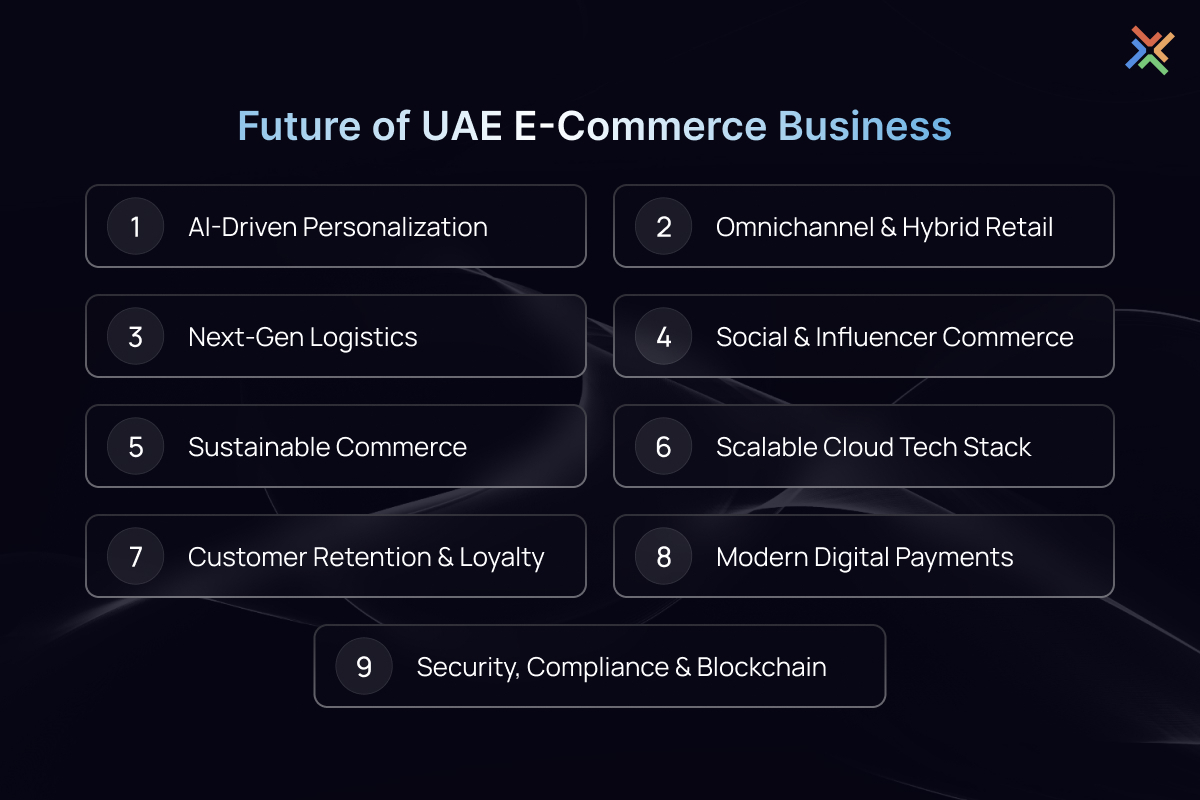
Preparing for the future requires continuous innovation:
- AI & Hyper-Personalization: Use behavior data to drive predictive, extremely relevant product suggestions, content, and offers beyond basic retargeting efforts.
- Omnichannel and Hybrid Retail: Offer a seamless and ubiquitous shopping experience through BOPIS, ROPO, and unified inventory.
- Innovative Logistics: Consider quicker alternatives like drones to fulfill orders and utilize digital transparency in supply chain processes to foster greater trust.
- Social Commerce: Utilize social media platforms as a way to acquire sales, leveraging consumer reviews to influence sales.
- Security and Compliance: Utilize Blockchain in Supply Chain Transparency and Data Protection Regulations in the UAE
- Scalable Technology Stack: Use cloud-based infrastructure for real-time inventory management systems, analytics, marketing automation, etc.
- Customer Retention: Implement loyalty programs, personalization, and post-purchase interactions to create stronger customer relationships.
- Invisible Commerce: Prepare for AI agents that aid or automate purchasing.
- Modern Payment Systems: Provide quick, secure, and diverse payment choices that include digital wallets.
- Sustainability: Infuse eco-friendly and ethical practices as an essential part of the business philosophy to cater to the increasingly rising demand
Build Winning Mobile-First E-Commerce Solution with WDCS
In 2026, mobile-first is not a design choice; rather, it's the minimum to thrive in the UAE's fast-growing e-commerce market. Already driving 70-80% of online purchases, its total value is well on course to surpass $20 billion. Consumers demand rapid loading times, seamless navigation, AI-fueled personalization, secure mobile payments, and hyperlocal fulfillment. The business that doesn't pay attention to mobile-first will get left behind.
WDCS provides end-to-end eCommerce services in UAE, covering customized eCommerce website solutions to scalable headless commerce architecture and AI-driven mobile experiences. Whether it be a B2B platform, a multivendor marketplace, or a mobile commerce solution, our team of expert eCommerce developers in UAE assures your business stays ahead.
By partnering with WDCS, this means faster time to market, higher conversion rates, and future-ready infrastructure built for the UAE market. Contact us today to build solutions that help capture market share, enhance user trust, and secure long-term competitive advantage.
FAQs
Q: What is "Mobile-First" e-commerce, and why is it crucial for UAE businesses in 2026?
A: Mobile-first e-commerce means designing websites and apps for mobile devices before desktop. It’s crucial due to UAE’s high mobile usage (over 70-80% for online shopping), impacting SEO, user experience, and conversions.
Q: How do I create a mobile-first UX for UAE customers?
A: Focus on fast-loading pages, simple navigation, one-click checkout, readable visuals, bilingual support, and visible trust signals such as reviews and secure payments.
Q: What emerging tech should UAE e-commerce businesses adopt in 2026?
A: AI for personalization, AR for immersive shopping, voice commerce, and integration with social commerce platforms like TikTok Shop and Instagram.
Q: How important is an omnichannel strategy for mobile success?
A: Essential. Unified experiences across mobile, web, social, and physical stores improve consistency, satisfaction, and conversion rates.
Q: What role do social commerce and influencers play?
A: Social commerce drives product discovery and direct purchases. Influencers boost credibility and engagement among mobile-first audiences.
Q: How can personalized marketing improve mobile conversions?
A: Use AI-driven recommendations, location-based offers, and tailored content to increase engagement, average order value, and repeat purchases.
Q: How do I build trust quickly on mobile in the UAE?
A: Display reviews, ratings, clear policies, secure payment icons, and fast customer service prominently.
Q: What are the best mobile payment solutions in UAE?
A: Local digital wallets like Apple Pay, Google Pay, and BNPL solutions (Tabby, Tamara) offer convenience, speed, and security for mobile users.
Q: How important are fast load times for mobile e-commerce in the UAE?
A: Extremely. Slow websites lead to high bounce rates. Optimize images, implement responsive design, and use CDNs for speed.
Build Your Mobile-First E-Commerce Platform with WDCS
WDCS delivers end-to-end eCommerce services in UAE, from custom website solutions to scalable headless commerce platforms. Our expert eCommerce developers create fast, secure, and AI-driven mobile experiences that boost conversions, improve customer engagement, and future-proof your business. Partner with WDCS to capture market share, optimize mobile performance, and secure a competitive edge in 2026 and beyond.