How AI Agents Are Powering Smart City Projects in Dubai
July 10, 2026

Ayush Kanodia
.jpg?w=1920&q=75)
Most smart city pilots look impressive in a demo and stall the moment they touch real infrastructure. A traffic model that works on a test corridor breaks when it meets 130 live government systems, strict data residency rules, and a network that cannot tolerate a single missed signal. Dubai is one of the few places where these systems already run at city scale, not in a lab.
This guide breaks down how AI agents actually operate inside Dubai's smart city projects, what measurable results they deliver, and what it takes to build them under UAE compliance rules. You will get the market numbers, the national strategies driving procurement, the technology stack, the real deployment risks, and a clear view of why government and enterprise teams partner with a specialized AI development company UAE instead of bolting on off-the-shelf tools.
Executive Summary
- The UAE AI market reached USD 3.47 billion in 2023 and is projected to grow at a 43.9% CAGR to USD 46.33 billion by 2030 (Grand View Research). This is an active procurement budget, not an aspiration.
- AI agents are the decision layer, not a feature. They detect conditions across traffic, energy, and public systems, coordinate responses, and execute actions in real time.
- Results are measurable: up to 25% congestion reduction in key Dubai corridors, 15% lower travel time, 20% fuel savings, and 40% faster municipal decision-making.
- National strategies define who wins contracts: the UAE National AI Strategy 2031, Dubai Autonomous Transportation Strategy, and Dubai Paperless Strategy set the timelines and compliance bar.
- The hard part is production: PDPL data sovereignty, legacy integration, cybersecurity at infrastructure scale, and a real talent gap. Initiatives often exceed AED 500,000 each.
- In-region delivery matters: enterprises and government agencies need an AI development company UAE with compliance-first architecture and proven delivery, which is where teams hire AI engineers UAE for smart city work.
Why Dubai Treats AI as Infrastructure, Not a Feature
Urban growth is the forcing function. The UAE's population is forecast to grow by 140% by the end of the century, which compounds pressure on transport, utilities, and public services at the same time. You cannot staff your way out of that. You optimize continuously or you fall behind.
That is why AI agents sit underneath Dubai's city systems as a connective layer. They detect conditions across mobility, energy, and public services, coordinate a response, and act without waiting for a human to read a dashboard. A smart city is not a pile of connected sensors. It is a system that anticipates and prevents problems instead of reacting to them after they happen.
The distinction matters for procurement. Dubai stopped buying isolated tools and started buying decision systems that survive real use.
The UAE AI Market Overview
Market size tells you whether a trend is hype or budget. In the UAE, it is budget.
- 43.9% CAGR from 2024 to 2030, reaching USD 46.33 billion (roughly AED 170 billion).
- Software led with 35.9% of revenue share in 2023, driven by real-time insight and decision support.
- 98% of UAE businesses view AI as a major enabler of resilience, per a Dataiku report cited in the same research.
The growth is concentrated in a clear AI roadmap, the rise of large language models, and heavy investment in data security and privacy. For a CIO or procurement lead, the takeaway is direct. The money is committed, the tenders are live, and the bar for participation is rising every quarter.
National Strategies Driving Smart City Spend
National strategies are not marketing documents. They are procurement frameworks with budgets, timelines, and accountability. Alignment with them is a structural advantage when you bid for government work.
- UAE National AI Strategy 2031: maps AI integration across nine sectors with the aim of placing the country among the top ten global AI leaders. AI is expected to contribute USD 96 billion to the economy by 2031.
- Dubai Autonomous Transportation Strategy: targets 25% of all journeys as autonomous by 2030. The strategy projects AED 22 billion in annual economic returns, cuts transportation costs by 44%, reduces accidents by 12%, and saves 396 million transport hours per year.
- Dubai Paperless Strategy: eliminates more than one billion paper documents used annually in government transactions, replacing them with fully digital, AI-supported services.
- Digital Dubai: has launched over 130 initiatives, including the Dubai AI Roadmap, the AI Lab, and an Ethical AI Toolkit for transparent, fair, and accountable systems.
Read these as a map of where contracts flow. If your architecture and compliance posture match the strategy, you are in the running. If they do not, you are out before the technical review.
How AI Agents Actually Work in a Smart City
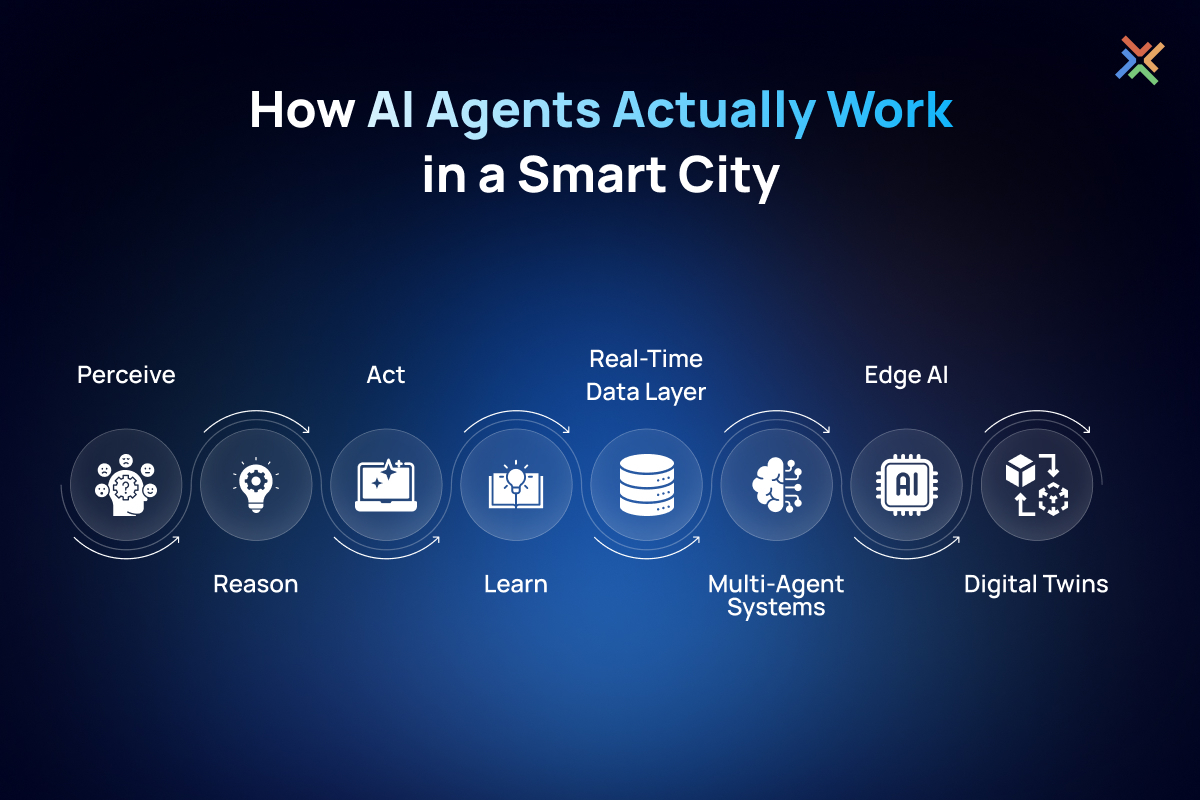
An AI agent is not a chatbot, and it is not rule-based automation. Traditional automation follows fixed scripts and breaks the moment conditions fall outside the script. An agent perceives, reasons, acts, and learns, which lets it handle unstructured, changing urban conditions.
In production, a city-scale agent does four things:
- Perceives: ingests data from cameras, GPS probes, road sensors, and city systems measuring electricity, motion, or pressure.
- Reasons: weighs live conditions against goals, even when inputs are noisy or incomplete.
- Acts: adjusts signals, reroutes fleets, or dispatches services through connected systems.
- Learns: improves its responses as new data arrives.
The real-time data layer
Fragmented data is the failure mode that kills most city projects. Traffic lights, cameras, transit networks, and utility sensors each speak their own format, and a planner ends up reading five dashboards that disagree.
A real-time data fabric fixes this by connecting those inputs into one operational layer. According to internal industry benchmarks, that coordination accelerates municipal decision-making by up to 40% by replacing scattered inputs with one coordinated view.
Role-based multi-agent systems
One giant model controlling a whole city is a single point of failure. Production systems split work across role-based agents instead. One agent handles signal timing, another manages fleet dispatch, another monitors energy load, and an orchestration layer coordinates them. This is how you speed up service delivery without one model becoming the bottleneck.
Edge AI and digital twins
Latency is the silent killer in safety-critical systems. A traffic decision that waits on a round trip to a central cloud arrives too late to matter.
Edge AI processes data locally on devices like traffic sensors and cameras, so decisions happen in milliseconds without overloading central servers.
Digital twins are 3D virtual models of real infrastructure. They let authorities simulate road closures, test disaster response, and assess infrastructure changes before touching the physical city.
Where AI Agents Deliver Measurable Results in Dubai
Vague claims about efficiency do not win procurement. Numbers do. Here is where AI agents produce results that hold up in Dubai's live systems.
Intelligent traffic management
Dubai's Roads and Transport Authority runs one of the most advanced AI traffic ecosystems in operation. Thousands of sensors feed machine learning models that adjust signal timing, reroute vehicles, and predict congestion before it forms. RTA's own AI Strategy spans 81 projects across six operational pillars.
Up to 25% congestion reduction in key Dubai corridors.
Up to 15% lower travel time and 20% fuel savings in optimized logistics and delivery routes.
Up to 30% delivery efficiency gain and 75% less route-planning time through predictive dispatch.
Smart energy grids
The UAE's Net Zero 2050 target depends on energy systems that predict instead of react. AI agents forecast demand at neighborhood level, balance supply, and integrate renewable sources like the Mohammed bin Rashid Solar Park through predictive maintenance and output optimization. Cities managing infrastructure through continuous simulation report traffic flow gains of up to 30% and energy and operational cost reductions of around 20%.
AI governance and public services
Dubai's Zero Bureaucracy approach cut government processes from many steps to one or two. More than 99% of government services now run online, saving over 300 million paper transactions a year. AI agents and chatbots handle license renewals, permits, and citizen queries 24/7 in Arabic and English.
Predictive public safety and emergency response
Dubai Police use AI-driven facial recognition, behavior analysis, and anomaly detection to flag threats and monitor high-risk areas. Emergency navigation systems provide custom routing for ambulances, including traversal through restricted areas and offline functionality, supporting response time reductions of up to 20%.
The Technology Stack Behind Production-Grade Agents
A clean demo hides the stack. Running agents across a live city needs specific components working together, each chosen for production conditions rather than appearance.
- LLMs and RAG: Retrieval-Augmented Generation and private LLMs deployed inside Virtual Private Clouds keep responses accurate and data in-region.
- Computer vision: powers traffic monitoring, radiology workflows in hospitals like Rashid Hospital, and anomaly detection in surveillance.
- Edge AI and IoT: local processing on sensors and devices for low-latency decisions.
- Multi-agent orchestration: coordinates role-based agents across mobility, utilities, and public services.
- MLOps and model governance: automated retraining and continuous monitoring keep models accurate and compliant as conditions shift.
- Blockchain and AI integration: adds data transparency, security, and traceability for logistics and public records.
That last point on MLOps is where most projects quietly fail. A model that works at launch drifts within months. Without retraining pipelines and monitoring, accuracy degrades and trust erodes.
The Real Deployment Challenges Nobody Knows
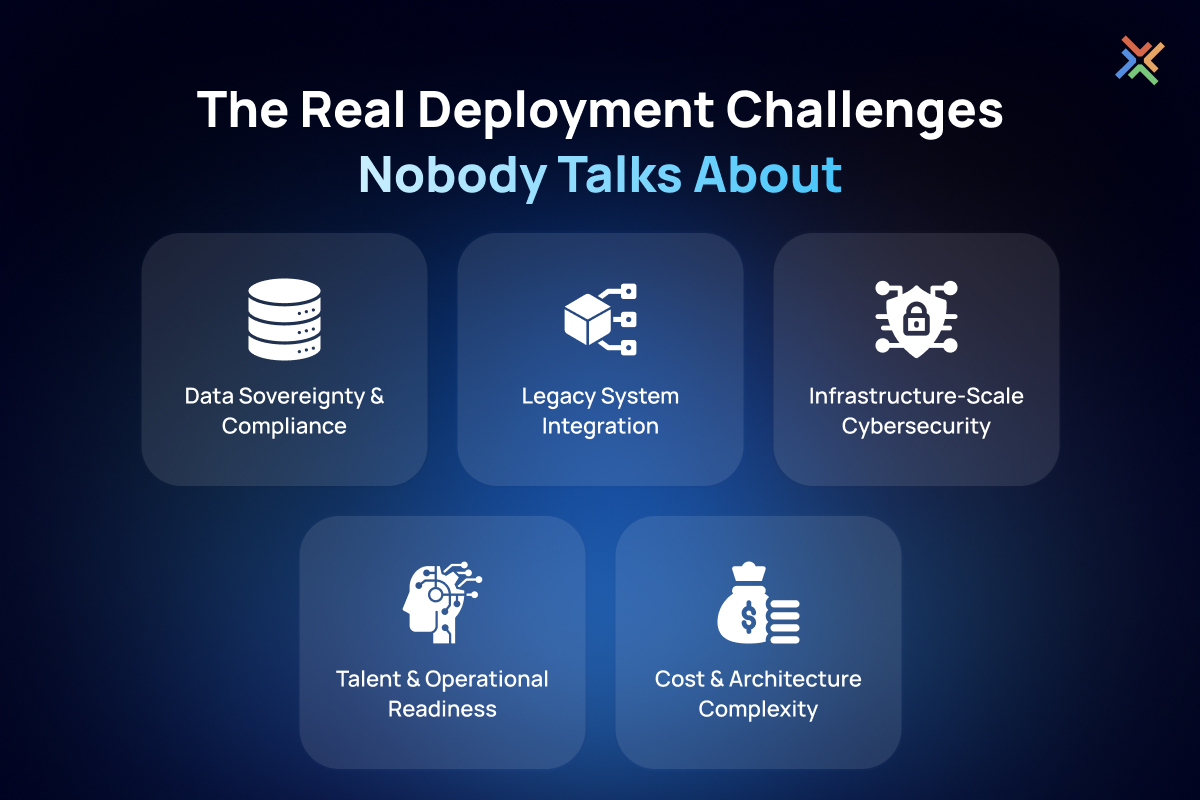
The opportunity is large. So is the complexity. These are the five challenges that decide whether a smart city project ships or stalls.
- Data sovereignty under PDPL: The UAE's Personal Data Protection Law and sector rules govern how citizen data is stored, processed, and transferred. Many global AI platforms default to overseas processing, which creates an immediate compliance gap. Agents handling citizen data must run on compliant, in-region infrastructure.
- Legacy system integration: A city runs thousands of IoT endpoints, multiple clouds, and old systems that lack standards. Connecting modern agents to that mix needs deep custom integration and API work.
- Cybersecurity at infrastructure scale: When an agent controls traffic signals or a power grid, a breach becomes a public safety event. Security has to be built in from day one, not added later.
- Talent and cross-functional readiness: Deployment needs data science, cloud architecture, domain knowledge, and regulatory expertise on one team. Most enterprises lack that bench internally, which is why they hire AI developers UAE with smart city experience.
- Cost and infrastructure investment: Urban AI initiatives can exceed AED 500,000 each. Without the right architecture, that number climbs fast.
The pattern across all five is the same. Each one looks manageable in isolation and compounds in production. That is the reason in-region delivery experience changes the outcome.
What Comes Next: Agentic City Management
Dubai is moving from AI that analyzes to AI that acts on its own. The next phase is agentic, where systems run urban operations with humans supervising rather than driving.
- Autonomous infrastructure: agents independently control signals, balance energy distribution, and manage waste collection in real time.
- AI-powered digital twins: predict traffic flow, test disaster response, and find infrastructure weak points before construction.
- Generative AI in governance: 24/7 citizen services that answer queries instantly and personalize interactions.
- Predictive public safety: real-time analysis that forecasts high-risk areas and shortens emergency response.
Human oversight stays central. The goal is faster, cleaner, more dependable services, with people supervising the agents that keep the city running.
Why You Need a Specialized AI Development Company UAE
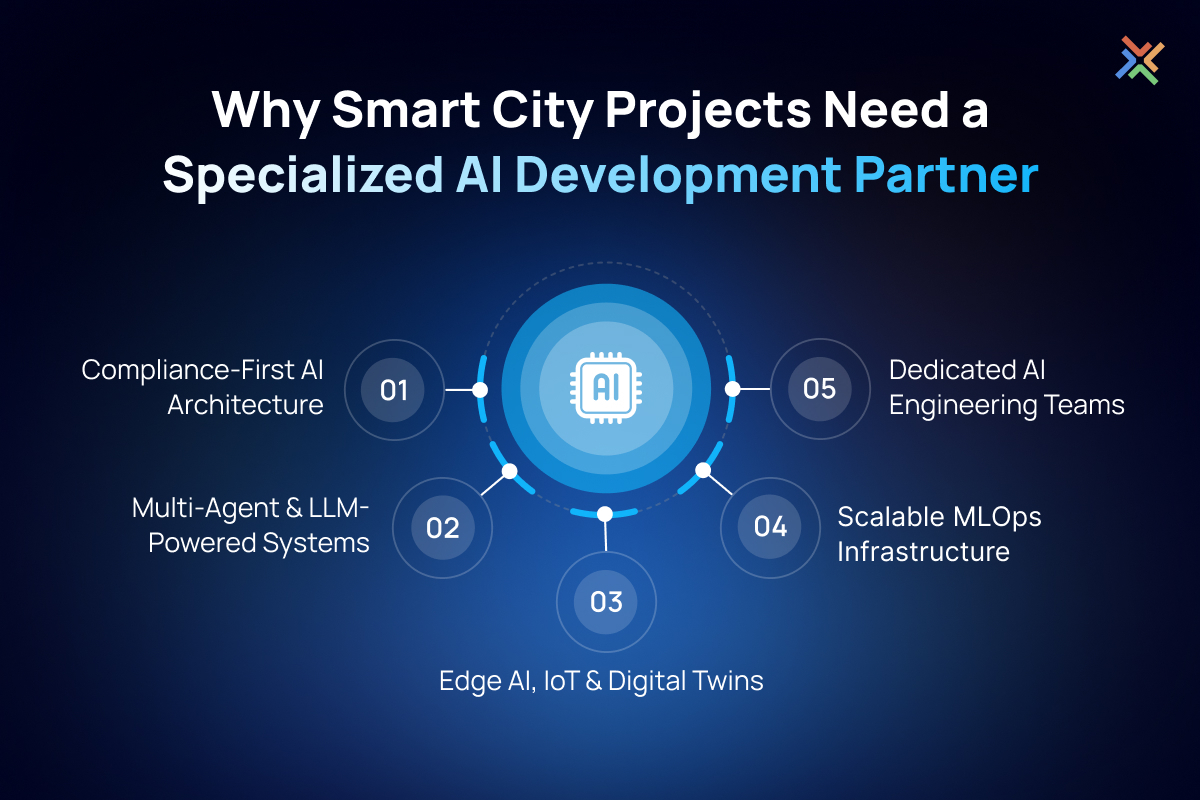
Off-the-shelf AI tools default to overseas data processing and generic architecture. In a market governed by PDPL and national procurement frameworks, that is a non-starter for government and enterprise systems. You need a partner whose architecture is compliance-first and whose delivery is proven in the region.
That is the gap WDCS Technology fills. We provide AI development services UAE built for smart city and public-sector conditions:
- Multi-agent and LLM-powered systems designed for in-region data residency.
- Edge AI, IoT integration, and digital twin development for live infrastructure.
- MLOps pipelines that keep models accurate and audit-ready over time.
- Dedicated teams when you need to hire AI engineers UAE or scale an existing one fast.
The window to position inside Dubai's smart city build-out is narrowing as budgets get committed and timelines tighten. If you are a CIO, CTO, digital transformation lead, or procurement decision-maker, the next step is concrete. Talk to our team about your smart city or enterprise AI project, and hire AI developers UAE who can deliver under real compliance pressure.
Build Your Smart City AI Project with the Right UAE AI Development Partner
Dubai's smart city momentum is creating a narrow window for enterprises and public-sector teams that want to move from planning to deployment. The winners will not be the teams with the most AI slides. They will be the ones that can ship compliant systems, integrate with real infrastructure, and show measurable gains in mobility, energy, safety, and service delivery.
If your organization is evaluating a smart city initiative, this is the point to choose a partner that can design the architecture, handle UAE compliance, and execute at production scale. WDCS Technology helps organizations scope, build, and scale city-grade AI systems with in-region expertise.
Ready to build? Connect with our experts to scope your project and hire AI engineers UAE with proven smart city delivery experience.
Plan Your Smart City AI Project with WDCS Technology
Smart city AI looks straightforward until it has to work with live infrastructure, compliance rules, and public-sector scale. WDCS Technology helps enterprises and government-focused teams design, build, and deploy AI systems that hold up in production. If you need an AI development company UAE organizations can rely on, talk to our team to scope your project, reduce delivery risk, and hire AI developers UAE with real smart city experience.