Cloud Cost Optimization in UAE: Reduce AWS or Azure Spend in 2026
January 10, 2026

Ayush Kanodia
.jpg?w=1920&q=75)
Cloud adoption in the UAE has gone beyond the testing phase. Migration projects have developed into broad, vital, enterprise-grade cloud environments supporting core applications, analytics, AI models, and Industry 4.0 frameworks. AWS and Azure have become foundational to the digital operations of finance, manufacturing, logistics, healthcare, retail and government.
As usage advances, cloud costs are becoming more of an issue. The business value cloud technology provides is not keeping up with the growing costs. The bills are increasing month over month and as a result, there are no ownership concerns. The engineering teams concentrate on system uptime, not on cost. The finance teams then look at the costs and in the absence of technical understanding, make no input to manage the costs.
In the absence of sufficient management, between 60 and 70 cloud spend is simply lost to poor management over provisioning, or simply letting resources lie idle. In the fast growing digital sectors in the UAE the combination of aggressive scaling and AI workloads make cloud cost optimisation more pressing than ever.
Optimising cloud costs in 2026 should not imply spending less money or stifling innovation. It is about designing more efficient frameworks, integrating financial oversight within DevOps, and more closely regulating cloud resources to business needs. Organizations that adapt this practice along with cloud and DevOps services in the UAE will achieve sustainable scalability. For those that fail to make these adaptations, the paradox of increasing spending on the cloud and diminishing profit margins will become more visible.
This blog outlines tips for UAE businesses on how to spend less on AWS or Azure while gaining more on performance, compliance, and operational control.
What Is Cloud Cost Optimization?
Reducing spend on cloud is about managing your operational use in a way that maximizes every dirham spent. Cloud Services cost initialization is not a one-time event, a tool that is purchased, or something that only the finance people do.
In a nutshell, cloud cost optimization addresses these three questions:
Are we overspending for the value we get?
Is our Cloud structure built for maximum flexible efficient scaling?
Is there a measurable value tied back to our Cloud spend?
In contrast to conventional IT, Cloud environments offer flexibility and dynamic operational capabilities. They can spend resources provisioning in an operational sense, and can also spend them in a forgotten sense. Without governance, these operational capabilities can lead to waste.
Innovative cloud cost optimization integrates:
- DevOps practices in automation, monitoring, CI/CD
- Crafted Cloud architecture discipline
- FinOps principles of accountability and forecasting
- For UAE organizations in competitive and regulated markets, flexible
For UAE organizations in competitive and regulated markets, flexible structuring is a prerequisite to maintaining and building sustainable growth.
Common Causes of Cloud Overspend
When it comes to overspending on the cloud, it is not as simple as one single mistake, it is usually multiple mistakes leading to inefficiency.
Idle or Underutilized Resources
The biggest waste of money on the cloud is the cloud resources that the organization is not using. Examples of these include:
- Virtual machines that use little to no CPU
- Unused storage that is somehow still being paid for
Databases that have been paid for because they are expecting peak usage that is simply not there
- Load balancers for not used services
- IP addresses that are paid for but not used
This is especially true for the dev/test cycles. These things are very easy to spin up, but once they are up, there is little to no effort to spin them back down. These types of situations create resources that the organization is not using, but that they are not being billed for, thus leading to large and avoidable cloud bills.
Over-Provisioned Workloads and Legacy Architecture
More than a few companies from the United Arab Emirates have cloud systems that were built with a leave and shift approach. This means that old servers from on premise systems were moved over to cloud systems like AWS and Azure. These are usually done with the expectation that over-provisioning is a current best practice.
The result? Cloud systems that as a whole operate at a very low utilization level. This is especially true for older monolithic legacy architectures that simply do not allow for proper granular scaling of the systems. Without proper autoscaling and systems that are isolated from one another in a work load manner, the systems as a whole can only be paid for the one peak demand, thus leading to cloud bills that are larger than they need to be because the utilization is so much below the peak.
Shadow IT and Untracked Cloud Usage
Shadow IT is becoming a serious problem. Many business units and dev teams build cloud resources that bypass approved routes, potentially employing shared or unmanaged accounts.
As a result, we can encounter:
- Services that don’t have an attributing cost.
- Security and compliance problems.
- Duplicate services.
- Deficiency of responsibility.
In the heavily regulated UAE, Finance, and Healthcare, Government sectors, Shadow IT is not a cost issue, it is a governance failure.
Multi-Cloud Complexity and Lack of Visibility
The adoption of multiple clouds is growing, but it is also increasing complexity. Each cloud solution provider in the UAE has its own unique pricing, billing, discounts, billing cycles, and metrics.
Without centralized visibility, organizations struggle to:
- Compare costs across clouds
- Track data egress charges
- Understand inter-cloud dependencies
- Attribute costs accurately
Poor visibility leads to reactive decisions instead of strategic optimization.
Step-by-Step AWS Cost Optimization
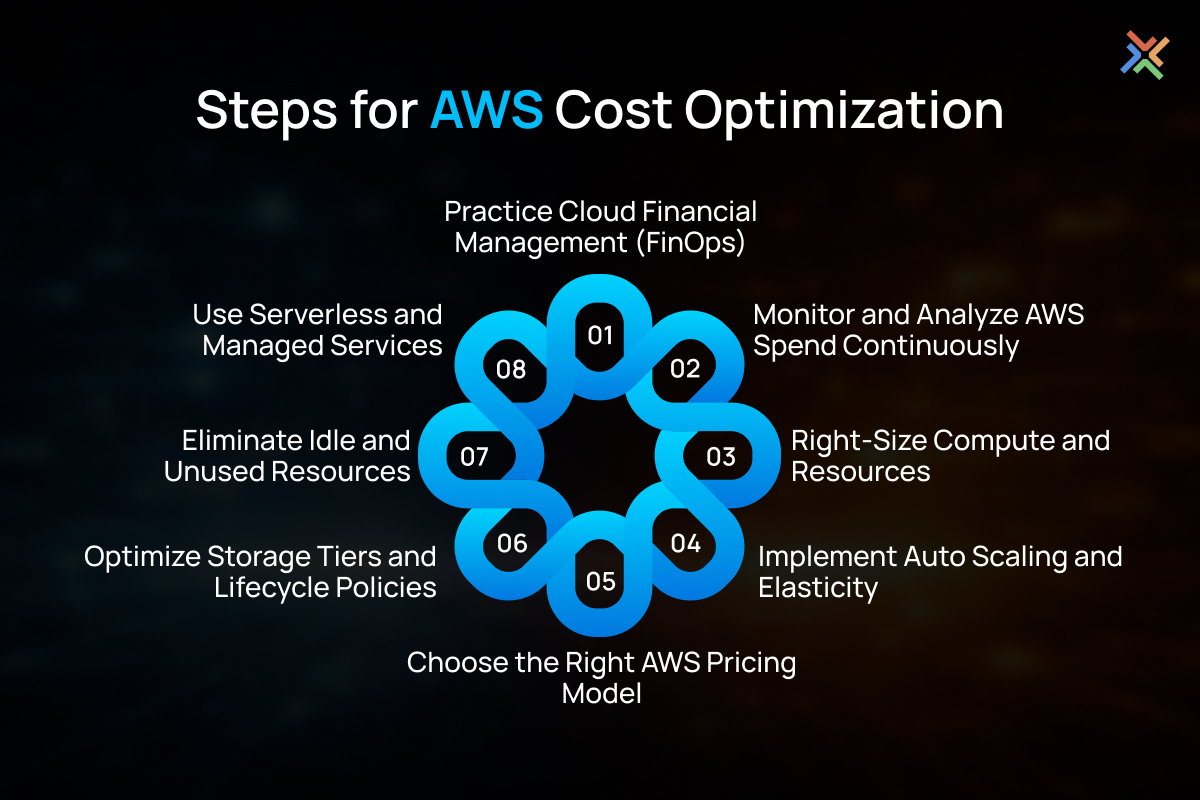
Amazon Web Services is the top choice for an ever-increasing number of businesses due to the massive scale of their cloud service providers, including analytics, artificial intelligence, and software as a service (SaaS). When attempting to reduce costs, there is a specific process to follow.
Step 1: Establish a Baseline
Starting with a strong foundation is key to improving any system, and the same is true with AWS optimization. Starting with the basics of the service will provide the most accurate costs with the greatest visibility through tools like the:
- AWS Cost Explorer
- Cost & Usage Reports (CUR)
Next, analyze your spending on these services:
- EC2
- S3
- RDS
- data transfer
Where applicable, separate your analysis by these dimensions:
- Linked accounts
- Environments (production, staging, development)
- Time periods (30, 60, 90 days)
After following these steps, a baseline will be established to identify the greatest cost drivers and unusual usage at the baseline.
Step 2: Rightsize EC2 and Compute Resources
Compute is typically the largest AWS cost component. Rightsizing focuses on aligning instance capacity with actual usage.
This is achieved through a number of key actions, including:
- Reviewing CPU, memory, and network utilization
- Identifying and analyzing instances that are operating below the 20-30% utilization threshold
- Migrating down to smaller or burstable kinds of instances
- Evaluating and potentially replacing instances with newer ARM-based Graviton instances
A 30-50% reduction in compute costs is a common result of rightsizing cloud computing solutions in the UAE with the same principles applying to other regions as well.
Step 3: Commitments, Reserved Instances & Savings Plans
When workloads are sufficiently stable and have been properly resized, you can apply the primary principle for cost optimization: commitment-based pricing will yield the greatest return on your investment.
- For considerable flexibility spanning instance types, Savings Plans are your best option, while
- Reserved Instances are best designed for stable and predictable workloads.
If you have a balanced approach, you will be best suited to commit to between 50 and 70 percent of your baseline utilization. This will provide sufficient flexibility for scaling and sustaining innovation.
Step 4: Optimize Storage (S3, EBS, Snapshots)
Storage expenses are cumulative, even if you don't notice their increase right away.
Best practices include:
- Utilizing S3 lifecycle policies to store your data in lower-cost tiers.
- EBS volumes that are not linked should be removed.
- Retaining policies of snapshots should be adjusted.
- Newer storage alternatives that are more cost-effective should be adopted.
Over time, small storage optimizations add up to create impressive changes.
Step 5: Database Optimization (RDS, DynamoDB)
Databases are critical to performance, and costly.
- Optimization involves:
- Right-sizing your databases instances
- Selecting the appropriate storage and IOPS levels
- Using Reserved Instances for steady workloads
- Implementing autoscaling and caching, where applicable
The aim of these strategies is to achieve the right balance between performance, resilience, and cost.
Step 6: Leverage Spot Instances for Fault-Tolerant Workloads
Spot Instances are a great way to save money, as they are cheaper than other instances for workloads that can be interrupted.
This includes:
- Continuous Integration and Continuous Development (CI/CD)
- Batch processing
- Analytics of data
- Containerized workloads
When used with intelligent failover strategies, Spot can lower your compute expenses by as much as 90%.
Step-by-Step Azure Cost Optimization
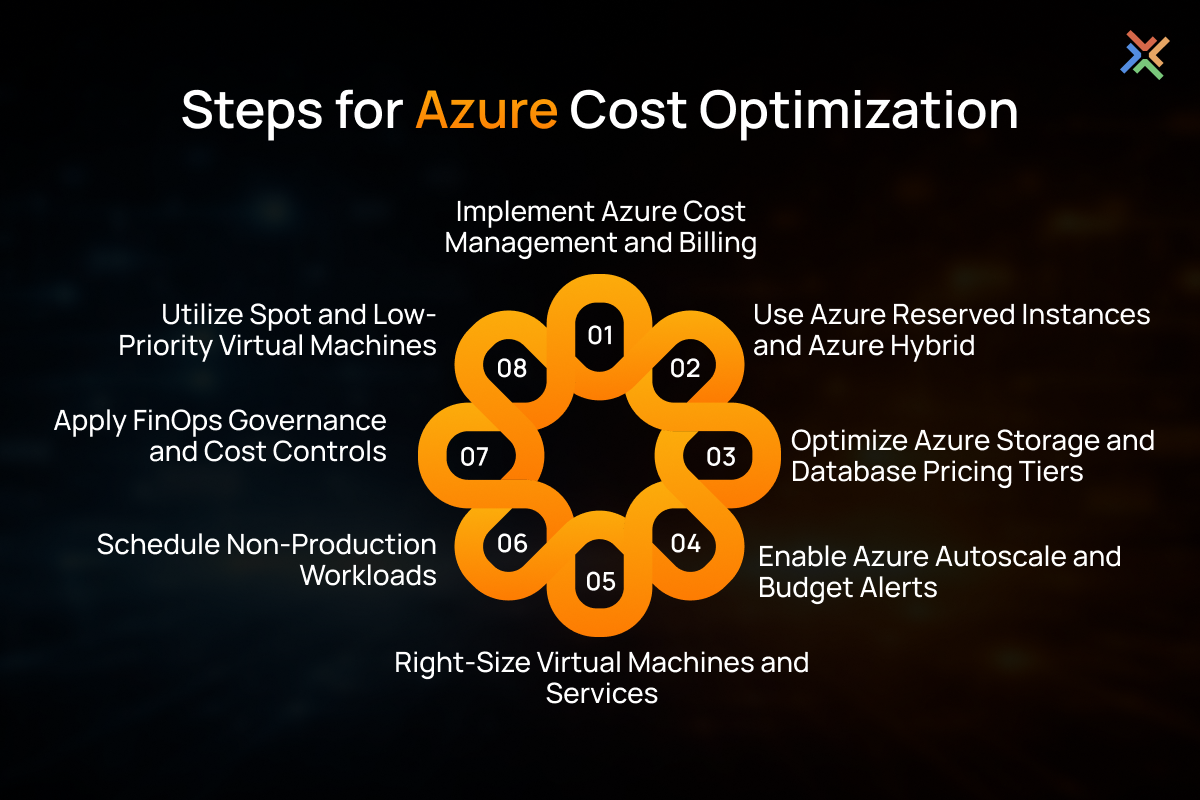
In the UAE, Azure is a highly used tool because of the Microsoft ecosystem and enterprise licensing.
Step 1: Establish a Baseline (Azure Cost Management)
With Azure Cost Management, you can see your expenses across subscriptions and resource groups. Identify which areas you have spent the most in and where you have the most anomalous activity.
Step 2: Reserved Instances & Hybrid Benefits
The saving potential in Azure is mostly due to licensing.
- Reserved VM instances help lower long-term computing expenses.
- The Azure Hybrid Benefit makes the use of Windows and SQL licenses easier.
For large corporations, this could mean large and immediate savings.
Step 3: Storage and Database Tiering
Azure storage optimization focuses on correct tier selection:
- Hot, cool, and archive tiers for Blob Storage
- Elastic pools and serverless options for databases
Choosing the right tier prevents overpayment for underused resources.
Step 4: Autoscaling and Cost Alerts
Autoscaling makes sure the capacity always meets the current demand. Budget alerts and run-away detection make sure the costs stay in check without ruining the performance.
Step 5: Rightsizing and Scheduling Workloads
Non-production workloads shouldn’t be run 24/7. Scheduling your dev and test environments to run outside of business hours can save you 40-60%..
Multi-Cloud Cost Management Strategies
Comparing AWS, Azure, GCP: Cost vs. Performance
There is no universally cheaper cloud. Cost efficiency depends on workload characteristics, licensing, and architecture.
- AWS excels at scale and service depth
- Azure benefits enterprise licensing
- GCP is competitive for analytics workloads
Workload Placement for Cost Efficiency
Place workloads based on:
- Data locality
- Compliance requirements
- Latency sensitivity
- Cost structure
Strategic placement prevents unnecessary duplication and data transfer charges.
Managing Cross-Cloud Traffic and Hidden Costs
Data egress is often underestimated. Optimizing architecture to minimize cross-cloud traffic can dramatically reduce hidden costs.
Multi-Cloud vs. Single-Cloud: Pros and Cons
Multi-cloud improves resilience but increases complexity. Single-cloud simplifies governance but increases dependency. Optimization requires a deliberate balance.
Tools & Technologies for Cost Optimization
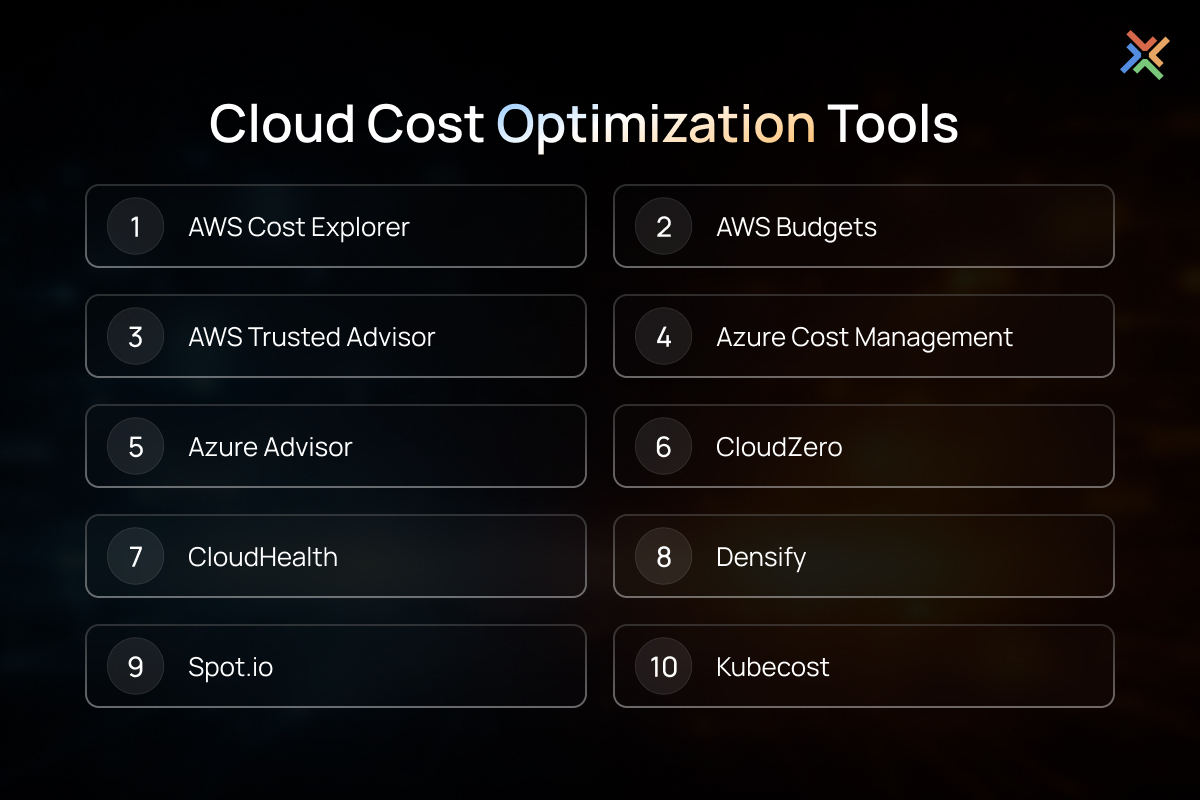
Native Cloud Tools
AWS and Azure provide built-in tools for cost analysis, recommendations, and budgeting. These form the foundation of optimization efforts.
Third-Party Tools
Advanced environments benefit from platforms such as CloudZero, CloudHealth, Densify, Spot.io, and Kubecost, especially for multi-cloud visibility.
Analytics & AI
Modern system providers use AI development services for cloud optimization:
Modern tools use AI for:
- Anomaly detection
- Predictive forecasting
- Automated rightsizing recommendations
AI-driven optimization is becoming standard in 2026.
Choosing the Right Tool
The right tool depends on scale, complexity, and internal maturity. Tools should support strategy, not replace it.
Best Practices For Continuous Cloud Cost Optimization
Cloud cost optimization must be continuous, not reactive. Key practices include:
- Standardize tagging and reporting across all cloud resources to gain clear visibility into costs by application, environment, team, and business unit. Without consistent tagging, cloud spend becomes opaque and impossible to optimize at scale.
- Embed cost optimization into DevOps workflows by integrating cost checks into CI/CD pipelines, infrastructure-as-code templates, and deployment reviews. This ensures cloud engineers consider cost alongside performance and security from the design stage.
- Automate scheduling, scaling, and rightsizing for both production and non-production workloads. Automated start/stop schedules, autoscaling policies, and continuous rightsizing prevent waste from reappearing as workloads evolve.
- Track KPIs that link cloud spend to business outcomes, such as cost per user, cost per transaction, or infrastructure cost as a percentage of revenue. These metrics shift conversations from “cloud bills” to ROI and efficiency.
- Treat cloud cost optimization as a continuous process, not a one-time exercise. Regular reviews, optimization cycles, and shared accountability ensure long-term cost control in dynamic cloud environments.
Implement Cloud Cost Optimization Plan with WDCS
Managing cloud costs is different from how many organizations approach it today. With WDCS, organizations create an actionable cloud cost optimization plan, allowing them to gain visibility to cloud spend, eliminate waste, and align the use of resources to business needs.
Over the years, WDCS has helped organizations understand their baseline cloud usage, assess underused and unused cloud resources, and apply the right mix of rightsizing, reserved instances, and automation. In addition to immediate cost savings, WDCS lays the accounts for the continuous optimization framework that incorporates cloud governance, tagging policies, and an automation mix with the real time cloud monitoring of your cloud resources.
A continuous cloud cost optimization process from WDCS empowers the engineering and finance teams to make business driven performance improvements that will increase operational efficiency, scalability and ROI. Get a free quote from WDCS, your cloud service provider in UAE to build a cloud infrastructure that’s cost optimized, resilient and aligned to your business goals.
Optimize Your Cloud Spend with UAE Cloud Experts
Struggling with rising AWS or Azure bills? WDCS helps UAE enterprises gain full visibility, eliminate cloud waste, and align cloud spend with real business outcomes. Our cloud engineers design, optimize, and continuously manage your cloud environment for performance, compliance, and predictable ROI.