How AI is Transforming Visa Processing in UAE’s Travel & Government Systems
April 21, 2026

Ayush Kanodia
.jpg?w=1920&q=75)
Visa processing in most countries is still treated as an administrative workflow. Applications are submitted, verified, reviewed, and approved through sequential steps involving multiple departments. That model works when volumes are predictable and risks are manageable.
The UAE operates in a different operational reality. As a global hub for tourism, investment, long-term residency, and skilled migration, the country processes extremely high volumes of visa applications with diverse risk profiles. At the same time, immigration policies are evolving rapidly, with new visa categories, flexible residency models, and digital-first government services.
This creates a structural problem: traditional systems cannot scale decision-making speed and accuracy simultaneously without introducing operational bottlenecks. Artificial intelligence is solving this not by “automating steps” but by reconstructing visa processing as a real-time intelligence system embedded across government infrastructure.
Instead of treating each application as an isolated workflow, AI enables continuous evaluation across identity systems, security databases, biometric layers, and historical immigration behavior. This is why the UAE is emerging as one of the most advanced real-world examples of AI-driven governance in immigration systems.
Organizations building similar infrastructure increasingly rely on an experienced AI Development Company UAE to design systems that meet government-scale expectations, regulatory constraints, and operational resilience.
Why Traditional Visa Systems Are Structurally Limited
Traditional visa processing systems are built on linear logic. Each application passes through a fixed sequence: submission, verification, review, and approval. While this model is simple to manage, it creates fundamental limitations when scaled to national-level immigration systems like the UAE.
The first constraint is scalability. Human-dependent verification processes scale linearly with application volume. When demand increases due to tourism spikes, work visa inflows, or policy changes, governments must proportionally increase staffing and operational resources. This creates inefficiency and delays during peak cycles.
The second constraint is a fragmented data architecture. Immigration systems rely on multiple disconnected databases such as identity registries, employer records, border control systems, and security watchlists. Without unified intelligence, decision-making becomes slow and incomplete.
The third constraint is reactive risk detection. Fraud, identity mismatches, and compliance violations are typically identified after submission or during manual review stages. This delays action and increases security exposure.
The fourth constraint is inconsistency in decision-making. Even with standardized rules, human evaluation introduces variability, which affects both fairness and operational efficiency.
These are not minor inefficiencies. They are architectural bottlenecks that cannot be solved with incremental digitization. They require system redesign, which is where AI becomes essential.
How AI Reconstructs Visa Processing Into a Real-Time Intelligence System
AI fundamentally changes the structure of visa processing from a sequential pipeline into a parallel intelligence network.
Instead of processing applications step-by-step, AI systems evaluate multiple dimensions simultaneously. Identity validation, document authenticity, behavioral risk scoring, and eligibility checks happen in parallel across integrated government systems.
This creates a shift from static approval models to dynamic decision intelligence frameworks. Every visa application is continuously evaluated against live data streams, including immigration history, biometric records, employer verification systems, and security intelligence databases.
The key transformation is temporal. Traditional systems operate after data is submitted. AI systems operate continuously, updating risk and eligibility scores as new information becomes available.
This allows governments to move from reactive processing to predictive governance. Applications are no longer simply approved or rejected; they are dynamically classified into risk tiers that determine routing, escalation, or auto-approval.
In the UAE context, this architecture aligns with broader national objectives of building integrated digital government ecosystems where departments are interconnected through shared intelligence layers.
Core AI Technologies Powering UAE Visa Processing Systems
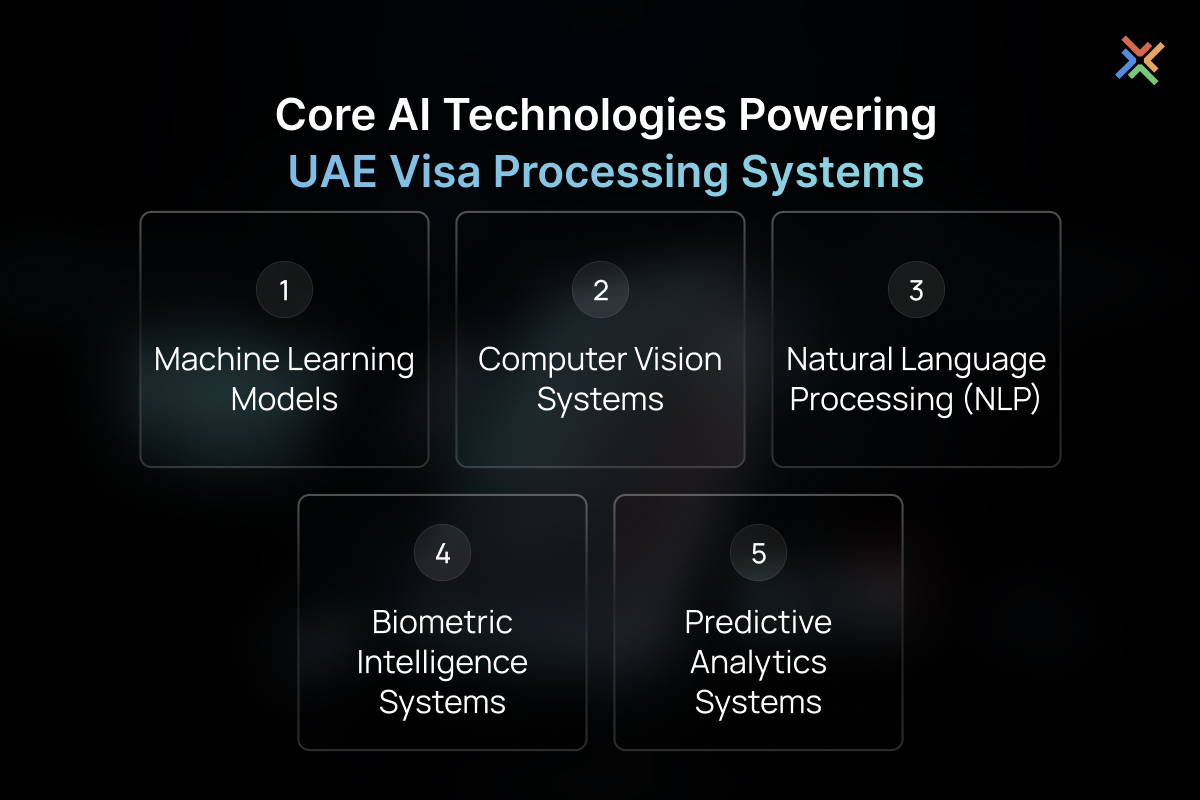
AI-driven visa infrastructure is not based on a single technology but on a layered ecosystem of intelligent systems working together.
Machine learning models form the core decision engines. These models analyze historical visa data, detect patterns in approval and rejection trends, and generate predictive risk scores for new applications. Over time, they improve accuracy by learning from continuously updated datasets.
Computer vision systems are used for document verification. They analyze passports, identity cards, employment letters, and certificates to detect tampering, inconsistencies, and fraudulent modifications. Unlike manual verification, these systems can process high volumes of documents in seconds with consistent accuracy.
Natural language processing systems interpret unstructured data such as application forms, employer statements, and supporting documents. They convert human language into structured data that can be evaluated by decision engines.
Biometric intelligence systems validate identity through facial recognition, fingerprint matching, and iris scanning. These systems are deeply integrated into the UAE border control infrastructure, ensuring continuity between visa issuance and entry verification.
Predictive analytics systems forecast immigration demand, fraud risk clusters, and operational workload distribution. This enables governments to allocate resources proactively rather than reactively.
Together, these technologies form a multi-layered intelligence stack that transforms visa processing into a high-performance, data-driven system.
End-to-End AI Visa Processing Workflow in UAE Systems
The modern AI-driven visa lifecycle begins at the moment of application submission. Unlike traditional systems, where processing starts after submission is complete, AI systems begin validation immediately.
At the intake stage, applications are checked for completeness, structural validity, and eligibility alignment. Missing or inconsistent data is flagged instantly, reducing downstream processing load.
Once validated, identity resolution systems cross-check applicant information against national identity databases, immigration records, and international watchlists. This ensures identity authenticity before deeper processing occurs.
Fraud detection systems then evaluate documents and behavioral patterns. These systems analyze inconsistencies in metadata, document formatting, historical patterns, and cross-referenced data sources to generate risk scores.
Based on these scores, applications are routed dynamically. Low-risk applications can be auto-approved, medium-risk applications are sent for AI-assisted human review, and high-risk applications are escalated for manual investigation.
After approval, AI systems continue monitoring compliance behavior. Visa usage, travel patterns, and renewal eligibility are continuously assessed to ensure ongoing regulatory compliance.
This transforms visa processing from a one-time transaction into a lifecycle management system.
UAE Government Adoption and Real-World Implementation
The UAE has already deployed AI-driven systems across multiple immigration and travel infrastructure layers.
Smart airport systems use biometric verification gates that eliminate manual passport checks for many travelers. These systems integrate facial recognition and identity databases to enable near-instant verification.
Residency and work permit systems use AI to validate employer authenticity, applicant eligibility, and regulatory compliance automatically, significantly reducing processing times.
Visa renewal systems are increasingly automated, with AI systems triggering renewal workflows based on eligibility conditions and compliance history.
Government identity platforms integrate data across multiple departments, creating unified intelligence systems that support real-time verification and decision-making.
Cross-border intelligence systems analyze travel patterns to enhance national security and optimize immigration policy decisions.
These implementations demonstrate that AI in UAE visa systems is not experimental. It is operational at scale.
Strategic Benefits of AI in Immigration Systems in the UAE
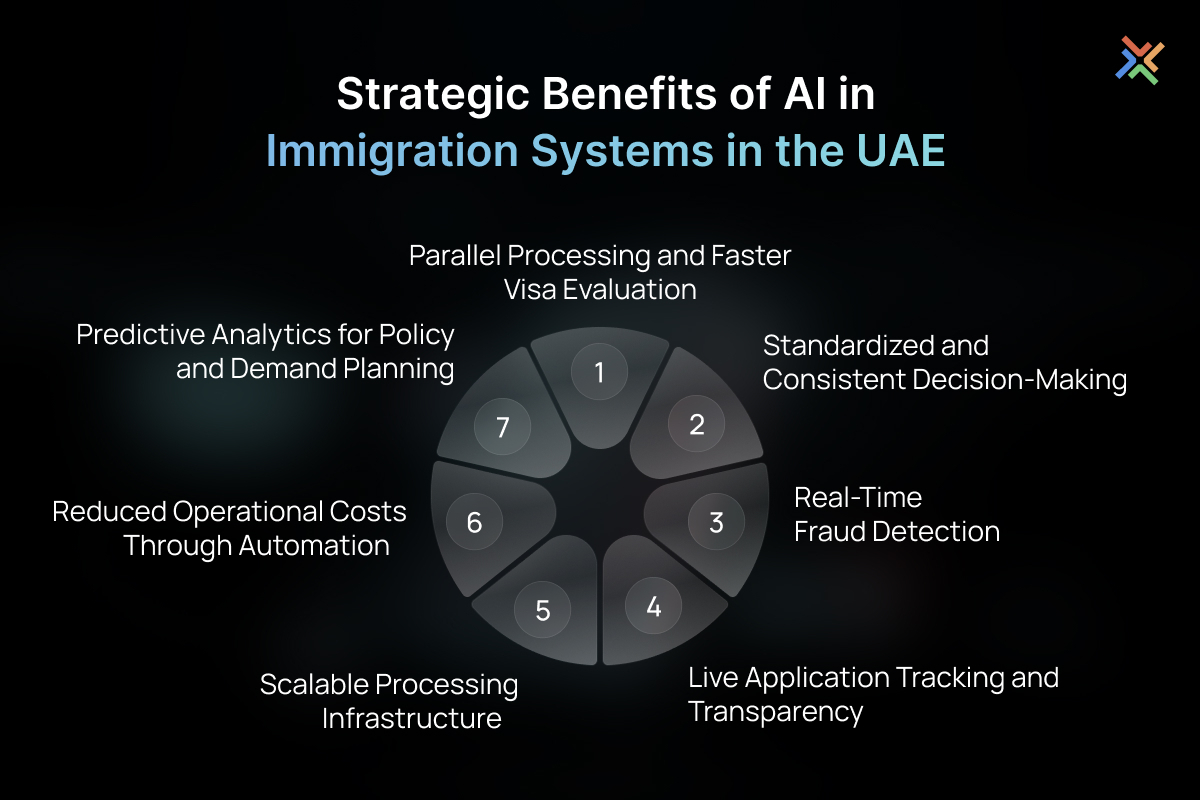
AI is reshaping immigration systems by enabling faster, more consistent, and intelligence-driven visa processing at scale.
- Parallel processing reduces visa workflow time by evaluating identity, documents, and eligibility simultaneously instead of sequential checks.
- Machine-driven decision models ensure consistent, standardized evaluation across all applications, reducing human variability.
- Real-time fraud detection identifies anomalies at the submission stage using cross-database and behavioral pattern analysis.
- Live application tracking improves transparency and reduces dependency on manual inquiry systems.
- Scalable architecture handles surge demand without a proportional increase in manpower or processing delays.
- Automation of repetitive verification tasks reduces operational costs and frees officers for exception-based review.
- Predictive analytics enables governments to forecast visa demand, fraud trends, and policy impact before execution.
Challenges and Governance Considerations in AI-Powered Immigration Systems
While AI improves efficiency, immigration systems require strict governance due to high sensitivity around identity, privacy, and national security.
- Sensitive biometric and identity data require strong encryption, access control, and compliance-grade security frameworks.
- Algorithmic bias risk exists if models inherit patterns from historical visa decisions without proper audit and correction.
- Legacy immigration systems often lack API readiness, making AI integration technically complex.
- AI decision-making must remain explainable and auditable for regulatory and legal accountability.
- Human oversight is required for high-risk, borderline, or policy-sensitive visa decisions.
- Continuous model retraining is necessary to align with evolving immigration laws and policy updates.
Future of AI in UAE Immigration Systems and Border Intelligence
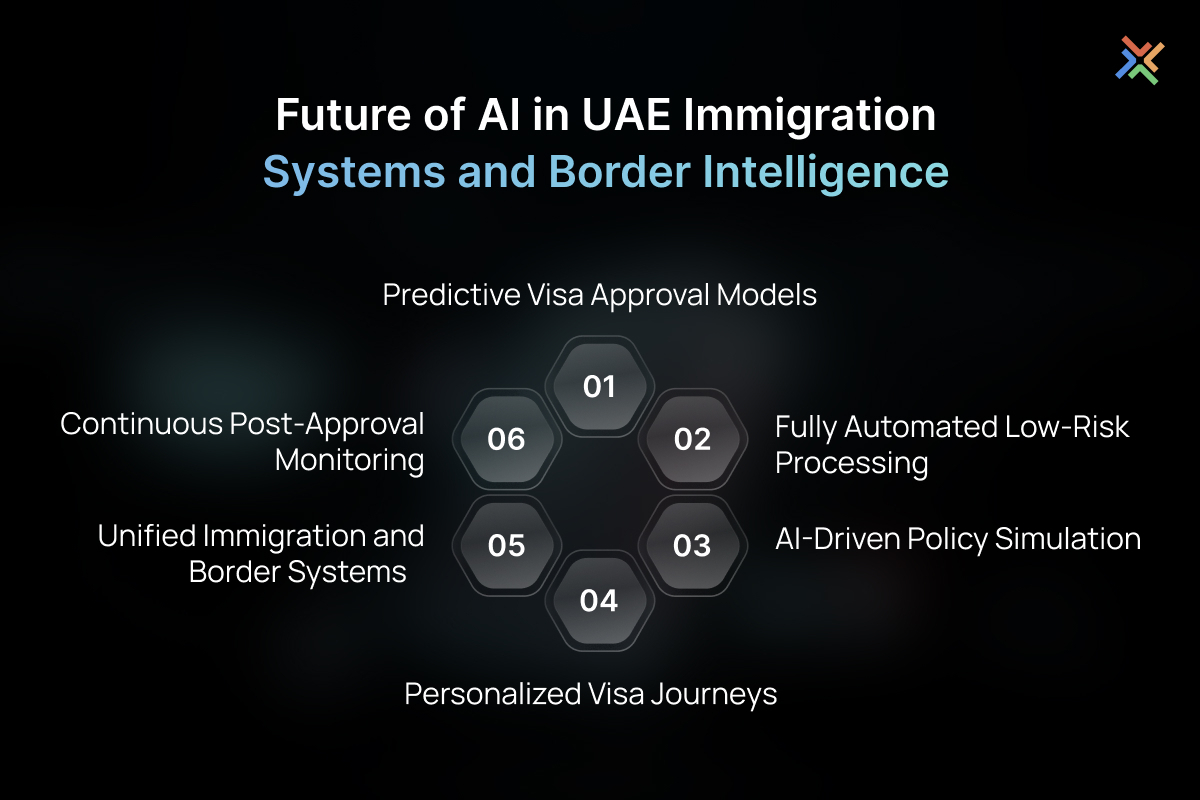
Immigration is evolving from rule-based processing to predictive, adaptive, and fully connected intelligence ecosystems across visa and border operations.
- Predictive approval models will assess application outcomes based on behavioral and historical data before submission.
- Low-risk visa categories will move toward fully automated end-to-end processing workflows.
- Governments will simulate policy changes using AI before implementation to predict impact on volume and security.
- Visa journeys will become personalized based on applicant profile, nationality, and risk classification.
- Immigration, border control, and residency systems will merge into a unified intelligence ecosystem.
- Continuous AI monitoring will track compliance and eligibility even after visa approval.
WDCS Technology UAE Is Building the World’s First Intelligence-Driven Immigration Ecosystem
Visa processing in the UAE is no longer a manual or even semi-digital workflow. It is evolving into a fully integrated intelligence system where AI governs speed, accuracy, compliance, and security simultaneously. This shift represents a structural transformation in how governments manage mobility at scale.
Organizations aiming to build similar systems require more than software development capabilities. They need deep expertise in AI architecture, data governance, and government-grade system design. This is where partnering with a specialized AI Development Company UAE becomes critical.
WDCS Technology UAE operates at this intersection, building AI systems designed for high-scale government and enterprise environments where accuracy, compliance, and performance are non-negotiable. The future of immigration is not automation. It is intelligent, adaptive governance systems powered by AI.
To explore how WDCS Technology UAE can help you design or implement AI-powered immigration or government systems, contact us today for a consultation.
FAQs
1. How is AI used in visa processing systems in the UAE?
AI is used to automate and enhance core immigration workflows such as identity verification, document authentication, eligibility assessment, and fraud detection. It connects multiple government databases in real time to evaluate applications faster and more accurately than manual systems. This enables UAE immigration authorities to handle high application volumes with improved consistency and security.
2. What is the main benefit of AI in visa processing?
The primary benefit of AI in visa processing is significantly faster and more reliable decision-making. Instead of sequential manual checks, AI evaluates multiple data points in parallel, reducing processing delays. It also minimizes human error and ensures standardized decision-making across all applications.
3. How does AI detect fraud in visa applications?
AI detects fraud by analyzing inconsistencies across documents, identity records, and behavioral data patterns. It compares application data with government databases, biometric systems, and historical visa records to identify anomalies. Suspicious cases are flagged in real time, allowing authorities to take immediate action instead of discovering fraud later in the process.
4. Does AI replace human officers in visa approval processes?
No, AI does not replace human officers in immigration systems. Instead, it works as a decision-support layer that automates repetitive and rule-based tasks while humans handle complex, high-risk, or exceptional cases. This human-in-the-loop model ensures both efficiency and regulatory accountability.
5. How does AI improve visa processing speed in the UAE?
AI improves processing speed by running multiple verification tasks simultaneously, including identity checks, document validation, and eligibility scoring. This removes the bottleneck of sequential manual reviews. As a result, visa decisions can be made significantly faster, especially for low-risk applications.
6. What data is used in AI-based visa systems?
AI systems use structured and unstructured data such as biometric information, passport and identity records, travel history, employer verification data, and immigration databases. This multi-source data integration allows AI to build a complete risk and eligibility profile for each applicant.
7. Is AI secure for visa and immigration processing systems?
Yes, AI systems in immigration are designed with high-level security frameworks including encryption, access control, and biometric authentication. Data is processed within a secure government infrastructure to ensure compliance with strict privacy and cybersecurity regulations. This makes the system suitable for sensitive national identity data.
8. What challenges exist in AI-powered immigration systems?
Key challenges include protecting sensitive personal and biometric data, ensuring algorithmic fairness, and integrating AI with legacy government systems. Additionally, governments must maintain transparency and ensure that AI-driven decisions remain explainable and auditable for compliance purposes.
9. How does AI improve transparency in visa applications?
AI improves transparency by enabling real-time tracking of visa applications across different processing stages. Applicants and authorities can view status updates, verification progress, and decision outcomes without relying on manual follow-ups. This reduces uncertainty and improves trust in the immigration process.
10. What is the future of AI in UAE immigration systems?
The future of AI in UAE immigration includes predictive approval systems, fully automated low-risk visa processing, and integrated border-to-residency intelligence platforms. AI will also simulate policy outcomes before implementation, allowing governments to make data-driven immigration decisions at scale.
Build AI-Powered Visa & Immigration Systems in UAE
Design immigration systems that move beyond automation into real-time intelligence. Enable faster approvals, stronger fraud detection, and fully connected government workflows. Work with experts for AI development services UAE to build scalable, secure, and compliance-ready AI architectures for national systems. Book a consultation to explore how your visa infrastructure can be transformed.