AI Agents vs Chatbot Development in UAE: Choosing the Best Option
December 24, 2025

Ayush Kanodia
.jpg?w=1920&q=75)
Artificial intelligence is not something that will happen in the future. It has already changed the way customers are engaged, the efficiency of business operations, and the way business is conducted. In this regard, among the most influential concepts related to AI are the use of chatbots and AI agents.
In UAE, with the digital transformation agenda, UAE National AI Strategy 2031, and smart city frameworks in Dubai and Abu Dhabi, the selection of an AI automation model becomes a strategic move that is not dependent on technology. Selecting the right AI automation model through an experienced AI agent and AI chatbot development company in UAE has a significant influence on ROI, customer satisfaction, and competitive advantage for the business.
This guide explores the area of AI chatbots and AI agents, including what the distinctions are, factors to consider for development, use in industry, and the market outlook. This will hopefully allow businesses in the UAE to make informed decisions.
What are AI chatbots?
Chatbots can be described as software that is roughly designed with the purpose of copying conversation between humans. By the use of logical reasoning or simple natural language processing, these chatbots respond on the basis of predetermined triggers or keywords that are pre-scribed or pre-designed. Repetitive jobs with high volumes of work can be their forte. Such jobs can be predetermined with efficiency as the primary goal.
Think of a chatbot as you would about a vending machine. A vending machine is very predictable. It always gives you the same level of service. But a vending machine is very rigid. It has no flexibility.
Core Capabilities:
- FAQ Handling: The chatbot can relay frequently asked questions from customers such as business hours, product-related questions, and return policies.
- Task Automation: Automation can also be used in appointment scheduling and order tracking.
- Lead Qualification: Sales teams can gather details and forward them without spending excess time.
- E-Commerce Support: Bots can easily perform basic product suggestions and inventory updates.
Example: You can make a delivery order for a pizza with the Dominos chatbot named Dom. You can track the order as it gets placed. Dom has set the standard across many industries for the use of chatbots with great efficiency.
Advantages:
- Quick Deployment: Deployment takes a couple of days since templates have already been created.
- Cost-Effective: A small business will efficiently benefit from one of these chatbots, especially if the business entails a lot of repetitive tasks.
- 24/ 7 Availability: A chatbot will have no wait lines.
Limitations:
- Reactive Nature: The chatbot is able to respond to messages but cannot create an expectation of what the user will be needing.
- Limited Problem Solving: The bots are not capable of navigating tasks that require multiple actions.
- Static Learning: Without editing the bot, the chatbot will not be able to learn.
- Limited Enterprise Integration: Chatbots do not easily integrate with other systems like customer relationship management systems or enterprise resource platforms.
AI-powered chatbots are excellent for predictable, transactional interactions, but for any interactions that require awareness and depth, chatbots will not suffice.
What are AI Agents?
AI systems that have the ability to reason, decide, and do tasks across various platforms are known as AI agents. An AI agent differs from a chatbot since it can apply various techniques like large language systems, machine learning, and generative AI so that it can act accordingly based on the context and also complete tasks.
Consider an automated AI system as a personal assistant that is part of your work process. It can break down sales leads on your behalf, report on the meetings you didn’t attend, prepare customized marketing reports, or even automate invoice payments. All this is done without any necessary human interference.
Core Competencies
- Autonomous Decision-Making - Able to finish tasks single handedly with human involvement only during approval or when there are exceptions to handle.
- Context Awareness - Skills to understand and react to active conversations and to the environment with the relevant enterprise data.
- Continuous Learning - Retains knowledge from previous encounters and improves every time the same actions are reproduced.
- Cross-System Integration - Able to interact with and access customer relationship management, enterprise resource planning, and data management systems. Along with this, application programming interfaces are available to perform complex workflows.
- Advanced Problem-Solving - Possesses the ability to solve issues arisen from any knowledge domain.
Use Cases
- Finance - Automation of loan approval, fraud detection and prevention, personalized advisory services and its automated delivery.
- Retail and E-Commerce - Demand forecasting, inventory control, customer-specific product recommendations, and personalized marketing automations.
- Logistics - Automation of regulatory compliance, process delay identification and prediction, and shipping route optimization.
- Healthcare - Medical diagnosis assistance, medical record data analysis, and recommendations for treatment.
- Human Resources - Automating candidate screening, scheduling interviews, and employee engagement analysis.
- Marketing - Delivery of recommendations, detection of anomalies, optimization of campaigns, and execution of data-driven actions.
In other cases, while Papier, a stationery company in the UK, expanded into the US, they employed the use of AI technology to address customer inquiries. Alone, this agent reduced the number of tickets while increasing response times for improved efficiency without requiring additional human resources.
AI agents development services are being strategically pursued and proactively implemented and are designed to be relevant on high impact workflows that are the best fits for organizations that are transforming into digital.
Key Differences Between AI Agents and Chatbots
Every technology automates communication in one way or gets impacted by digitization. The impact AI works at chatbots' level are in autonomy, depths of intelligence, and impacts of the business.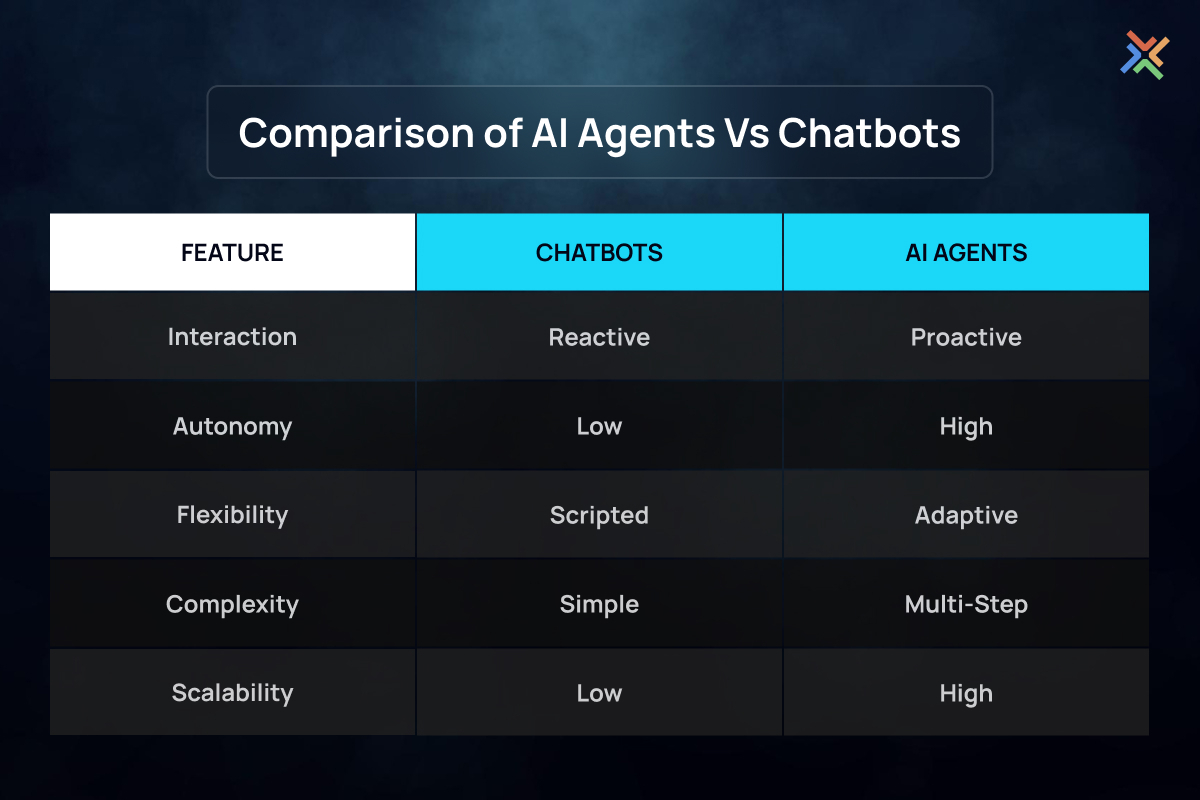
Interaction Style
Reactive vs Proactive Chatbots: Wait for the end-user input and engagement to follow the communication script to any line, which is a line of a flow.
AI Agents: Anticipate the end user communication. Execute proactive engagements, and thus, the flow is more human and natural.
Depth of the engagement, Complexity, and Problem Solving
Chatbots: Designed to handle probably highly simplified and predefined buckets of activities, e.g. sales assistants help troubleshoot customer service to answer the FAQ or maybe do a basic booking of a service.
AI Agents: Handle multi-step dynamically interdependent workflows and sequentially adjust to changes in the workflow and environment.
Learning, Adaptability, and Context Awareness
Chatbots: Have an ever-expanding set of business rules or workflows interdependent to each other and disparate data, user prompts, and required manual updates.
AI Agents: Immerse inter-independently to elicit a complex flow, adapt and coordinate in real time, user prompts to brand new activities.
Enterprise Integration and Scalability
Chatbots: Have all the limitations to a silo engagement of one application interface, thus one workflow, which doesn't scale with business growth.
AI Agents: Have the ability to interlink all the technology resources that the enterprise relies upon in multiple subsystems of (CRM, ERP, marketing, dashboards), thus scale with business growth.
AI Agent & Chatbot Development Considerations
Designing chatbots and AI agents is different because it requires varying degrees of technical planning, business readiness, and long-term operational thinking. Every business has their own internal constraints and limitations, causing every business to have a different baseline with their AI.
Technical Requirements
Chatbots are made using low code platforms, or simple NLP engines. AI agents require advanced LLMs, machine learning frameworks, and API integration with real-time orchestration and complex reasoning.
Choosing the Right AI Framework
Rule Based: Most efficient with basic, predictable user interactions.
ML Powered: Less configuration, with the ability to manage moderately complex user workflows.
LLM Based: The core of AI agents, with capabilities to execute reasoning, complex multi-step workflows, and retain contextual information.
Enterprise System Integration
AI agents require expansive integration with enterprise systems such as CRMs, ERPs, dashboards, and other third-party systems. Boxed chatbots can integrate systems functionally, however, they rarely drive complex multi-system workflows.
AI Compliance and Data Privacy
In the UAE, businesses must comply with the PDPL, financial regulations, and other sector-specific provisions. AI agents that handle and process sensitive data must have encryption, audit ability, and user access controls to satisfy technical and operational compliance.
Chatbots Differ from AI Agents
While chatbots require manual scripting to adjust workflows, AI agents are trained using historical data of user interactions, and the output of a workflow. AI agents are capable of learning and self-improvement, with little input from the user.
Monitoring and Quality Assurance
Monitoring QA, engagement of customers, and efficiency of a team of a company, are all functions of AI that help answer real time analytics. AI provides diagnostics for teams more detailed and broader than most chatbots which simply track whether a task got done or if it satisfied the user.
Industry Applications Across Key Sectors
The type of AI agents and chatbots can be understood better using real life examples from various industries.
Finance
Artificial Intelligence sorts through fraudulent transactions, decides on loan approvals, and automates payments. Other account related queries, such as FAQs can be dealt with by chatbots.
Retail and E-commerce
AI Buyers can be predicted so that vendors can meet and manage supply. Individualized recommendations are sent and chatbots can answer order related questions.
Logistics
AI can manage and remove shipping complications, such as route optimization, predicting delays, and shipping automation. Other shipment related friction is handled by chatbots for shipment control.
Healthcare
AI suggests diagnoses and prescriptions, manages patient data, and chatbots manage calendars and answer health FAQs.
Human Resources
AI gauges employee engagement and activity. Candidate screening, interview scheduling, and other policy related queries can be handled by chatbots, as they simply manage the leave calendar.
Marketing
AI manages marketing through trend forecasting and providing it with strategic actions. Other resource use can be moderated by chatbots.
Companies that adopt AI, ROI Insights Report, claim to see a 40-50% drop, on average, in the time it takes to carry out other actions. Fast response times, superior customer satisfaction, and higher ROI are the results, which is better than solely relying on chatbots.
Regional and Global AI Adoption Trends and Market Growth
Global and regional trends show a clear shift from basic automation toward intelligent, autonomous AI systems.
UAE Market Trends
Banks, government services, and logistics companies use AI to enhance decision-making while reducing human workload. Chatbot supervision is paired with AI agents and is being adopted in the UAE through hybrid models as well.
Global Expansion
United States and United Kingdom: AI agents with finance, healthcare, and e-commerce integration result in greater efficiency and client satisfaction.
AI agents Interoperability with Generative AI
With the AI agents, operations can be automated and the predictive capabilities are enhanced.
Government and Regulatory Considerations
The UAE has started to provide guidelines to ensure that AI is used in Safe and Ethical manners, while focusing on increasing productivity and fortifying systems.
The Expansion of the Market
The AI Market in the UAE is predicted to grow from 67 million USD in 2024 to over 700 million by 2030.
The Global Market of Enterprise automation is expected to grow over USD 500 billion by 2030, mainly due to the advancement of autonomous AI.
Choosing the Right AI Deployment Solution
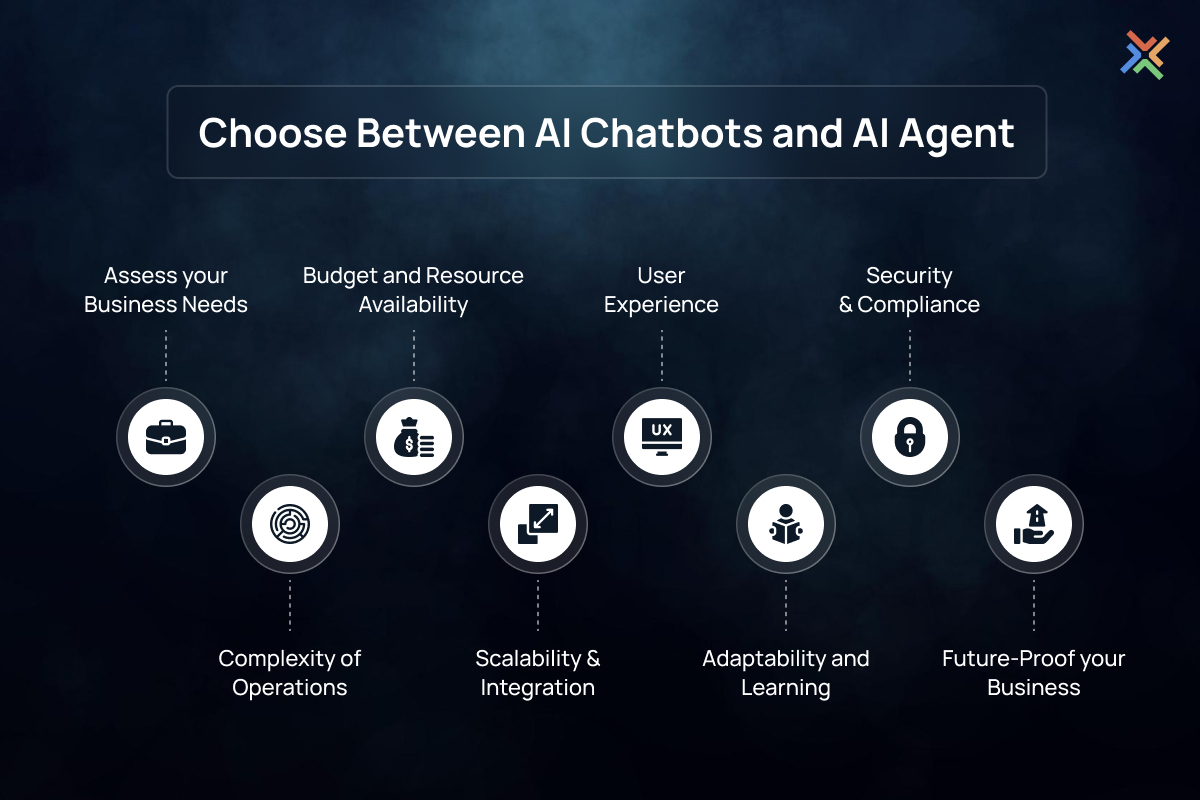
Some differences to consider are in the Areas of Operational Complexity, Customer experience, Budget and Resources, Integration Needs, and Future Proofing.
The best approach is to use the AI chatbots to answer less complex questions, while the AI agents can be used to work on more elaborate questions on their own, and are able to add content autonomously.
The Future of AI In Customer Engagement and Automation
Large Language Models (LLMs) and Generative AI are guiding the next intelligent automation strategy. Businesses are now able to:
- Predict and shape insights before decisions are made.
- Advance multi-tool workflows without needed personnel.
- Personalize marketing to an entire customer base.
- Focus the final transformed chatbots into semi-autonomous LLM agents to increase ROI.
Companies that act now to incorporate LLM agents and combinatorial (hybrid) models into workflows will decrease operational 'friction,' future-proof the business, and increase the 'smart' scalability of the enterprise.
Pick The Right AI Automation Model of the Future!
An automation pathway is offered by AI chatbots or AI agents. Inexpensive, rapid, and constant assistant chatbots address standard queries. Responsive, intelligent agents, however, offer integrated solutions to complex business processes.
Most complexities of AI automation in the UAE will arise from design of the business processes. The goal is to offer the customer experience and automation the customer expects. The situation of AI agent automation will increase customer experience, satisfaction, and organizational efficiency and control of strategic automation for imbalanced workflows will lie in hybrid models.
WDCS Technology has successfully supported various UAE firms in their shift from reactive to proactive chatbots, autonomous AI agents. If you want to implement enterprise-grade AI solutions, connect us. WDCS Technology guarantees that businesses do not only utilize AI, but also achieve noteworthy goals with it, that enhances efficiency, increases revenue, and sustains competitiveness in the fast-changing digital economy.
Frequently Asked Questions
Q1. What’s the difference between chatbots and AI agents?
A chatbot is a rule-based system that provides replies to specific inputs. An AI agent on the other hand is an independent agent that can do multi-step tasks, adapt to learn from different completed tasks, and make decisions based on the surrounding context.
Q2. Can AI agents do chatbots jobs?
Not completely. People hire AI chatbot developers for tasks that are simple and repetitive like FAQs and other basic customer tasks. An AI agent is more valuable for advanced tasks and workflows that require automation and personalized support. Thus, to optimize efficiency, a lot of companies make use of both.
Q3. How do AI agents learn differently from chatbots?
Unlike chatbots that are largely static and require manual updates, AI agents learn from their interactions and refine their outputs. They get better over time because of the use of machine learning and LLMs.
Q4. Do AI agents cater for small businesses too or just the big ones?
AI agents can be used in businesses of any size. The initial investment needed for the setup, while more extensive than a simple chatbot for small and medium enterprises in particular, will still be warranted as the use of AI agent will significantly improve the customer experience and automate complex workflows.
Q5. How do AI agents integrate with business systems?
AI agents, as opposed to chatbots, are able to connect with customer relation management systems (CRMs), enterprise resource planning (ERPs), databases, and third-party systems. This allows them to automate business processes and enhance data-driven decision-making.
Q6. What industries benefit most from AI agents?
Automating processes and boosting performance on tasks such as customer service, accuracy, and data-driven insights are core to the value generated in the sectors of finance, retail, and marketing by AI agents.
Transform Your Business with WDCS AI Development Solutions
Partner with WDCS Technology to create AI systems that are secure, scalable, and aligned with UAE enterprise standards. From development to deployment, we help you leverage AI to improve workflows, increase efficiency, and drive growth.